

Campaign warns of dangers of falling prey to data scams in Saudi Arabia

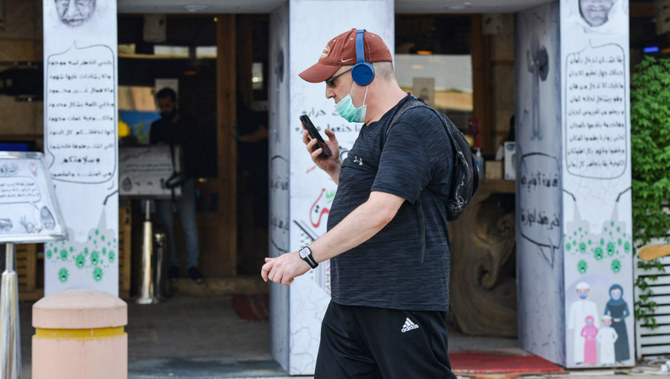
A mask-clad man walks while holding his phone past the entrance of a cafe in Saudi Arabia's capital Riyadh. (AFP file photo)
Short Url
Updated 19 February 2022
Follow

Campaign warns of dangers of falling prey to data scams in Saudi Arabia

  • Citizens offered advice on how to protect personal information, avoid revealing it to online fraudsters

JEDDAH: Millions of Saudis are being warned about the dangers of falling prey to data scammers as part of a major new internet privacy awareness campaign.

The “How much would you sell your data for?” initiative has seen the Saudi Communications and Information Technology Commission send out texts via local mobile phone companies advising people to be on their guard when sharing data.

Saeed Al-Ghamdi, the commission’s director of corporate communication, told Arab News that the campaign aimed to highlight the importance of personal data privacy and preventing information, such as names, ages, gender, and marital status being revealed to online fraudsters.

CITC campaign literature points out how easily hoaxers can trick unsuspecting internet users into parting with their personal details, commonly by simply asking for permission to access or share private information.

The commission recommends only downloading apps from reliable sources, keeping them updated, carefully reading terms and conditions of use, limiting access to only necessary services, and regularly reviewing and modifying the permissions granted to apps.

Meanwhile, the Saudi Public Security, on its Twitter account, urged people living in the Kingdom to immediately report any suspected scams to their nearest police station or via the Kollona Amn (we are all security) app.

According to a survey conducted in September 2020 by cybersecurity firm Kaspersky in conjunction with Toluna research agency, 64 percent of people in Saudi Arabia said they had been targeted by fraudsters trying to steal money and bank card details.

The study also revealed that more than 62 percent of respondents thought scammers had targeted them or family more frequently during the coronavirus pandemic.

It pointed out that methods used to trap victims included special offers and false claims about products said to diagnose and treat COVID-19, and payment requests for alleged non-compliance with health and safety rules related to the virus outbreak.

Of those questioned for the survey, 83 percent had ignored messages, emails, and invitations from unknown sources to follow links, while 40 percent said they used antivirus apps.


Saudi inventor wins two gold medals at Mideast International Invention Fair

Updated 14 sec ago
Follow

Saudi inventor wins two gold medals at Mideast International Invention Fair

  • Khudry was recognized for inventing a device designed to filter materials and recycle used liquids
  • The innovation aims to improve efficiency in liquid purification and reuse

RIYADH: Saudi inventor Duaa Nizar Khudry won two gold medals at the 16th International Invention Fair in the Middle East (IIFME), held in Kuwait from February 8 to 11, the Saudi Press Agency (SPA) reported.

Khudry was recognized for inventing a device designed to filter materials and recycle used liquids, an innovation aimed at improving efficiency in liquid purification and reuse. The technology has potential applications in environmental protection, industrial processing, and water conservation, particularly in regions where sustainable resource management is critical.

A member of the Mawhiba Alumni Program, Khudry represented Saudi Arabia with the support and nomination of the King Abdulaziz and His Companions Foundation for Giftedness and Creativity (Mawhiba), which was participating in the fair for the third time.

She received her first gold medal from the fair’s organizers and was also awarded the IFIA Best Invention Award by the International Federation of Inventors’ Associations, recognizing her innovation as one of the most outstanding entries in the exhibition.

The IIFME, organized annually by the Kuwait Science Club since its launch in 2007, is regarded as one of the region’s largest specialized invention exhibitions and a major platform for inventors to present their work to international audiences.

As a student, Khudry won first place nationwide at the National Olympiad for Scientific Creativity (Ibdaa) in 2013 for the same recycling device, competing against tens of thousands of students across the Kingdom. She later obtained an official patent for the invention in 2024, strengthening its scientific and commercial potential. 

She studied chemistry and is currently pursuing graduate studies in materials science and engineering under the Custodian of the Two Holy Mosques Scholarship Program. Her research focuses on environmental sustainability, advanced materials, and liquid purification technologies.