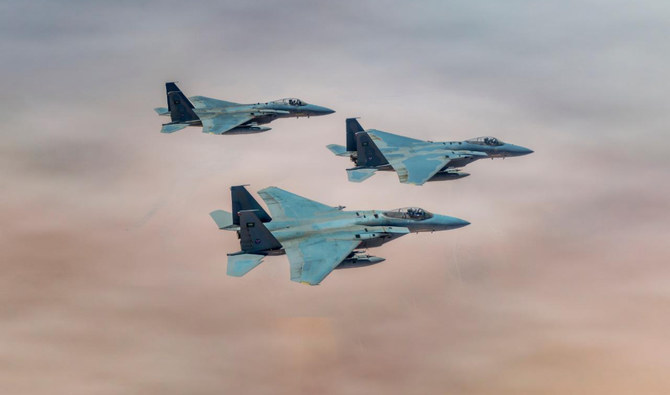
RIYADH: The Coalition to Restore Legitimacy in Yemen said it carried out airstrikes in Yemen’s capital, Al Ekhbariya reported on Friday.
The airstrikes were in response to threats and were necessary to protect civilians, the coalition said.
The Iran-backed Houthi militia regularly target Saudi Arabia, mainly using drones and missiles against civilian infrastructure.
Last week, a drone attack on Abha International Airport in the Kingdom’s south left twelve civilians injured.
On Jan. 17, three civilians died after the militia used drones to attack the UAE.
The Houthi militia seized the capital from the Yemeni government in 2014 and continue to control large parts of the country.
The government, with the support of regional allies, has been attempting to prevent the military expansion of the militia, who enjoy support from Iran and other terror-designated entities.
Diplomatic efforts to resolve the seven-year conflict have so far been unsuccessful.

Coalition strikes drone operating base in Yemeni capital
https://arab.news/2ztk5
Coalition strikes drone operating base in Yemeni capital
Around 180 Gazans have left via Rafah crossing since reopening
- “Official statistics on the movement at the Rafah crossing from Monday, February 2, 2026, until Thursday, February 5, 2026, show a severe restriction on travel,” Thawabteh said
RAFAH, Palestinian Territories: Around 180 Palestinians have left the Gaza Strip since the limited reopening of the Rafah crossing with Egypt a week ago, according to officials in the territory.
The Rafah crossing, the only gateway for Gazans to the outside world that does not pass through Israel, reopened for the movement of people on February 2, nearly two years after Israeli forces seized control of it during the war with Hamas.
Between Monday and Thursday, 135 people crossed into Egypt from Gaza through the crossing, mostly patients and their companions, according to Ismail Al-Thawabteh, head of the Hamas-run media office in the Palestinian territory.
“Official statistics on the movement at the Rafah crossing from Monday, February 2, 2026, until Thursday, February 5, 2026, show a severe restriction on travel,” Thawabteh said.
He said the crossing was also closed on Friday and Saturday.
The Palestinian Red Crescent Society confirmed that 135 Gazans had left through the crossing between February 2 and 5.
On Sunday, another 44 people left the Gaza Strip through the crossing to Egypt, Mohammed Abu Salmiya, director of the territory’s main Al-Shifa Hospital, told AFP.
They included 19 patients, while the rest were their companions, he added.
A source at the border on the Egyptian side also confirmed the figure for travelers passing through the gateway on Sunday.
It brought the total number to 179 people entering the Gaza Strip.
“My son was injured during the war and a metal plate was inserted in his leg for a year and a half,” Rajaa Abu Al-Jadian told AFP as she prepared to leave through the crossing earlier on Sunday.
“They told us it had to be removed to prevent further damage.”
Travel through the crossing is also taking place in the opposite direction, with dozens returning to Gaza during the same period.
Thawabteh told AFP that 88 people entered the Gaza Strip from Egypt since the crossing reopened, often meeting their families in tearful reunions.
Israel allowed the reopening of the Rafah crossing on Monday, reportedly following US pressure, but has so far restricted passage to patients and their accompanying relatives.
The reopening of Rafah has long been demanded by the United Nations and aid organizations, and forms a key element of US President Donald Trump’s truce plan for Gaza, where humanitarian conditions remain dire.
For thousands of sick and wounded Palestinians, the crossing’s reopening offers a rare chance to seek medical treatment in Egypt or elsewhere.
Abu Salmiya said last week that around 20,000 patients in Gaza urgently require treatment, including 4,500 children.