ISLAMABAD: The Secretary General of the Organization of Islamic Cooperation (OIC), Hissein Brahim Taha, has expressed “concern” over rising intolerance and incidents of faith-based violence during an address at the inaugural segment of the 8th Meeting of The Istanbul Process held virtually this week.
The meeting, hosted by Pakistan, witnessed broad participation of states from all regions, relevant UN officials and experts, religious leaders, civil society, business representatives and journalists.
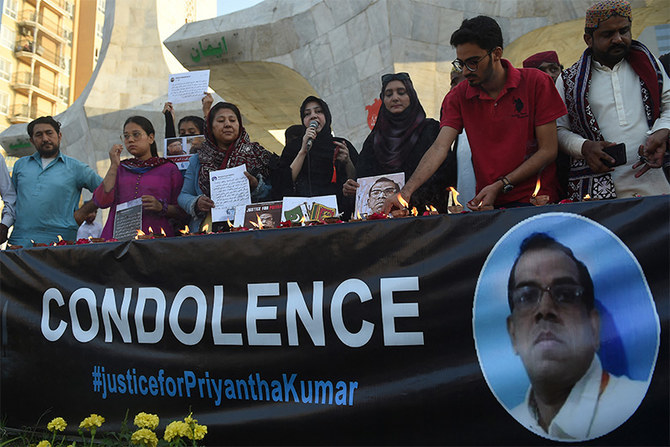
Taha’s comments about rising hate crimes came as an enraged mob stoned to death a middle-aged man for allegedly desecrating the Holy Quran inside a mosque in a remote village in eastern Pakistan last week.
The latest killing comes just months after a mob of factory employees tortured and burned a Sri Lankan manager in Sialkot in December over apparent blasphemy in a “horrific” attack that Prime Minister Imran Khan said had brought shame on the country.
“Taha expressed OIC’s concern over the continued rise of hatred, intolerance, discrimination and violence practiced on the basis of faith,” the OIC said in a statement, quoting the secretary general. “He mentioned that the phenomenon is a threat to humanity as it jeopardizes peace and security in the world, in recalling the terrorist incidents that occurred in 2019 in New Zealand and Sri Lanka.”
“The OIC Secretary General underlined the crucial importance of collective efforts at international level to reverse such a tendency and to prevent atrocities from reoccurring, by using all available means and tools,” the statement added.

OIC expresses concern over rising hate crimes after another ‘blasphemy’ lynching in Pakistan
https://arab.news/rerh3
OIC expresses concern over rising hate crimes after another ‘blasphemy’ lynching in Pakistan
- OIC secretary general’s comments come as mob lynches man for allegedly desecrating Holy Quran
- The killing comes months after a Sri Lankan factory manager was lynched over alleged blasphemy in Sialkot
Islamabad court sentences seven individuals to life imprisonment over ‘digital terrorism’
- The convicts include Wajahat Saeed Khan, Shaheen Sahbahi, Haider Raza Mehdi, Adil Raja, Moeed Peerzada, Akbar Hussain and Sabir Shakir
- The cases against them relate to May 9, 2023 riots over ex-PM Imran Khan’s arrest that saw vandalization of government, military installations
ISLAMABAD: An Islamabad anti-terrorism court (ATC) on Friday awarded two life sentences each to seven individuals, including journalists and YouTubers, over “digital terrorism,” in connection with May 9, 2023 riot cases.
The court sentenced Wajahat Saeed Khan, Shaheen Sahbahi, Haider Raza Mehdi, Adil Raja, Moeed Peerzada, Akbar Hussain and Sabir Shakir under various sections of the Anti-Terrorism Act and the Pakistan Penal Code.
The riots had erupted after former prime minister Imran Khan was briefly arrested in Islamabad on corruption charges on May 9, 2023, with his supporters attacking government buildings and military installations in several cities.
ATC judge Tahir Sipra announced the reserved verdict, following a trial in absentia of the above-mentioned individuals who were accused of “digital terrorism against the state on May 9.”
“The punishment awarded will be subject to the confirmation by Hon’ble Islamabad High Court,” the verdict read, referring to each count of punishment awarded to the convicts.
It also imposed multiple fined on the convicted journalists and YouTubers, who many see as being closed to Khan.
The prosecution presented 24 witnesses, while the court had appointed Gulfam Goraya as the counsel of the accused, most of whom happen to be outside Pakistan.
Pakistan’s anti-terrorism laws allow trials in absentia of the accused persons.
Thousands of supporters of Khan’s Pakistan Tehreek-e-Insaf (PTI) party were detained in the days that followed the May 2023 riots and hundreds were charged under anti-terrorism laws in a sweeping crackdown, with several cases transferred to military courts.
The government of PM Shehbaz Sharif accuses Khan’s party of staging violent protests in a bid to incite mutiny in the armed forces and to derail democracy in the country. The PTI denies inciting supporters to violence and says the government used the May 2023 protests as a pretext to victimize the party, a claim denied by the government.
The May 2023 riots took place a little over a year after Khan fell out with Pakistan’s powerful military, blaming the institution for colluding with his rivals to oust him from office in a parliamentary no-trust vote, a charge denied by the military.
Khan, who has been jailed since Aug. 2023 on a slew of charges, has led a campaign of unprecedented defiance against the country’s powerful military. He also accuses the then generals of rigging the Feb. 8, 2024 election in collusion with the election commission and his political rivals to keep him from returning to power. The military, election commission and Khan’s rivals deny the allegation.


