‘I can’t move’: Queen Elizabeth complains of stiffness during engagement

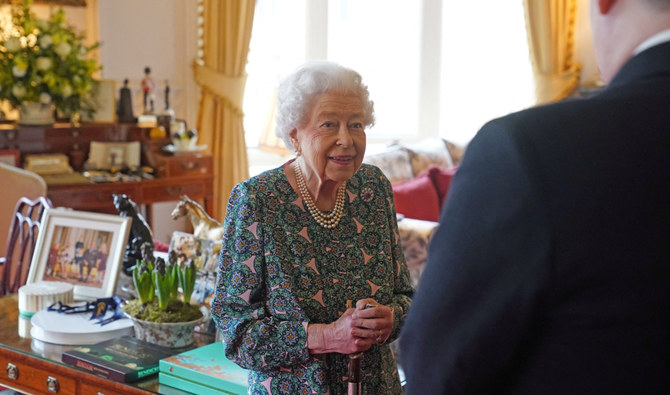
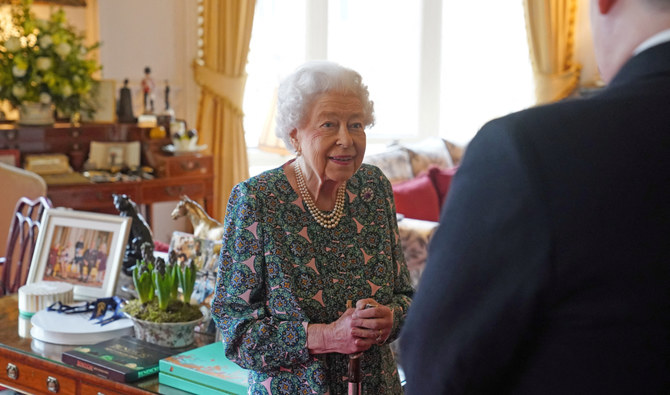
Britain's Queen Elizabeth speaks during an audience where she met the incoming and outgoing Defence Service Secretaries at Windsor Castle in Windsor, Britain, February 16, 2022. (Reuters)
Short Url
Updated 17 February 2022
Follow

‘I can’t move’: Queen Elizabeth complains of stiffness during engagement

LONDON: Queen Elizabeth II complained Wednesday about mobility issues, as she carried out her first in-person official engagements since fears emerged that she could have contracted coronavirus last week.
In video footage released of the 95-year-old monarch receiving two senior Royal Navy officers at her Windsor Castle residence, she could be heard remarking “as you can see, I can’t move” as she stood while holding a walking stick.
Meeting the officers in the Oak Room sitting room at the castle, west of London, she had pointed to her left leg or foot as the area giving her discomfort.
Buckingham Palace declined to comment, but it is understood she was feeling slightly stiff rather than having injured herself or being unwell.
In a separate development, anxiety had grown about the queen’s possible exposure to Covid-19 after Prince Charles, her eldest son, tested positive for the virus for the second time, two days after meeting her.
His wife Camilla, the Duchess of Cornwall, also then tested positive, and the couple have been self-isolating since, according to aides.
Buckingham Palace has not revealed whether the queen — who this month marked 70 years on the throne — has taken any Covid tests herself.
On Tuesday, she held two virtual audiences from Windsor, meeting via video-link with newly appointed ambassadors from Estonia and Spain.
Meanwhile earlier this month, on the eve of the 70th anniversary of her accession to the throne, she held a reception for locals at Sandringham, her estate in eastern England.
It was reportedly her largest in-person public engagement since an unexplained health issue last autumn that saw her spend a night in hospital and subsequently take a step back on medical advice.
The palace was criticized for a lack of transparency over the issue, eventually confirming that she had spent the night in hospital in October for “preliminary” tests, the nature of which have never been specified.



Pakistan rules out talks with Afghanistan, says more than 330 Afghan fighters killed in operations

Updated 56 min 31 sec ago
Follow

Pakistan rules out talks with Afghanistan, says more than 330 Afghan fighters killed in operations

  • Pakistan is a major non-NATO ally of Washington, while the US considers the Afghan Taliban a “terrorist” group

ISLAMABAD: Pakistan has ruled out talks with Afghanistan until there is an end to “terrorism” emanating from Afghan soil, officials said on Friday. The statement follows the killing of more than 330 Afghan fighters in cross-border skirmishes this week.

The latest clashes between the neighbors erupted after Pakistani airstrikes on Afghan territory last weekend triggered retaliatory attacks along the border on Thursday, escalating long‑simmering tensions over Pakistan’s claim that Afghanistan shelters Pakistani Taliban militants. Afghanistan denies this, saying Pakistan is deflecting blame for its own security failures.

Pakistani Information Minister Attaullah Tarar said his country had killed 331 Afghan fighters, destroyed over 100 posts and targeted 37 military locations across Afghanistan. Afghan officials have said more than 50 Pakistani soldiers have been killed and several Pakistan posts captured. Neither casualty figures nor battlefield claims by either side could be independently verified.

Meanwhile, Mosharraf Zaidi, Prime Minister Shehbaz Sharif’s spokesperson for foreign media, ruled out any talks with Afghanistan until Kabul addresses the issue, while the US expressed support for what it called Pakistan’s “right to defend itself” against attacks from Afghanistan’s Taliban rulers.

“There won’t be any talks, there is nothing to talk about ... Terrorism from Afghanistan has to end,” Zaidi told state-run Pakistan TV Digital, saying Islamabad would continue to target militant havens inside Afghanistan.

“Pakistan’s responsibility is to protect its citizens. If we know that there is a terrorist in point A and we know that there is a terrorist enabler at point A, we will find a weapon to land at point A and eliminate the threat.”

Zaidi said he did not expect Pakistan to deviate from this position: “We have clearly articulated what we are doing and what we plan on continuing to do and what it will take for us to stop doing what we are doing.”

He added: “And we will expect that both the international community and the regime in question, the Afghan Taliban, will come to their senses and will help reduce instability and disorder in this region.”

Pakistan is a major non-NATO ally of Washington, while the US considers the Afghan Taliban a “terrorist” group.

“The United States supports Pakistan’s right to defend itself against attacks from the Taliban, a Specially Designated Global Terrorist group,” Reuters quoted a State Department spokesperson as saying.

US diplomat Allison Hooker said on X she had spoken with Pakistan Foreign Secretary Amna Baloch on Friday.

The State Department spokesperson said Washington was aware of the escalation in tensions and “outbreak of fighting between Pakistan and the Afghan Taliban,” adding the US was “saddened by the loss of life.”

“The Taliban have consistently failed to uphold their counterterrorism commitments,” it said. “Terrorist groups use Afghanistan as a launching pad for their heinous attacks.”

Meanwhile, Afghan Taliban spokesperson Zabihullah Mujahid called for talks to resolve the crisis.

“We have always emphasized peaceful resolution, and now too we want the issue to be resolved through dialogue,” he said on Friday afternoon.

Asked what Pakistan desired, Tarar said: “Neutralizing the threat and ensuring that Pakistan is safe. Because for us, we’ve been good neighbors, we’ve been very friendly neighbors, we’ve been very, very generous neighbors. Our generosity, unfortunately, has often been seen as our weakness. So the objective, aim is to neutralize the threat and make Pakistan safe.”

He added it was too early to comment on a ceasefire as it was an evolving situation.