

Saudi defense chief’s India visit part of ‘steady evolution’ of relations: Experts

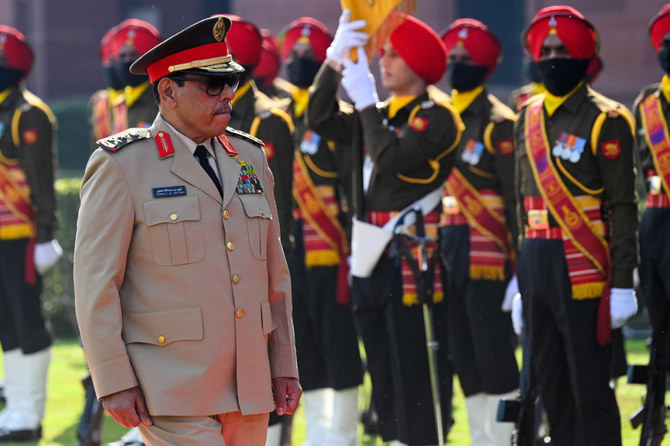
Commander of Royal Saudi Armed Forces of Saudi Arabia Fahd bin Abdullah Mohammed Al-Mutair (L) inspects the guard of honor prior to a meeting in New Delhi on February 15, 2022. (AFP)
Short Url
Updated 16 February 2022
Follow

Saudi defense chief’s India visit part of ‘steady evolution’ of relations: Experts

  • Chief of Royal Saudi Land Forces’ trip first of its kind to India
  • Indian PM working to broaden ties with Riyadh beyond energy, build strategic partnership

NEW DELHI: This week’s visit to India by the chief of the Royal Saudi Land Forces was part of a “steady evolution” of strategic ties between the two nations, foreign policy experts said on Wednesday.

For decades relations between New Delhi and Riyadh have mostly revolved around energy cooperation. The latest “first ever visit” by a Saudi defense chief to India comes over a year after the head of the Indian army made a trip to Riyadh.

The Indian Ministry of Defense described this week’s visit by Lt. Gen. Fahd bin Abdullah Mohammed Al-Mutair as “historic and landmark,” adding that it marked “deepening bilateral defense cooperation” between the two countries.

Until a few years ago, India’s relationship with Saudi Arabia was driven primarily by trade and the Indian diaspora in the Middle East. The Kingdom is one of the main energy suppliers to India and home to more than 3.5 million Indian expatriates.

Over recent years, there has been some cooperation on security, with Riyadh deporting four wanted fugitives to India.

But Indian Prime Minister Narendra Modi has been working to broaden ties, and the two governments have agreed to build a strategic partnership.

Defense relations have seen a notable upswing in the last year with a series of high-level interactions and the first bilateral naval exercise, Al-Mohed Al-Hindi, conducted during August in Jubail. Up until the third quarter of last year, India was the second-largest trade partner of the Kingdom.

Some analysts see Modi’s overtures to Saudi Arabia as being part of a diplomatic effort to put pressure on archrival Pakistan by forging bonds with some of Islamabad’s closest allies.

Foreign policy experts noted that Al-Mutair’s visit was “part of the steady evolution of India’s strategic partnership with Saudi Arabia.”

“India’s strategic partnership with Saudi Arabia, that began in 2010, was accelerated during the visit of PM Modi to Riyadh and the return of Crown Prince Mohammed bin Salman in 2019,” Talmiz Ahmad, former Indian ambassador to Saudi Arabia, told Arab News. “The defense component of the partnership is very significant because it indicates a meeting of minds of two countries on regional security issues.”

He said that the relationship between the two nations was “not based on a zero-sum approach.”

“Each country has relationships with different countries on the basis of their interests,” Ahmad added. “What is significant is that over the last 20 years Saudi Arabia has steadily given priority to its ties with India as an energy, economic, and strategic partner because their strategic interests are common and both countries are committed to partnering with each other against the problems of extremism.”

Muddassir Quamar of the New Delhi-based think tank, the Institute for Defense Studies and Analyses, said the visit underlined “growing military-to-military ties.”

“There is a new-found momentum in bilateral ties, and it is reflected in military cooperation among other areas,” Quamar added. “The visit by the Indian defense chief to the Kingdom in 2020 strengthened bilateral security and defense ties.

“A shared vision of bringing economic prosperity, peace, and stability and combating terror has brought the two countries closer.

“In addition to Saudi officers joining training courses in Indian military schools, India and Saudi Arabia are also looking to collaborate in the defense manufacturing sector,” Quamar said. “The visit by Lt. Gen. Fahd bin Abdullah Al-Mutair will further enhance bilateral defense cooperation between New Delhi and Riyadh.”


Nigerian police deny church attacks as residents insist 168 people are held by armed groups

Updated 11 sec ago
Follow

Nigerian police deny church attacks as residents insist 168 people are held by armed groups

Kaduna State Police Commissioner Muhammad Rabiu described news reports of the attacks as rumors
It is common for police and locals to have contradicting accounts of attacks in Nigeria’s hard-hit villages

KADUNA, Nigeria: Nigerian police denied reports of simultaneous church attacks in northwestern Kaduna state over the weekend, even as residents shared accounts of kidnappings at the churches in interviews Tuesday.
A state lawmaker, Usman Danlami Stingo, told The Associated Press on Monday that 177 people were abducted by an armed group Sunday. Eleven escaped and 168 are still missing, according to the lawmaker and residents interviewed by AP.
Kaduna State Police Commissioner Muhammad Rabiu described news reports of the attacks as rumors, saying the police visited one of the three churches in the district of Kajuru and “there was no evidence of the attack.”
It is common for police and locals to have contradicting accounts of attacks in Nigeria’s hard-hit villages.
“I am one of the people who escaped from the bandits. We all saw it happen, and anyone who says it didn’t happen is lying,” said Ishaku Dan’azumi, the village head of Kurmin Wali.
Nigeria is struggling with several armed groups that launch attacks across the country, including Boko Haram and Daesh-WAP, which are religiously motivated, and other amorphous groups commonly called “bandits.”
Rights group Amnesty International condemned the “desperate denial” of the attack by the police and government.
“The latest mass abduction clearly shows President Bola Tinubu and his government have no effective plan for ending years of atrocities by armed groups and gunmen that killed thousands of people,” the group said in a statement.
A Kaduna-based Christian group, the Christian Solidarity Worldwide Nigeria, said in a press release that security operatives did not allow its members to visit the sites of the attacks.
“The military officer who stopped the CSWN car said there was a standing order not to allow us in,” Reuben Buhari, the group’s spokesperson, said.
The Chikun/Kajuru Active Citizens Congress, a local advocacy group, published a list of the hostages. The list could not be independently verified by the AP. Police did not respond to a request for questions on the list.
The Christian Association of Nigeria also verified the attacks and has a list of the hostages, according to a senior Christian leader in the state who spoke on condition of anonymity for fear of his safety.
“This happened, and our job is to help them. These people came, attacked and picked people from churches,” he said. “But I think they prefer to play the politics of denying, and I don’t think that’s what we want.”
Attacks against religious worship centers are common in Nigeria’s conflict-battered north. They are a part of the country’s complex security crisis that also affects schools, such as in November when hundreds of schoolchildren and their teachers were abducted in another part of Kaduna.
In the past few months, the West African nation has been in the crosshairs of the US government, which has accused the Nigerian government of not protecting Christians in the country, leading to a diplomatic rift. The USlaunched an attack against an alleged Daesh group members on Nigerian territory on Dec. 25, an operation the Nigerian government said it was aware of.