

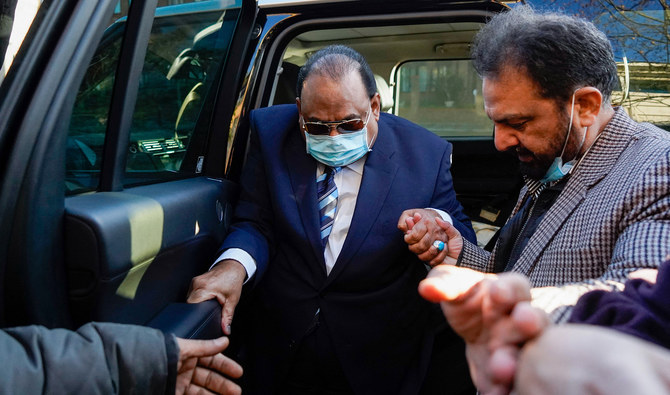

KARACHI: The Muttahida Qaumi Movement (MQM) should be allowed to operate in Pakistan once again, said one of its senior office bearers on Wednesday, after the party’s founding leader Altaf Hussain was found not guilty of encouraging acts of terrorism through his speeches to his followers in Karachi.
British police said in 2019 they had charged the London-based leader with a terrorism offense in connection with a speech delivered three years ago in which he was accused of urging a crowd of hunger strikers in Karachi to ransack media houses and storm the local headquarters of a military unit.
Two TV studios were soon after attacked and taken off air, while police officers were assaulted and injured. One person was killed in the violence.
“The Pakistani establishment should realize its mistake after this verdict, remove the ban [on MQM], open Nine-Zero [the party’s headquarter in Karachi], and allow our party to function which is our democratic right,” Mustafa Azizabadi, a senior MQM leader, told Arab News. “The judgement is enough to prove that Altaf Hussain was innocent and he was implicated in a false case.”
“The London court’s jury examined every fact, listened to the prosecution and found that the allegations against Hussain were baseless,” he continued. “The parties and factions created before and after the speech miserably failed to inspire confidence among people who have always supported the MQM founder.”
Amir Khan, a leader of the MQM-Pakistan, a faction created after Hussain’s controversial August 2016 speech, did not respond to repeated requests for a comment.
A senior Pakistan Peoples Party (PPP) leader Shehla Raza said the decision of London jury would not have much of an impact on Karachi, a city which was once remotely ruled by Hussain from self-exile.
“It can only leave an impact if Hussain returns to Karachi which he never will,” she told Arab News. “We believe the international jury's decision is made to disturb Pakistan’s peace.”
Speaking to the media, Governor Sindh Imran Ismail of the ruling Pakistan Tehreek-e-Insaf party, dismissed the notion that some “backdoor diplomacy” had taken place to exonerate the MQM founder in London.
“No talks can be held with a person who has been raising slogans against Pakistan, who has been seeking to break the country, and who has been against the very existence of Pakistan,” he said. “Hussain has no role here anymore.”
However, a ruling party’s National Assembly member from Karachi, Aamir Liaquat Hussain, welcomed the development in a series of Twitter posts.
“I congratulate Altaf Bhai [brother] on his acquittal from the bottom of my heart,” he said.
Owais Tohid, a political analyst, agreed that the decision would not revive Hussain’s politics in Karachi, though he maintained it was a setback for people who disowned him.
“With the recent decision by a London court to acquit Altaf Hussain from terrorism charges, the ghost will continue to haunt those who disassociated themselves from him after his controversial speech,” he told Arab News. “The decision will give a boost to dedicated MQM workers and their association with Altaf Hussain will further solidify.”
Tohid said “the security apparatus” would not allow the MQM to revive its old structure.
“The party’s mass support has obviously shattered during last few years and its control through force will not be allowed anymore,” he added.


