

Pakistan approves textile policy for sustainable export growth — commerce chief

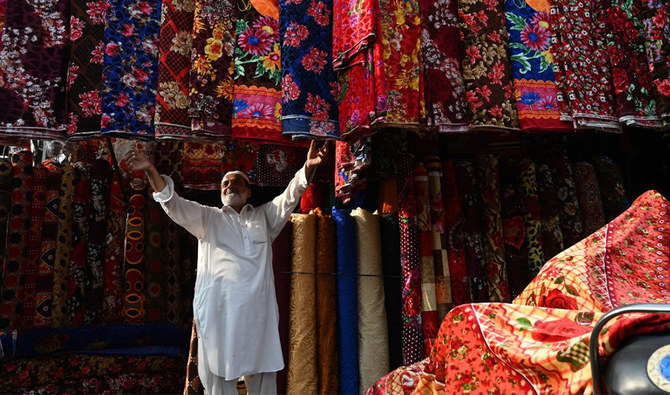
A Pakistani shopkeeper hangs fabric at his shop in a market in Lahore on September 16, 2019. (AFP/File)
Short Url
Updated 16 February 2022
Follow

Pakistan approves textile policy for sustainable export growth — commerce chief

  • Abdul Razak Dawood says the country’s textile exports will increase to $21 billion by the end of the current fiscal year
  • The country’s share in global textile market is only 1.8 percent, offering it huge opportunities for sectoral growth

KARACHI: Pakistan’s commerce chief Abdul Razak Dawood said on Wednesday the government had approved Textiles and Apparel Policy, 2020-25, with the objective of ensuring sustainability of textile sector exports.

Last week, the Economic Coordination Committee (ECC) of the cabinet had approved the revised Textiles and Apparel Policy, 2020-25, after incorporating a few changes along with an implementation report.

“One of the main objectives of the policy is to give the textile industry internationally competitive electricity and gas rates to enhance the exports,” Dawood said while addressing a news conference in Islamabad.

“In the textile policy, we are assuring businesses that we will provide them internationally competitive prices,” he continued. “We will maintain tariff rationalization throughout the policy period.”

The commerce chief said the salient features of the policy also included export growth of value-added products along with geographic diversification.

He also maintained the country would achieve $21 billion of textile exports by the end of the current fiscal year.

“We have made good progress which means there will be a growth in textile exports of $6 billion by the end of June 2022,” he said. “We will grow by 26 percent this year.”

Pakistan posted its highest textile exports during the first seven months of the ongoing fiscal year (7MFY22). The sector’s exports increased by 25 percent to $10.93 billion during the July 2021-January 2022 period, according to the Federal Bureau of Statistic.

Pakistan’s textile sector provides employment to about 40 percent of industrial workforce in the country, consumes almost 40 percent of banking credit for manufacturing and accounts for 8.5 percent of the gross domestic product.

The textile sector which is the single largest consumer of domestic cotton contributes 62 percent share in the overall export of the country, according to All Pakistan Textile Mills Association (APTMA).

Pakistan has previously announced two five-year textiles policies for 2009-14 and 2014-19 to increase its exports to $25 billion and $26 billion, respectively. However, it could not manage to meet these targets in the past.

The third policy was approved in March 2020 by Prime Minister Imran Khan, though it is yet to be officially implemented.

Dawood said on Wednesday the country’s share in the global textile products was only 1.8 percent, adding there was huge opportunity for sectoral growth.

“Pakistan stands at the fifth position for selling cotton yarn, second position for selling denim fabric, and second position for selling cotton cloth in the world,” he informed.

The commerce chief added the value of one pound of cotton was $2 about 10 years ago, adding it was $8 today.

“This means we are doing better with one pound of cotton,” he said. “It is a very good sign for us.”

Calling for product and geographic diversification, he noted that much of the country’s exports were confined to only 10 countries.

“We are exporting 75 percent of all our goods to only 10 countries,” he said. “This means that we have not achieved the required level of diversification. Only 15 tariff lines in the customs book constitute 50 percent of our exports.”

Dawood informed the textile sector was in the process of increasing its production capacity with import of machinery, saying the main industrial players were spending $435 million for the purpose and had already brought 50 percent of these advanced products to the country.


Pakistan’s deputy PM says country will not send forces to Gaza to disarm Hamas

Updated 27 December 2025
Follow

Pakistan’s deputy PM says country will not send forces to Gaza to disarm Hamas

  • Ishaq Dar says Pakistan open to peacekeeping but Gaza’s internal security is Palestinian responsibility
  • Pakistan’s top religious clerics from different schools have warned against sending forces to Palestine

ISLAMABAD: Deputy Prime Minister Ishaq Dar said on Saturday Pakistan was willing to contribute to an international peacekeeping force in Gaza, though it would not deploy troops to disarm or de-weaponize Hamas.

The statement follows media reports saying Washington views Pakistan as a potentially significant contributor given its battle-hardened military and wants it to be part of International Stabilization Force (ISF), which is part of United States President Donald Trump’s 20-point framework for a Gaza peace plan.

The plan announced by Trump at the White House on September 29 was formally adopted at the Sharm El-Sheikh Peace Summit in October. Co-chaired by Trump and Egyptian President Abdel Fattah El-Sisi, the summit brought together leaders from 27 countries to sign the “Trump Declaration for Enduring Peace and Prosperity.”

Deployment of troops from Muslim-majority countries during a transitional stabilization phase is a key part of the plan before the war-ravaged Palestinian territory moves toward reconstruction and a longer-term political settlement.

“If they say that we should go and start fighting, disarm Hamas, de-weaponize them, and go and destroy the tunnels that Hamas has built until now, that is not our job,” Dar, who is also the country’s foreign minister, told reporters during a year-end briefing in Islamabad.

He emphasized there was clarity between Pakistan’s civil and military leadership over the matter.

“We have a very complete understanding on this matter that we cannot do that kind of work,” he added.

The deputy prime minister said Pakistan had been using the term “peacekeeping” and had never used the phrase “peace enforcement” while discussing the force.

“I have been very clear: Pakistan will be happy to join if the mandate is not peace enforcement and disarming and de-weaponizing Hamas.”

The government’s stance comes amid growing domestic pressure over the issue.

On Monday, a group of Pakistan’s top religious leaders, chaired by prominent scholar Mufti Taqi Usmani, warned the government against yielding to what they described as international pressure to send forces to Gaza.

In a joint statement from Karachi, the clerics — representing Deobandi, Barelvi, Ahl-e-Hadees and Shia schools of thought — said that Washington wanted Muslim countries to send their forces to Gaza to disarm Hamas.

“Several Muslim governments have already refused this, and pressure is being increased on Pakistan,” it added.

Addressing such concerns, Dar said Pakistan would not land its forces in Palestine to “fight Muslims.”

Israel has repeatedly called for the disarmament of Hamas as a precondition for any long-term settlement, and the United Nations Security Council has also endorsed the ISF framework in November.

However, Dar maintained during the media briefing the internal security of Gaza was the Palestinian responsibility.

“The Palestinian Authority, their government, it is their job, it is the job of their law enforcement agency,” he said

The deputy prime minister also highlighted Pakistan’s involvement in the “Arab Islamic Group of Eight,” including Saudi Arabia, Jordan, Egypt, the United Arab Emirates, Qatar, Turkiye and Indonesia, which has been coordinating on the crisis.

He said the efforts of these countries had brought some peace to Palestine and reduced bloodshed.

“Our declared policy is that there should be an independent two-state solution,” he continued while calling for pre-1967 borders.