Yemen aid cuts to deepen as funds dry up, UN warns

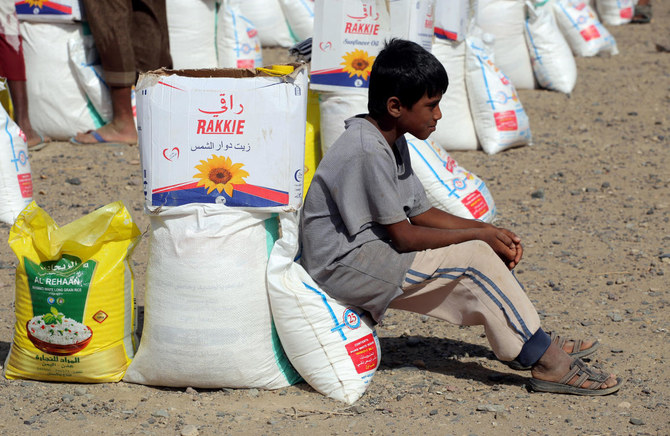
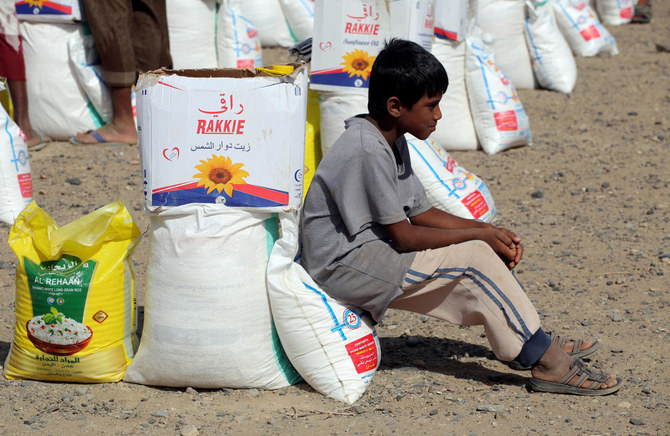
The UN’s 2021 Humanitarian Response Plan received only 58 percent of the requested funds from donors, UN data shows. (File/AFP)
Short Url
Updated 16 February 2022
Follow

Yemen aid cuts to deepen as funds dry up, UN warns

  • The World Food Programme has since January reduced rations for 8 million of the 13 million people it feeds a month

DUBAI: Yemenis face more cuts in humanitarian aid in coming months because of funding shortages that could reduce food rations in a country where millions face starvation, the United Nations aid chief warned, as the war sees its biggest escalation in years.
Martin Griffiths told the UN Security Council on Tuesday that by the end of January nearly two thirds of major UN aid programs had already scaled back or closed.
“The humanitarian operation ... is about to start doing a lot less,” Griffiths said. “Aid agencies are quickly running out of money, forcing them to slash life-saving programs.”
The UN’s 2021 Humanitarian Response Plan received only 58 percent of the requested funds from donors, UN data shows. Competing demands on donors and concerns about aid obstruction in Yemen have contributed to the shortfall, although some donors did step up funds mid-2021 when warnings of famine escalated.
The nearly seven-year-old war between Yemen’s Iran-aligned Houthi group and a Saudi-led coalition, and ensuing economic collapse, have left 80 percent of Yemen’s population reliant on help.
The World Food Programme has since January reduced rations for 8 million of the 13 million people it feeds a month, and Griffiths said rations may be cut further from March, or stopped.
Efforts for a cease-fire stalled as the warring sides ramp up military operations and resist compromise. The Houthis want a coalition blockade on areas the group holds lifted ahead of any truce talks, while Riyadh wants a simultaneous deal.
UN Yemen Envoy Hans Grundberg told Tuesday’s briefing he continued to push for de-escalation while starting consultations next week with multiple Yemeni stakeholders.
“Trust is low and ending this war will require uncomfortable compromises which no warring party is currently willing to make,” Grundberg said.
The Saudi-led alliance intervened in Yemen in March 2015 after the Houthis ousted the government from the capital, Sanaa, in a conflict in which several Yemeni factions vie for power.


Over 2,200 Daesh detainees transferred to Iraq from Syria: Iraqi official

Updated 12 sec ago
Follow

Over 2,200 Daesh detainees transferred to Iraq from Syria: Iraqi official

  • Iraq is still recovering from the severe abuses committed by the terrorists

BAGHDAD: Iraq has so far received 2,225 Daesh group detainees, whom the US military began transferring from Syria last month, an Iraqi official told AFP on Saturday.
They are among up to 7,000 Daesh detainees whose transfer from Syria to Iraq the US Central Command (CENTCOM) announced last month, in a move it said was aimed at “ensuring that the terrorists remain in secure detention facilities.”
Previously, they had been held in prisons and camps administered by the Kurdish-led Syrian Democratic Forces (SDF) in northeast Syria.
The announcement of the transfer plan last month came after US envoy to Syria Tom Barrack declared that the SDF’s role in confronting Daesh had come to an end.
Saad Maan, head of the security information cell attached to the Iraqi prime minister’s office, told AFP on Saturday that “Iraq has received 2,225 terrorists from the Syrian side by land and air, in coordination with the international coalition,” which Washington has led since 2014 to fight Daesh.
He said they are being held in “strict, regular detention centers.”
A Kurdish military source confirmed to AFP the “continued transfer of Daesh detainees from Syria to Iraq under the protection of the international coalition,” using another name for Daesh.
On Saturday, an AFP photographer near the Kurdish-majority city of Qamishli in northeastern Syria saw a US military convoy and 11 buses with tinted windows.

- Iraq calls for repatriation -

Daesh seized swathes of northern and western Iraq starting in 2014, until Iraqi forces, backed by the international coalition, managed to defeat it in 2017.
Iraq is still recovering from the severe abuses committed by the terrorists.
In recent years, Iraqi courts have issued death and life sentences against those convicted of terrorism offenses.
Thousands of Iraqis and foreign nationals convicted of membership in the group are incarcerated in Iraqi prisons.
On Monday, the Iraqi judiciary announced it had begun investigative procedures involving 1,387 detainees it received as part of the US military’s operation.
In a statement to the Iraqi News Agency on Saturday, Maan said “the established principle is to try all those involved in crimes against Iraqis and those belonging to the terrorist Daesh organization before the competent Iraqi courts.”
Among the detainees being transferred to Iraq are Syrians, Iraqis, Europeans and holders of other nationalities, according to Iraqi security sources.
Iraq is calling on the concerned countries to repatriate their citizens and ensure their prosecution.
Maan noted that “the process of handing over the terrorists to their countries will begin once the legal requirements are completed.”