

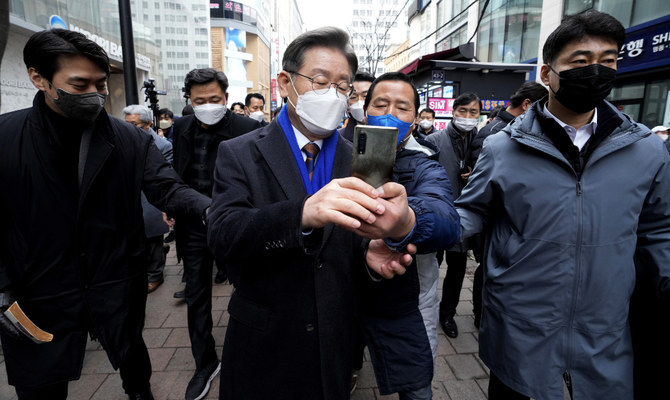

SEOUL: South Korea’s presidential candidates formally began campaigning on Tuesday in what is set to be the tightest race in 20 years between its two main parties, dominated by scandals that have allowed a third challenger to potentially play the role of kingmaker.
Polls say voters are looking for a president who can clean up polarized politics and corruption and tackle the runaway housing prices and deepening inequality that have dogged Asia’s fourth-largest economy.
Curbing North Korea’s weapons tests and resuming talks would be a plus, but even a record month of missile testing by Pyongyang in January hasn’t made foreign policy a key issue for the March 9 vote in South Korea.
But the major issues named in the polls have been overshadowed by scandals and petty controversies, ranging from allegations of abuse of power to spats over one candidate’s relationship with a shaman and an anal acupuncturist.
Fourteen candidates have signed up since official registration opened on Sunday, with Lee Jae-myung, the flag-bearer of the ruling Democratic Party, facing off against Yoon Suk-yeol from the conservative main opposition People Power Party.
Dubbed the “unlikeable election” due to high disapproval ratings and smear campaigns waged by both sides, Lee and Yoon are neck and neck in polls, although Yoon has maintained a slight lead in recent weeks.
A survey released on Sunday by Realmeter showed 41.6 percent of respondents favored Yoon and 39.1 percent picked Lee, while Southern Post put Yoon just 0.5 percent ahead with 35.5 percent.
That would contrast with the last three presidential elections, which were largely predictable. The upcoming contest could be the closest since 2002 when an opposition challenger lost to former President Roh Moo-hyun by a 2.33 percent margin, or 570,980 votes.
“This is the foggiest election we’ve seen in a while, it’s very rare that a likely winner had yet to emerge just three weeks before the vote,” said Bae Jong-chan, a political analyst who runs the Insight K think tank.
A former governor of Gyeonggi province, Lee shot to prominence through his aggressive handling of the coronavirus pandemic and his advocacy of universal basic income.
Yoon is a political novice, but has gained popularity thanks to his image as a staunch prosecutor-general who steered high-profile investigations into corruption scandals engulfing aides to former President Park Geun-hye and current President Moon Jae-in.
But growing frustration over mainstream politics and controversy involving both candidates’ families have been a fillip for Ahn Cheol-soo, a renowned software mogul and doctor who is a minor opposition contender.
MERGED CAMPAIGN
Ahn formally offered on Sunday to merge campaigns with Yoon, saying it would expedite a “overwhelming victory” and national unity.
His latest ratings hovered between 7-8 percent after peaking at 15 percent. Polls indicated a convincing victory if Yoon and Ahn unite, although it was not clear if all Ahn’s supporters would automatically follow him on a combined ticket.
Some officials from Yoon’s campaign have also called for a merger, floating the idea of forming a coalition government and appointing Ahn as prime minister.
Yoon said he would give the proposal “positive consideration” but said he was not entirely happy about Ahn’s call to use a poll to pick which of the two men would lead the ticket.
A Yoon aide said his campaign would prefer a negotiation between the candidates to determine the flag-bearer. Ahn said he was open to talks but would not accept unilateral demands for him to step down.
Ahn’s rise has come amid deepening voter disgust over controversies involving the families of both Lee and Yoon.
Lee, who has apologized over his son’s illegal gambling, faces a possible criminal investigation over allegations that he illegally hired a provincial government employee to serve his wife as a personal assistant, and let her misappropriate government funds through his corporate credit card.
Lee and his wife have apologized for causing public concern and said they would cooperate with any investigation.
Yoon, meanwhile, has apologized for his wife’s inaccurate resume when she applied for teaching jobs years ago, and denied accusations from Democrats that a shaman who is close to his wife was deeply involved in his campaign.
He has also denied ties to an anal acupuncturist.
Lee’s campaign raised new allegations on Sunday that Kwon Oh-soo, chairman and the largest shareholder of Deutsch Motors Inc., a BMW car dealer in South Korea, sponsored Yoon’s wife’s company in a bid to evade investigations while Yoon worked as a prosecutor. Kwon was arrested last year on charges of manipulating his firm’s stock prices.
The ruling Democratic Party also criticized Yoon at the weekend for putting his feet on a train seat without taking off his shoes as lacking a sense of citizenship and public etiquette.
Yoon’s campaign hit back, accusing the Democrats of levelling groundless allegations even after Lee vowed to cease negative campaigns.


