

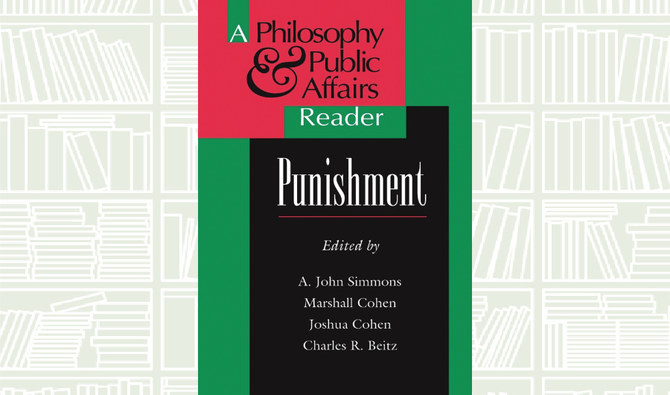
What We Are Reading Today: Punishment: A Philosophy and Public Affairs Reader

Short Url
Updated 14 February 2022
Follow

What We Are Reading Today: Punishment: A Philosophy and Public Affairs Reader

Edited by: A. John Simmons, Marshall Cohen, Joshua Cohen, and Charles R. Beitz

The problem of justifying legal punishment has been at the heart of legal and social philosophy from the very earliest recorded philosophical texts. However, despite several hundred years of debate, philosophers have not reached agreement about how legal punishment can be morally justified.

That is the central issue addressed by the contributors to this volume. All of the essays collected here have been published in the highly respected journal Philosophy & Public Affairs.

Taken together, they offer not only significant proposals for improving established theories of punishment and compelling arguments against long-held positions, but also original and important answers to the question, “How is punishment to be justified?”

Part I of this collection, “Justifications of Punishment,” examines how any practice of punishment can be morally justified. Contributors include Jeffrie G. Murphy, Alan H. Goldman, Warren Quinn, C. S. Nino, and Jean Hampton.


What We Are Reading Today: Renaissance

Photo/Supplied
Updated 28 December 2025
Follow

What We Are Reading Today: Renaissance

  • Designed by Adjaye Associates in association with Cooper Robertson, the new facility positions the museum at the heart of both campus and civic life as a center for the public humanities

Author: James Christen Steward

“Renaissance: A New Museum for Princeton” reflects on the history of the Princeton University Art Museum as one of the oldest collecting institutions in North America and the role of its architecture in campus making. 

The 2025 opening of its new building affirms the museum’s long-standing commitment to considering works of art in the original as essential tools for understanding the wider world. 

Designed by Adjaye Associates in association with Cooper Robertson, the new facility positions the museum at the heart of both campus and civic life as a center for the public humanities.