

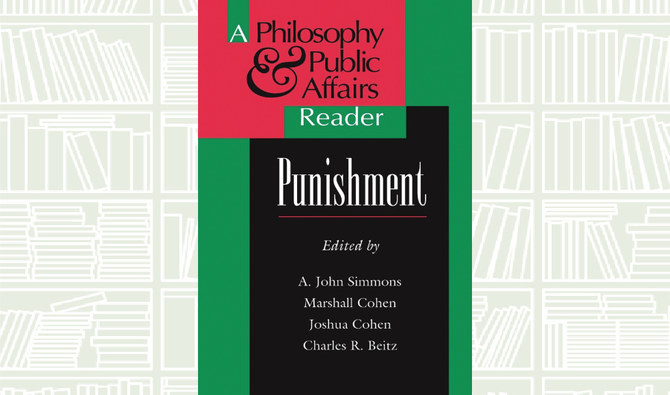
What We Are Reading Today: Punishment: A Philosophy and Public Affairs Reader

Short Url
Updated 14 February 2022
Follow

What We Are Reading Today: Punishment: A Philosophy and Public Affairs Reader

Edited by: A. John Simmons, Marshall Cohen, Joshua Cohen, and Charles R. Beitz

The problem of justifying legal punishment has been at the heart of legal and social philosophy from the very earliest recorded philosophical texts. However, despite several hundred years of debate, philosophers have not reached agreement about how legal punishment can be morally justified.

That is the central issue addressed by the contributors to this volume. All of the essays collected here have been published in the highly respected journal Philosophy & Public Affairs.

Taken together, they offer not only significant proposals for improving established theories of punishment and compelling arguments against long-held positions, but also original and important answers to the question, “How is punishment to be justified?”

Part I of this collection, “Justifications of Punishment,” examines how any practice of punishment can be morally justified. Contributors include Jeffrie G. Murphy, Alan H. Goldman, Warren Quinn, C. S. Nino, and Jean Hampton.


What We Are Reading Today: Worldly Afterlives by Julia Stephens

Updated 24 December 2025
Follow

What We Are Reading Today: Worldly Afterlives by Julia Stephens

Indian migrants provided the labor that enabled the British Empire to gain control over a quarter of the world’s population and territory. In the mid-1800s, the British government began building an elaborate bureaucracy to govern its mobile subjects, issuing photo IDs, lists of kin, and wills. It amassed records of workers’ belongings such as handwritten IOUs, crumpled newspaper clippings, and copper bangles. 

“Worldly Afterlives” uses this trove of artifacts to recover the stories of the hidden subjects of empire. Navigating the remains of imperial bureaucracy — in archives scattered across Asia, Africa, the Middle East, and the Americas — Julia Stephens follows migrant families as they traverse the Indian Ocean and the British Empire. She draws on in-depth interviews to show how the histories of empire reverberate in the present.