China’s treatment of Muslims ‘completely different’ from western media portrayal — PM Khan

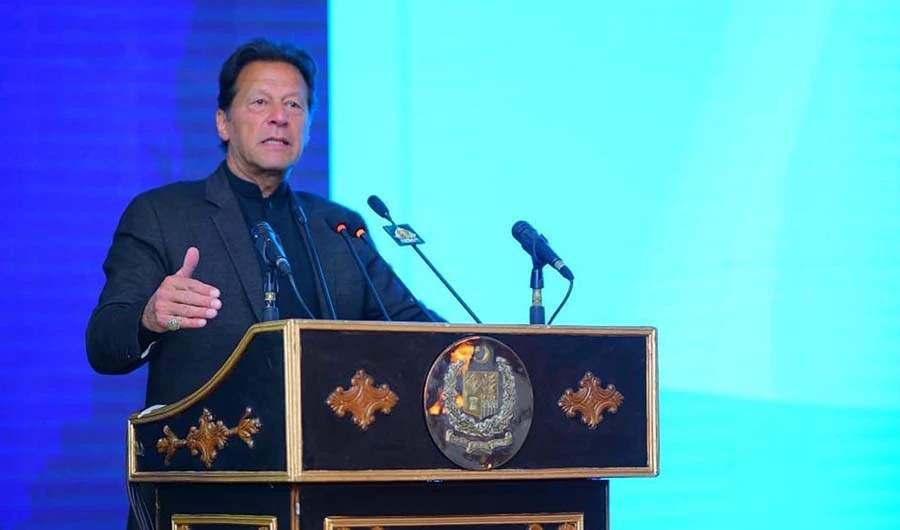
Pakistani Prime Minister Imran Khan addressing the international symposium on Pakistan's hydropower development in Islamabad on Feb 14, 2022. (PID)
Short Url
Updated 14 February 2022
Follow

China’s treatment of Muslims ‘completely different’ from western media portrayal — PM Khan

  • PM speaks during CNN interview, broadcast on Sunday, about China’s treatment of its Muslim minority in Xinjiang
  • Rights groups accuse China of abuses including torture, forced labor and detention of 1 million people in internment camps

ISLAMABAD: Prime Minister Imran Khan has said reports by the United States and western media about the treatment of Muslims in the far western Chinese region of Xinjiang presented a “completely different” picture than what had been observed by Islamabad’s envoy in Beijing during a visit.
The prime minister was responding to a question during a CNN interview, broadcast on Sunday, about China’s treatment of its Muslim minority in Xinjiang where rights groups accuse Beijing of widescale abuses against Uyghurs and other minority groups, including torture, forced labor and detention of 1 million people in internment camps.
China calls the camps re-education and training facilities, denies abuses, and says it is combating religious extremism.
Last month, the United Nations’ human rights chief said she was talking with China for a potentially imminent trip to Xinjiang region in what could provide rare close-up foreign scrutiny of the abuse accusations.
The issue has soured relations between Beijing and the West, bringing genocide accusations from Washington and a diplomatic boycott of the ongoing. Winter Games. China has denounced an international smear campaign.
“Two sides are completely different, what China is saying is completely different to what US is saying or western media is saying,” Khan told CNN’s Fareed Zakaria. “That’s why we asked our ambassador [In China] to give us his opinion and it not what is appearing in western media.”
“We had our Ambassador Moinul Haque in China, who went to Xinjiang, and according to his observations, the picture is not what has been portrayed in western media,” Khan added.
The prime minister also wondered why there was no similar “indignation” in western media about rights violations in Indian-administered Kashmir.
Kashmir is divided between India and Pakistan, with both countries claiming the territory in full and ruling it in part. The two nuclear-armed neighbors have fought two wars over the territory. More than 50,000 people have died in a revolt that erupted in 1989, government figures show. Human rights and separatists put the toll at double.
India has deployed tens of thousands of police and soldiers to keep the peace in the disputed Muslim-majority region after revoking its constitutional autonomy in 2019 to weld the region more tightly to the country.

Pakistan, UK launch £10 million higher education partnership

Updated 15 December 2025
Follow

Pakistan, UK launch £10 million higher education partnership

  • Pak-UK Education Gateway second phase expands climate research, scholarships, university exchanges
  • First phase was launched in 2018 and delivered 165 partnerships, 2,000 joint studies and £5 million in grants

ISLAMABAD: Pakistan’s Higher Education Commission (HEC) and the British Council have launched the £10 million second phase of the Pak-UK Education Gateway, the HEC said on Monday, a joint initiative aimed at deepening collaboration between universities in both countries on research, mobility and higher-education reform.

The program, funded equally by the HEC and the British Council, builds on a partnership launched in 2018 and seeks to strengthen institutional ties between Pakistani and British universities, focusing on shared challenges including climate change, skills development and economic growth.

Education cooperation has become an increasingly important pillar of broader Pakistan-UK relations, as both countries look to expand academic mobility, research collaboration and international recognition of qualifications at a time when higher-education systems face pressure to respond to climate risks, labor-market shifts and funding constraints.

“This £10 million partnership is set to deepen collaboration between UK and Pakistani universities on critical issues like Climate Change and Mobility. A true system-to-system commitment,” the HEC said in an X post. 

According to the British Council and HEC, the first phase of the Pak-UK Education Gateway supported 165 institutional partnerships, generated around 2,000 joint research papers and awarded £5 million in research grants. Officials say the second phase aims to build on that foundation as part of a longer-term effort to internationalize Pakistan’s higher-education sector.

“Education is the building block of growth and prosperity. Our work on education in Pakistan supports people throughout their lives: from helping reform education policy at the school level, to our strong partnership in higher education,” British High Commissioner Jane Marriott said in a statement.

“This next phase builds on our already strong relationship, and will unlock opportunities to help both our higher education sectors thrive.”

Opportunities under the second phase include increased funding for scholarships, joint research grants and faculty exchanges, alongside a Start-Up Challenge Fund to support Pakistan-UK university collaborations pursuing commercial opportunities and access to new markets.

The program will also focus on leadership and governance reforms within Pakistan’s higher-education system, including quality assurance, improved campus accessibility for people with disabilities, and greater participation of women in senior leadership roles. It further aims to expand opportunities for Pakistani students to study UK-accredited courses without leaving their home cities, alongside a commitment to mutual recognition of qualifications.

Pakistan’s Minister for Federal Education and Professional Training Khalid Maqbool Siddiqui said the initiative had already delivered concrete results since its launch in 2018, calling education “the bridge that connects people, cultures, and futures.”

Acting HEC Chairperson Nadeem Mahbub described the Gateway as a system-to-system partnership rather than a stand-alone program, noting that it had benefited institutions and students in both countries.