

Over 100 arrested in lynching of man over alleged blasphemy in Pakistani village

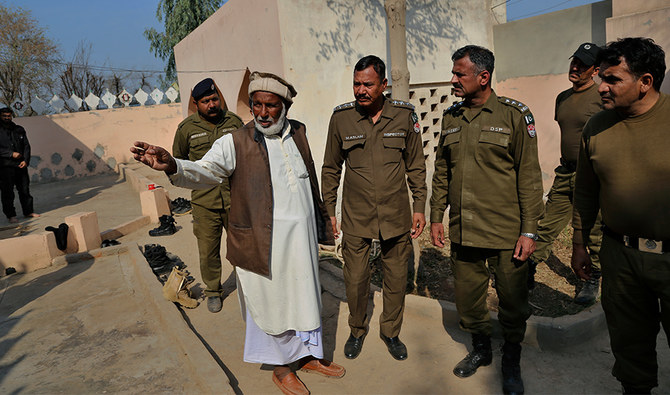
Mian Mohammad Ramzan the mosque custodian briefs police officers regarding the stoning to death of Mushtaq Ahmed by mob for alleged blasphemy in Tulamba, a remote village in the district of Khanewal, Pakistan, Feb. 13, 2022. (AP)
Short Url
Updated 14 February 2022
Follow

Over 100 arrested in lynching of man over alleged blasphemy in Pakistani village

  • A mob lynched a man last week because he allegedly burnt pages of Holy Qur’an in a village in Khanewal district
  • On Sunday, Prime Minister Imran Khan ordered action against the mob and any police who acted as onlookers

ISLAMABAD: Police in the Pakistani province of Punjab have said they have arrested more than 100 suspects in connection with the lynching of a middle-aged man over alleged blasphemy in a remote village in Khanewal district last week.
The killing comes just months after a mob of factory employees tortured and burned a Sri Lankan manager in Sialkot in December over apparent blasphemy in a “horrific” attack that Prime Minister Imran Khan said had brought shame on the country.
The Sialkot incident drew nationwide condemnation and authorities arrested dozens of people over involvement in the killing of Priyantha Kumara. Those linked to Kumara’s murder are facing a trial in Pakistan.
On Sunday, PM Khan ordered action against the mob and any police who acted as onlookers to the Saturday killing of the man for allegedly burning pages of the Holy Qur’an.
“Police identified and arrested 6 more main accused. So far 21 main accused have been arrested while a total of 102 suspects have been arrested,” Punjab police said on Twitter on Monday.
“Raids are underway to nab more suspects since last night,” police said.


A government spokesman said suspects were being identified through social media videos shot by the villagers in Tulamba, Khanewal district.
The mob gathered at a mosque on Saturday night after the son of its prayer leader announced that he had spotted the man burning pages of the holy book, Reuters said, quoting police official Munawar Hussain.
Police arrived to find the man unconscious and tied to a tree, Hussain said, adding that the mob also attacked the police.
“The villagers armed with batons, axes and iron rods killed him and hanged his body from a tree,” Hussain said.
He said that evidence so far gathered by police suggested the dead man, identified as Muhammad Mushtaq, was in his 50s and appeared to have had mental disabilities.
Pakistani Prime Minister Imran Khan’s adviser on religious harmony, Tahir Mahmood Ashrafi, said in a statement on Sunday said the killers in Khanewal had “defamed Islam and Muslims with this brutal act.”
“The incumbent government is amending the criminal law after 76 years in the country to ensure speedy trial and to take the involved elements to justice in such incidents,” Ashrafi said.
Mob killings over accusations of blasphemy — a crime that can carry the death sentence — are fairly frequent in Muslim-majority Pakistan.
In January this year, a Pakistani court sentenced a Muslim woman to death after finding her guilty of blasphemy for insulting Islam’s Prophet Muhammad (PBUH). The woman, Aneeqa Atteeq, was arrested in May 2020 after a man alerted police that she sent him offensive caricatures via WhatsApp.
 Under Pakistan’s blasphemy laws, anyone found guilty of insulting the religion or religious figures can be sentenced to death. While authorities have yet to carry out a death sentence for blasphemy, just the accusation can cause riots.
In December, at a memorial service for Kumara, PM Khan vowed his government would never again allow anyone to misuse religion to perpetrate violence in Pakistan.
“The government will not spare anyone who tries to use religion, particularly the name of the Prophet Muhammad (PBUH), to generate violence,” the prime minister said. “Such instances will not be allowed to take place on my watch.”


Pakistan says Indonesia’s Pertamina exploring cooperation in ‘vast untapped potential’ in minerals 

Updated 6 sec ago
Follow

Pakistan says Indonesia’s Pertamina exploring cooperation in ‘vast untapped potential’ in minerals 

  • Islamabad is pitching its largely untapped mineral sector to foreign investors as a new pillar of economic recovery and industrial growth
  • Jakarta is eyeing overseas mining partnerships through Pertamina to leverage its exploration expertise and secure strategic raw materials

ISLAMABAD: Indonesia has expressed interest in engaging in Pakistan’s largely untapped mineral sector, with Jakarta’s state-owned energy company Pertamina seen as a potential partner for exploration and mining cooperation, a statement from Pakistan’s Information Ministry said this week.

The engagement comes as Pakistan positions mining as a potential engine of long-term growth, following years of underinvestment and stalled projects, and as resource-rich Asian economies increasingly look overseas to secure supplies of critical minerals and diversify investment portfolios.

Government and industry estimates suggest Pakistan’s untapped mineral resources could be worth trillions of dollars, anchored by major copper-gold deposits such as Reko Diq, as well as coal, iron ore and emerging critical minerals. Meanwhile, Indonesia, one of the world’s leading producers of minerals such as nickel, coal and copper, has in recent years expanded the role of its state-owned firms in overseas energy and extractive ventures, driven by rising domestic demand, industrial policy linked to downstream processing and global competition for strategic resources.

Against this backdrop, Federal Minister for Petroleum Ali Pervaiz Malik met Indonesia’s Ambassador to Pakistan, Chandra Warsenanto Sukotjo, on Thursday to discuss cooperation with a particular focus on minerals and exploration, the information ministry said.

“Indonesia’s state-owned company, Pertamina, possesses extensive experience in exploration, and avenues for cooperation in exploration activities between the two countries could be explored,” the Indonesian ambassador said, according to the statement.

Malik welcomed Indonesia’s interest and assured full government support, highlighting what the statement described as Pakistan’s “vast untapped potential” in minerals and exploration. He encouraged Indonesian companies to partner with Pakistani firms on mutually beneficial projects.

The petroleum minister also formally invited Indonesia to participate in the Pakistan Minerals Investment Forum (PMIF) 2026, telling the ambassador that the upcoming event would be significantly larger than the previous two editions and aimed at attracting a wider pool of international investors.

Both sides agreed to continue engagement and explore concrete opportunities to deepen cooperation across minerals, exploration and energy, the statement said, framing the talks as part of broader efforts to strengthen Pakistan–Indonesia economic ties beyond traditional diplomatic and cultural links.

Pakistan holds significant reserves of copper, gold, coal and other minerals across Balochistan, Khyber Pakhtunkhwa and Gilgit-Baltistan, but officials say much of this potential remains underdeveloped due to legal disputes, infrastructure gaps and lack of foreign investment. In recent years, Islamabad has sought to change that by resolving long-running disputes, hosting international mineral investment forums, and courting partners from North America, the Gulf and Asia.

The government has placed particular emphasis on large-scale projects such as the Reko Diq copper-gold mine in Balochistan, while also encouraging smaller exploration and mining ventures through joint partnerships with foreign companies and state-owned enterprises.