ISLAMABAD: Iranian Interior Minister Ahmad Vahidi will arrive in the Pakistani capital of Islamabad on February 14 to hold bilateral talks, including discussions on border management, the Pakistani interior ministry said on Sunday.
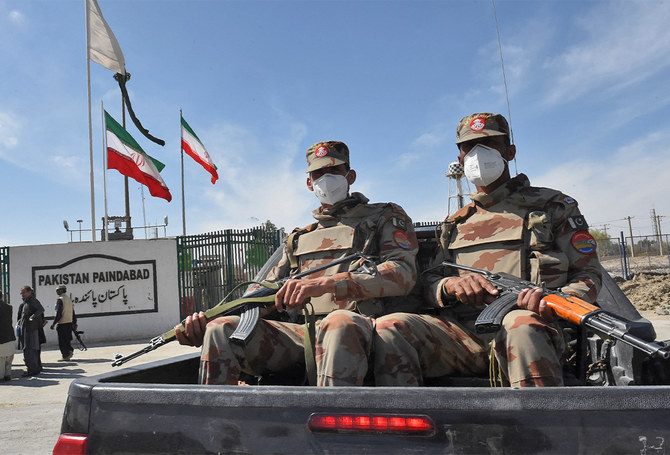
The visit by the Iranian interior minister follows a string of militant attacks in Pakistan’s southwestern Balochistan province, which shares a long and porous border with Iran.
Ten Pakistani soldiers were killed in an attack on a checkpoint in Kech on January 28, while another nine troops and 20 militants were killed in an operation to regain control of two military camps in Panjgur and Noushki from militants of the outlawed Balochistan Liberation Army (BLA).
Days later, Pakistani officials also said militants were launching these attacks from Afghanistan and Iran, and that they would raise the issue on the diplomatic level with both the countries.
“Iranian Interior Minister Ahmad Vahidi will arrive in Pakistan on the invitation of his Pakistani counterpart Sheikh Rashid Ahmed,” the Pakistani interior minister said in a statement.
He will meet key Pakistani officials, including Prime Minister Imran Khan, during his one-day visit, it said.
“Talks will be held relating to Pak-Iran border management and implementation of the prisoner exchange [agreement],” the statement read.
Balochistan, the southwestern Pakistani province which borders Iran and Afghanistan, has been marred by an insurgency for the last two decades, fueled by anger that its abundant reserves of natural resources are not relieving citizens from crushing poverty.
Militants often target security forces along Pakistan’s 959-kilometer-long border with Iran. Pakistan has also been erecting a fence along the border, which is expected to be completed within a year.
On Saturday, Pakistan Army Chief General Qamar Javed Bajwa visited Panjgur and spent a day with troops who repulsed terrorist attack on the security forces camp on February 2.


Iranian interior minister to visit Pakistan Monday for talks on border management
https://arab.news/makn3
Iranian interior minister to visit Pakistan Monday for talks on border management

- Ahmad Vahidi’s visit follows a string of militant attacks in Pakistan’s Balochistan that borders Iran
- Iranian minister will hold meetings with key Pakistani officials, including Prime Minister Imran Khan

Excavations resume at Mohenjo-Daro to study early Harappan city wall
- A joint Pakistani-US team probes multi-phase wall dating to around 2800 BC
- Research remains limited despite Mohenjo-Daro’s archaeological importance
ISLAMABAD: Archaeologists working at the ancient site of Mohenjo-Daro have resumed excavations aimed at better understanding the city’s early development, including the structure and chronology of a massive perimeter wall first identified more than seven decades ago, officials said on Saturday.
The latest excavation season, launched in late December, is part of a joint Pakistani-US research effort approved by the Technical Consultative Committee of the National Fund for Mohenjo-Daro, which met at the site this week to review conservation and research priorities. The work focuses on reassessing the city’s defensive architecture and early occupation layers through controlled excavation and carbon dating.
Jonathan Mark Kenoyer, a senior archaeologist involved in the project, told the committee that the excavation targets a section of the city wall originally uncovered by British archaeologist Mortimer Wheeler in 1950.
“This wall was over seven meters wide and built in multiple phases, reaching a height of approximately seven meters,” Kenoyer said, according to an official statement circulated after the meeting. “The lowest part of the wall appears to have been constructed during the early Harappan period, around 2800 BC.”
Organic material recovered from different excavation levels is being analyzed for carbon dating to establish a clearer timeline of the site’s development, the statement continued, adding that the findings would be published after detailed study.
The committee noted that despite Mohenjo-Daro’s status as one of the world’s earliest and largest urban centers, systematic research at the site has remained limited in recent decades. Its members agreed to expand archaeological studies and invited new research proposals to help formulate a long-term strategy for the site.
The committee also approved the continuation of conservation work on previously excavated material, including dry core drilling data, and reviewed progress on preserving a coin hoard discovered at the site in 2023, the results of which are expected to be published after conservation is completed.
Mohenjo-Daro, a UNESCO World Heritage site in Pakistan’s Sindh province, was a major center of the Indus Valley Civilization, which flourished more than 4,000 years ago.


