

Pakistan reports 44 deaths, over 3,000 new daily coronavirus infections

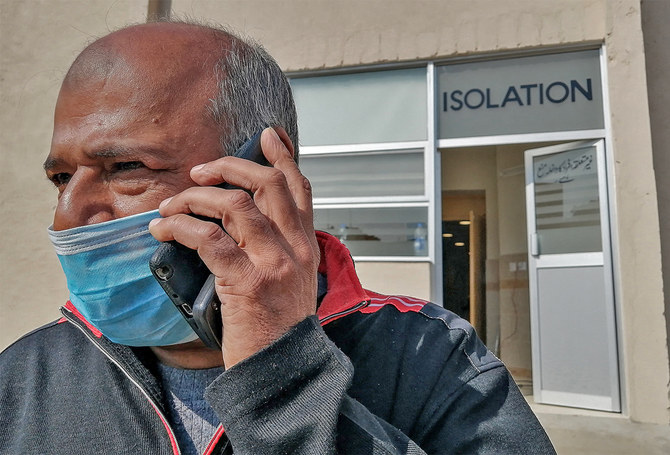
A doctor wearing a protective mask speaks on a phone as he leaves an isolation ward set up as a preventative measure following the coronavirus outbreak in Islamabad, Pakistan, on January 31, 2020. (AFP/File)
Short Url
Updated 12 February 2022
Follow

Pakistan reports 44 deaths, over 3,000 new daily coronavirus infections

  • As of now, the country has over 80,150 active cases of the virus
  • A day earlier, Pakistan vaccinated a record 2.24 million people

ISLAMABAD: Pakistan on Saturday reported another 44 deaths and more than 3,000 coronavirus cases, its pandemic response monitor said, as the South Asian nation continues to battle an omicron-driven fifth wave of infections. 
Since the 220-million strong nation reported its first COVID-19 case in February 2020, over 1.4 million Pakistanis have tested positive for the virus, while the number of deaths in the country has crossed 29,700. 
In the last 24 hours, 3,019 people tested positive for the virus, constituting a 5.36 percent positivity rate, according to the National Command and Operation Center (NCOC), the country’s pandemic response body. 
The number of active coronavirus cases currently stands at 80,168, while 1,640 patients are on critical care. 

Earlier this month, the NCOC announced a door-to-door vaccination drive to administer over 35 million doses to help the country fight the fifth wave of virus infections. 
On Thursday, NCOC chief Asad Umar tweeted that Pakistan had set a record for administering the most vaccine doses in a single day, i.e. 2.24 million. 
“Last 4 days in a row we have vaccinated more than 2 million each day. Every 3 out of 4 Pakistanis eligible for vaccination have received at least 1 dose,” he said. 
“58 percent are fully vaccinated. Well done Pakistan.” 


Pakistan to begin first phase of Hajj 2026 trainings from today

Updated 31 December 2025
Follow

Pakistan to begin first phase of Hajj 2026 trainings from today

  • Training programs to be held in phases across Pakistan till February, says religion ministry
  • Saudi Arabia allocated Pakistan a total quota of 179,210 pilgrims for Hajj 2026

ISLAMABAD: Pakistan’s religious affairs ministry has said that it will begin the first phase of mandatory Hajj 2026 training for pilgrims intending to perform the pilgrimage from today, Thursday.

The one-day Hajj training programs will be held in phases across the country at the tehsil level until February. The ministry directed intending pilgrims to bring their original identity cards and the computerized receipt of their Hajj application to attend the training sessions.

“Pilgrims should attend the one-day training program according to their scheduled date,” Pakistan’s Ministry of Religious Affairs (MoRA) said in a statement.

The ministry said training schedules are being shared through the government’s Pak Hajj 2026 mobile application as well as via SMS. It added that details of the schedule are also available on its website.

According to the ministry, training programs will be held in Abbottabad on Jan. 2; Ghotki, Thatta and Kotli on Jan. 3; and Tando Muhammad Khan and Khairpur on Jan. 4.

Hajj training sessions will be held in Rawalakot, Badin and Naushahro Feroze on Jan. 5, while pilgrims in Fateh Jang, Dadu and Tharparkar will receive the training on Jan. 6.

The ministry said training programs will be conducted in Umerkot and Larkana on Jan. 7, followed by sessions in Mirpurkhas, Shahdadkot and Mansehra on Jan. 8.

Pakistan’s religious affairs ministry has previously said these trainings will be conducted by experienced trainers and scholars using multimedia.

It said the training has been made mandatory to ensure that intending pilgrims are fully aware of Hajj rituals and administrative procedures.

Saudi Arabia has allocated Pakistan a quota of 179,210 pilgrims for Hajj 2026, of which around 118,000 seats have been reserved under the government scheme, while the remainder will be allocated to private tour operators.

Under Pakistan’s Hajj scheme, the estimated cost of the government package ranges from Rs1,150,000 to Rs1,250,000 ($4,049.93 to $4,236), subject to final agreements with service providers.
