Sudan rejects Western criticism of arrests as ‘blatant interference’

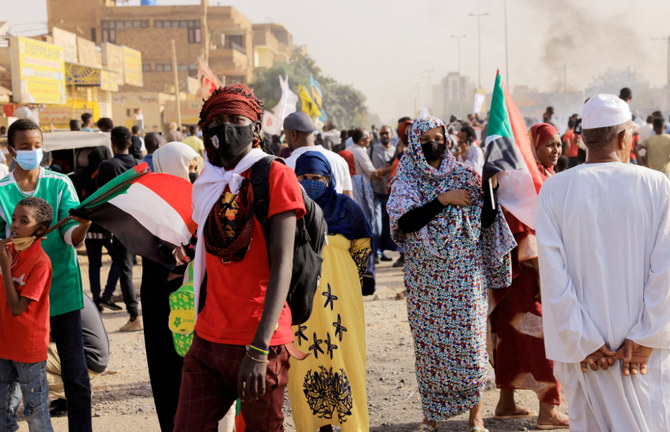
Protesters march during a rally against military rule following coup in Khartoum, Sudan, February 10, 2022. (Reuters)
Short Url
Updated 12 February 2022
Follow

Sudan rejects Western criticism of arrests as ‘blatant interference’

  • Protests organized by neighborhood resistance committees have drawn hundreds of thousands of people, and at least 79 have been killed and more than 2,000 injured in crackdowns

KHARTOUM: Sudan has denounced Western criticism of the arrest of two high-profile former officials opposed to military rule and charged with corruption, saying it was contrary to “diplomatic norms and practices.”
Khalid Omer Yousif and Wagdi Salih were arrested on Wednesday, a move Norway, the US, Britain, the EU, Canada, and Switzerland condemned as “harassment and intimidation” by Sudan’s military authorities.
“This is blatant interference in internal Sudanese affairs, contrary to diplomatic norms and practices,” the Sudanese Foreign Ministry said in a statement.
Both men had been part of the government that was toppled on Oct. 25 and had been detained in the weeks following. Since then, military leaders have repeatedly warned of foreign interference.
The two had been involved in a taskforce that seized assets from members of ousted President Omar Bashir’s regime that has come under criticism from the military. A committee reviewing its work said on Sunday it had found irregularities.

BACKGROUND

Lawyers said this week more than 100 people remain in prison, while some 2,000 had been arrested and released.

“The two citizens referred to were in fact detained based on clear criminal suspicion, not as a result of any political charge or motive, and the ambassadors concerned should have taken care to obtain accurate information from official sources,” the Foreign Ministry statement said.
The coup ended a partnership between the military and civilian political parties, drawing international condemnation and plunging Sudan into turmoil, with frequent nationwide demonstrations against the coup and a wave of political detentions.
Lawyers told Reuters this week more than 100 people remain in prison, while some 2,000 had been arrested and released.
Protests organized by neighborhood resistance committees have drawn hundreds of thousands of people, and at least 79 have been killed and more than 2,000 injured in crackdowns.
The wave of arrests has expanded following the killing of a senior police officer during a Jan. 13 protest close to the presidential palace in Khartoum.
The officer was stabbed to death, according to local media.
Security forces raided a Khartoum hospital and arrested six, including an injured protester and women who were visiting him, accusing them of being responsible for the killing.
The trend has frustrated diplomats working to bring the military and civilian leaders to some sort of an agreement.
“Arbitrary arrests and detention of political figures, civil society activists and journalists undermine efforts to resolve Sudan’s political crisis,” said Lucy Tamlyn, US chargé d’affaires in Sudan.


Controversial Israeli minister enters area around Al-Aqsa Mosque on first Friday of Ramadan

Updated 11 sec ago
Follow

Controversial Israeli minister enters area around Al-Aqsa Mosque on first Friday of Ramadan

  • Far-right National Security Minister Itamar Ben-Gvir is seen making provocative remarks directed at Palestinians in presence of Israeli police
  • It comes amid heightened Israeli security and restrictions on Palestinians entering the mosque, despite which an estimated 80,000 people attend first Friday prayers of the holy month

JERUSALEM: Israel’s far-right national security minister, Itamar Ben-Gvir, entered the area around Al-Aqsa Mosque on Friday, coinciding with the first Friday prayers of Ramadan.

Footage shared on social media showed him arriving through the Moroccan Gate, accompanied by the Israeli police commissioner, Daniel Levy, and the Jerusalem District police commander, Avshalom Peled.

Ben-Gvir was seen making provocative remarks directed at Palestinians in the presence of Israeli police officers, the Palestinian Wafa news agency reported.

The Moroccan Gate, located near Al-Buraq Wall, is one of the main entrances to Al-Aqsa and has been under Israeli control since 1967. It is regularly used by Israeli forces and settlers to access the mosque compound.

Jerusalem Governorate said the minister’s actions came amid heightened Israeli security measures and tighter restrictions on Palestinian in occupied Jerusalem during Ramadan.

Despite this, an estimated 80,000 worshippers attended the first Friday prayers of Ramadan at Al-Aqsa Mosque, according to figures provided by the Islamic Waqf Department in Jerusalem.

From early in the morning, Israeli forces imposed strict controls on Palestinians traveling from the West Bank to Jerusalem. Dozens of elderly worshippers were reportedly turned back at the Qalandia and Bethlehem checkpoints after being told they lacked the necessary permits.

Security forces also briefly detained four paramedics and disrupted the work of journalists and medical teams at Qalandia, witnesses said.

Additional security measures were also enforced at entrances to Jerusalem’s Old City and the gates of Al-Aqsa, with young men subjected to identity checks and a number of worshippers denied access.