


UNITED NATIONS: UN Secretary-General Antonio Guterres has called for stability in Libya, after the country found itself with two competing prime ministers, his spokesman said Friday.
Guterres called on “all parties to continue to preserve stability in Libya as a top priority.”
The secretary-general reminded “all institutions of the primary goal of holding national elections as soon possible in order to ensure that the political will of the 2.8 million Libyan citizens who registered to vote are respected,” in a statement.
The UN chief’s statement did not mention by name either Libya’s interim Prime Minister Abdelhamid Dbeibah or the new prime minister appointed on Thursday, Fathi Bashagha.
Guterres also did not repeat what his spokesman had said a day earlier, namely that the UN has continued to support Dbeibah as interim prime minister.
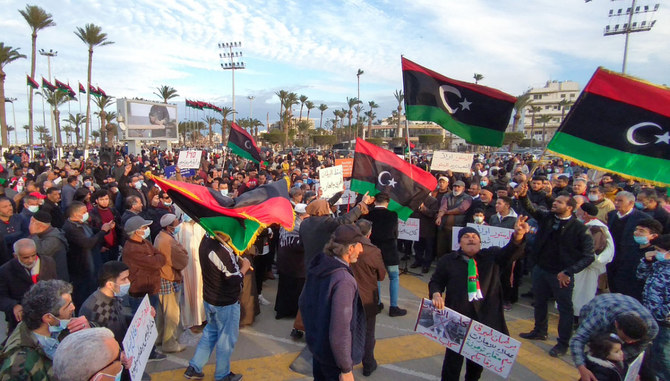
On Friday, dozens of protesters gathered in central Tripoli to oppose Bashagha’s assuming the post of premier. They called for the parliament in the eastern city of Tobruk that appointed him to be dissolved.
Secretary-General @antonioguterres closely following the situation in #Libya, calling on all parties and institutions to ensure criticial decisions are taken transparently. @UNSMILibya
Full statement here: https://t.co/7vbIAVC8zW
— UN Spokesperson (@UN_Spokesperson) February 11, 2022
Asked about Bashagha’s appointment on Thursday, the UN spokesman, Stephane Dujarric, said “yes” when asked whether the UN still recognized Dbeibah, whose job was to steer the country to elections. They had been scheduled for Dec. 24 but were postponed over disputes between the rival factions on laws governing the elections and controversial presidential contestants.
On Friday, Dujarric at first gave a more nuanced statement, saying Guterres is following the situation in Libya closely. His special adviser, Stephanie Williams, is on the ground and has been contacting the parties “trying to keep the process on track,” the spokesman said.
Guterres “takes note” of Thursday’s vote in the House of Representatives in Tobruk to designate a new prime minister,” Dujarric said. “The secretary-general further calls on all parties to continue to preserve stability in Libya as a top priority.”
Later Friday, Dujarric was again pressed on whether the UN still recognizes Dbeibah.
“There’s a prime minister, currently, Mr. Dbeibah,” Dujarric said. “And I’ve mentioned, we’ve taken note that the relevant Libyan institutions have voted for another person to be prime minister-designate, who is reportedly to form a government in the coming weeks.”
War-torn Libya’s parliament, based in the country’s east hundreds of miles (kilometers) from the capital, voted to replace Dbeibah with former interior minister Bashagha, raising the prospect of a power struggle in the capital after a year and a half of relative calm.
Dbeibah, a construction tycoon appointed a year ago as part of United Nations-led peace efforts, has vowed only to hand power to a government that emerges from a democratic vote.
His unity government took office in early 2021.
But when December 24 elections were canceled amid deep divisions over their legal basis and several controversial candidates, his rivals charged that his mandate had ended.
(With AFP and AP)


