Philippines welcomes international visitors after two years of closures

1 / 2
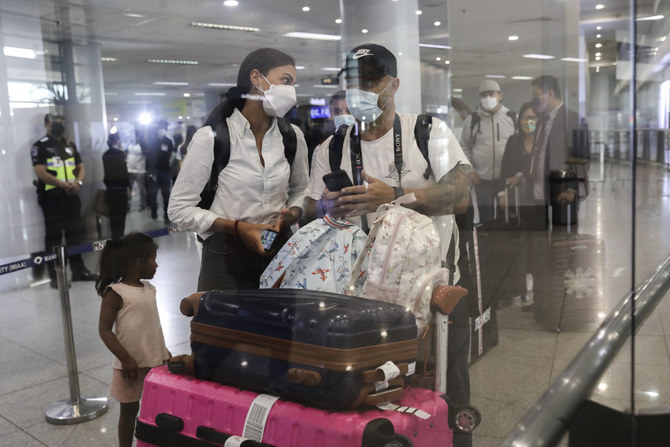
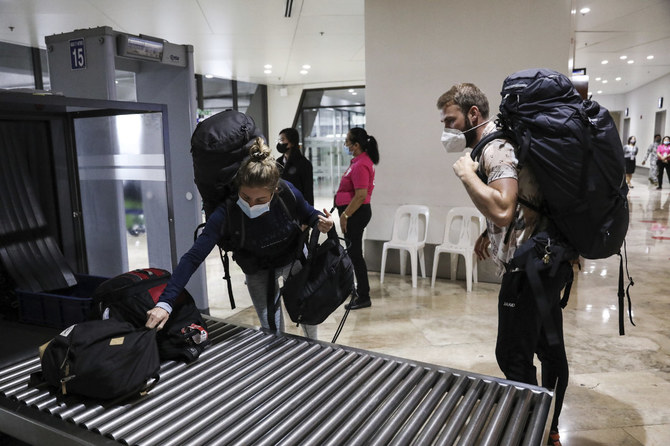
Foreign passengers queue as they arrive at Manila's international airport in the Philippines on Feb. 10, 2022. (AP Photo/Basilio Sepe)
2 / 2
Foreign passengers queue as they arrive at Manila's international airport in the Philippines on Feb. 10, 2022. (AP Photo/Basilio Sepe)
Short Url
Updated 10 February 2022
Follow

Philippines welcomes international visitors after two years of closures

  • Before the pandemic, tourism contributed nearly 13 percent of the country’s GDP
  • Number foreign arrivals expected to be about 12,000 a day in the coming months

MANILA: The Philippines reopened to fully vaccinated, COVID-negative foreign tourists on Thursday, after nearly two years of pandemic border closures.

Home to white sand beaches, famous diving spots, lively entertainment, cultural heritage and wildlife, the Philippines is dependent on tourism. When COVID-19 hit in 2020, most of the country’s tourism destinations were forced to shut.

But two years into the pandemic, the Southeast Asian nation has been largely successful in containing the local spread of the virus with lockdowns and vaccinations. It had planned to reopen in December, but the decision was postponed as the authorities decided to wait and see how the situation developed worldwide after the emergence of the omicron variant.

“We are happy, all stakeholders, that we are opening today,” Tourism Secretary Bernadette Romula-Puyat told reporters.

FASTFACTS

  • Before the pandemic, tourism contributed nearly 13 percent of the country’s GDP.
  • Number foreign arrivals expected to be about 12,000 a day in the coming months.

“We hope that this continues so that we get more jobs for our countrymen,” she said, adding that 1.1 million tourism workers in the country had lost their jobs during the pandemic and the reopening will have a huge impact on the country’s economic recovery.

Before the pandemic, in 2019, tourism contributed nearly 13 percent of the country’s gross domestic product, generating 2.51 trillion pesos ($50 billion), according to Philippine Statistics Authority data. In 2020, revenues from tourism plummeted to 973 billion pesos, with foreign arrivals slumping 82 percent.

The first flight with foreign tourists to reach Manila International Airport on Thursday arrived from Vancouver, Canada. Other flights came from the US, Singapore, Thailand, Indonesia, Malaysia, Bahrain and China.

A third of the nearly 11,500 passengers scheduled to arrive in the Philippines that day were foreigners, while the majority were returning Filipinos, according to Bureau of Immigration estimates.

It said it expects the number of foreign arrivals to be about 12,000 a day in the coming months.

Immigration Commissioner Jaime Morente said in a statement: “We see this as the start of the recovery of the tourism industry which we hope will renew its vigor as in the previous years.”

Visitors arriving in the Philippines must present proof of being fully vaccinated against COVID-19, a negative result of a PCR test taken within 48 hours before departure, and travel insurance for COVID-19 treatment costs, with a minimum coverage of $35,000 for the duration of their stay in the Philippines.


US talks with hard-line Venezuelan minister Cabello began months before raid

Updated 11 sec ago
Follow

US talks with hard-line Venezuelan minister Cabello began months before raid

NEW YORK/MIAMI/WASHINGTON: Trump administration officials had been in discussions with Venezuela’s hard-line interior minister Diosdado Cabello months before the US operation to seize President Nicolas Maduro, and have been in communication with him since then, according to multiple people familiar with the matter.
The officials warned Cabello, 62, against using the security services or militant ​ruling-party supporters he oversees to target the country’s opposition, four sources said. That security apparatus, which includes the intelligence services, police and the armed forces, remains largely intact after the January 3 US raid.
Cabello is named in the same US drug-trafficking indictment that the Trump administration used as justification to arrest Maduro, but was not taken as part of the operation.
The communication with Cabello, which has also touched on sanctions the US has imposed on him and the indictment he faces, dates back to the early days of the current Trump administration and continued in the weeks just prior to the US ouster of Maduro, two sources familiar with the discussions said. The administration has also been in touch with Cabello since Maduro’s ouster, four of the people said.
The communications, which have not been previously reported, are critical to the Trump administration’s efforts to control the situation inside Venezuela. If Cabello decides to unleash the forces that he controls, it ‌could foment the kind ‌of chaos that Trump wants to avoid and threaten interim President Delcy Rodriguez’s grip on power, according ‌to ⁠a source ​briefed on ‌US concerns.
It is not clear if the Trump administration’s discussions with Cabello extended to questions about the future governance of Venezuela. Also unclear is whether Cabello has heeded the US warnings. He has publicly pledged unity with Rodriguez, whom Trump has so far praised.
While Rodriguez has been seen by the US as the linchpin for US President Donald Trump’s strategy for post-Maduro Venezuela, Cabello is widely believed to have the power to keep those plans on track or upend them.
The Venezuelan minister has been in contact with the Trump administration both directly and via intermediaries, one person familiar with the conversations said.
All of the sources were granted anonymity to speak freely about sensitive internal government communications with Cabello.
The White House and the government of Venezuela did not immediately respond to requests for comment.

CABELLO HAS BEEN MADURO LOYALIST
Cabello has long been seen ⁠as Venezuela’s second most powerful figure. A close aide of late former President Hugo Chavez, Maduro’s mentor, he went on to become a long-time Maduro loyalist, feared as his main enforcer of repression. Rodriguez and Cabello have ‌both operated at the heart of the government, legislature and ruling socialist party for years, but ‍have never been considered close allies of each other.
A former military officer, ‍Cabello has exerted influence over the country’s military and civilian counterintelligence agencies, which conduct widespread domestic espionage. He has also been closely associated with pro-government militias, notably ‍the colectivos, groups of motorcycle-riding armed civilians who have been deployed to attack protesters.
Cabello is one of a handful of Maduro loyalists Washington has relied on as temporary rulers to maintain stability while it accesses the OPEC nation’s oil reserves during an unspecified transition period.
But US officials are concerned that Cabello — given his record of repression and a history of rivalry with Rodriguez — could play the spoiler, according to a source briefed on the administration’s thinking.
Rodriguez has been working to consolidate her own power, installing loyalists in key positions ​to protect herself from internal threats while meeting US demands to boost oil production, Reuters interviews with sources in Venezuela have shown.
Elliott Abrams, who served as Trump’s special representative on Venezuela in his first term, said many Venezuelans would expect Cabello to be removed ⁠at some point if a democratic transition is to advance.
“If and when he goes, Venezuelans will know that the regime has really begun to change,” said Abrams, now at the Council on Foreign Relations think tank.

US SANCTIONS AND INDICTMENT
Cabello has long been under US sanctions for alleged drug trafficking.
In 2020, the US issued a $10 million bounty for Cabello and indicted him as a key figure in the “Cartel de los Soles,” a group the US has said is a Venezuelan drug-trafficking network led by members of the country’s government.
The US has since raised the award to $25 million. Cabello has publicly denied any links to drug trafficking.
In the hours after Maduro’s ouster, some analysts and politicians in Washington questioned why the US didn’t also grab Cabello — listed second in the Department of Justice indictment of Maduro.
“I know that just Diosdado is probably worse than Maduro and worse than Delcy,” Republican US Representative Maria Elvira Salazar said in an interview with CBS’s “Face the Nation” on January 11.
In the days following, Cabello denounced American intervention in the country, saying in a speech that “Venezuela will not surrender.”
But media reports of residents being searched at checkpoints — sometimes by uniformed members of the security forces and sometimes by people in plain clothes — have become less frequent in recent days.
And both Trump and the Venezuelan government have said many detainees who are considered ‌by the opposition and rights groups to be political prisoners will be released.
The government has said that Cabello, in his role as interior minister, is overseeing that effort. Rights groups say the liberations are proceeding extremely slowly and hundreds remain unjustly detained.