NEW DELHI: A court in a southern Indian state told students on Thursday not to wear any religious clothing until it delivers a verdict on petitions seeking to overturn a ban on hijabs, headscarves used by Muslim women.
The court in Karnataka state is considering petitions filed by students challenging a ban on hijabs that some schools have implemented in recent weeks.
“We will pass an order. But till the matter is resolved, no student should insist on wearing religious dress,” the Press Trust of India news agency quoted Chief Justice Ritu Raj Awasthi as saying.
The court also directed the state to reopen schools and colleges which the chief minister had shut for three days as protests over the ban escalated earlier this week.
The issue grabbed headlines last month when a government-run school in Karnataka’s Udupi district barred students wearing hijabs from entering classrooms, triggering protests outside the school gate. More schools in the state followed with similar bans, forcing the state’s top court to intervene.
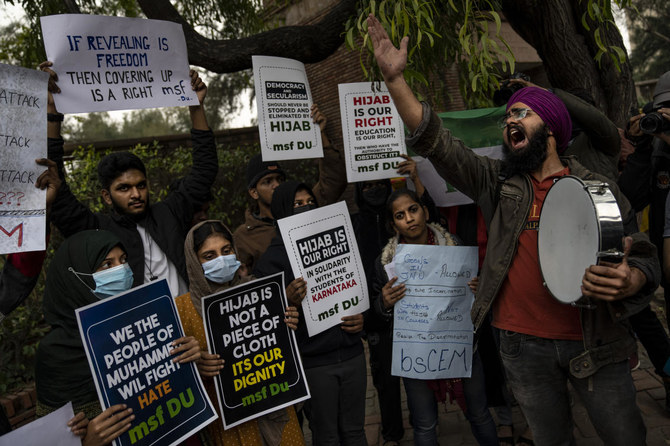
The uneasy standoff has raised fears among Muslim students who say they are being deprived of their religious rights in the Hindu-majority nation. On Monday, hundreds of students and parents took to the streets to protest the restriction.
The dispute in Karnataka has set off protests elsewhere in India. A number of demonstrators were detained in the capital, New Delhi, on Thursday, and students and activists have also marched in cities including Hyderabad and Kolkata in recent days.
It also captured attention in neighboring Muslim-majority Pakistan. “Depriving Muslim girls of an education is a grave violation of fundamental human rights,” its foreign minister, Shah Mahmood Qureshi, tweeted on Wednesday, calling the situation “absolutely oppressive.”
Nobel Peace Prize laureate and education activist Malala Yousafzai also condemned the ban. “Refusing to let girls to go to school in their hijabs is horrifying,” the 24-year-old Pakistani human rights campaigner tweeted.
For many Muslim women, the hijab is part of their faith and a way to maintain modesty. It has been a source of controversy for decades in some Western countries, particularly in France, which in 2004 banned them from being worn in public schools.
In India, where Muslims make up about 14 percent of the country’s almost 1.4 billion people, they are not banned or restricted in public places and are a common sight.
Some rights activists have voiced concerns that the bans could increase Islamophobia. Violence and hate speech against Muslims have increased under Prime Minister Narendra Modi’s governing Hindu nationalist party, which also governs Karnataka state.


India court: No religious clothes until hijab row settled
https://arab.news/zjeaz
India court: No religious clothes until hijab row settled

- The court in Karnataka state is considering petitions filed by students challenging a ban on hijabs
- The uneasy standoff has raised fears among Muslim students who say they are being deprived of their religious rights in the Hindu-majority nation


SpaceX acquires xAI in record-setting deal as Musk looks to unify AI and space ambitions
- The deal is the biggest M&A transaction of all time
- Deal values xAI at $250 billion, SpaceX at $1 trillion
Elon Musk said on Monday that SpaceX has acquired his artificial-intelligence startup xAI in a record-setting deal that unifies Musk’s AI and space ambitions by combining the rocket-and-satellite company with the maker of the Grok chatbot. The deal, first reported by Reuters last week, represents one of the most ambitious tie-ups in the technology sector yet, combining a space-and-defense contractor with a fast-growing AI developer whose costs are largely driven by chips, data centers and energy. It could also bolster SpaceX’s data-center ambitions as Musk competes with rivals like Alphabet’s Google, Meta, Amazon-backed Anthropic and OpenAI in the AI sector.
The transaction values SpaceX at $1 trillion, and xAI at $250 billion, according to a person familiar with the matter.
“This marks not just the next chapter, but the next book in SpaceX and xAI’s mission: scaling to make a sentient sun to understand the Universe and extend the light of consciousness to the stars!” Musk said. The purchase of xAI sets a new record for the world’s largest M&A deal, a distinction held for more than 25 years when Vodafone bought Germany’s Mannesmann in a hostile takeover valued at $203 billion in 2000, according to data compiled by LSEG. The combined company of SpaceX and xAI is expected to price shares at about $527 each, another person familiar with the matter said. SpaceX was already the world’s most valuable privately held company, last valued at $800 billion in a recent insider share sale. XAI was last valued at $230 billion in November, according to the Wall Street Journal. The merger comes as the space company plans a blockbuster public offering this year that could value it at over $1.5 trillion, two people familiar with the matter said.
SpaceX, xAI and Musk did not immediately respond to requests for comment.
The deal further consolidates Musk’s far-flung business empire and fortunes into a tighter, mutually reinforcing ecosystem – what some investors and analysts informally call the “Muskonomy” – which already includes Tesla, brain-chip maker Neuralink and tunnel firm the Boring Company. The world’s richest man has a history of merging his ventures together. Musk folded social media platform X into xAI through a share swap last year, giving the AI startup access to the platform’s data and distribution. In 2016, he used Tesla’s stock to buy his solar-energy company SolarCity.
The agreement could draw scrutiny from regulators and investors over governance, valuation and conflicts of interest given Musk’s overlapping leadership roles across multiple firms, as well as the potential movement of engineers, proprietary technology and contracts between entities.
SpaceX also holds billions of dollars in federal contracts with NASA, the Department of Defense and intelligence agencies, which all have some authority to review M&A transactions for national security and other risks.


