

Pakistani lawmakers seek to decriminalize attempted suicide to save lives, abolish stigma

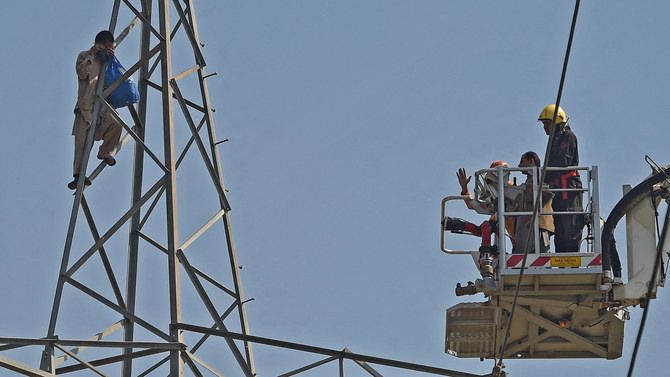
Pakistani rescuers, right, engage with a man who climbed a high tension pylon to commit suicide attempt as a protest for not receiving justice over the murder of his father, in Islamabad on March 9, 2018. (AFP/File)
Short Url
Updated 11 February 2022
Follow

Pakistani lawmakers seek to decriminalize attempted suicide to save lives, abolish stigma

  • Survivor of a suicide attempt can face a year in prison along with a financial penalty under the country’s existing law
  • The World Health Organization maintains about 24 million people need psychiatric assistance in Pakistan

ISLAMABAD: Pakistan’s parliament is all set to repeal a law that treats attempted suicide as a criminal offence to save lives and abolish the stigma associated with the act, said a mover of the proposed legislation on Thursday.

Section 325 of the British-era Pakistan Penal Code says a person will face imprisonment for a year or financial penalty or both for trying to commit suicide.

Senator Shahadat Awan of the opposition Pakistan Peoples Party (PPP) moved the bill in the upper house of parliament last year to repeal the law. Last week, a parliamentary committee unanimously passed the bill which would now be tabled in the Senate and National Assembly for a vote.

“This is an inhuman colonial-era law which must be repealed to save precious lives and abolish a stigma attached to it,” Awan told Arab News on Thursday.

He noted the law was implemented in a country where, according to the World Health Organization (WHO), mental disorders accounted for more than four percent of the total disease burden.

It is estimated that 24 million people in Pakistan are in need of psychiatric assistance. However, the country’s resources for screening and treatment of mental health disorders are not enough to meet its growing needs.

WHO maintains Pakistan has one of the lowest number of psychiatrists in the world, adding there are only about 0.19 therapists per 100,000 of its inhabitants.

“We need to realize that someone who attempts to commit suicide must be suffering from depression, mental illness or disorder,” Awan continued.

“The issue of suicide needs to be dealt with as a disease and should be treated as such,” he said while arguing that the existing law jeopardized lives of those who survive an attempt.

The PPP senator said the law made it mandatory for a medical facility to inform the police about an attempted suicide before treating and saving life of the individual concerned.

“Police later arrest such people and charge them for the offence,” he said. “This is a social stigma that needs to be done away.”

The World Health Organization Comprehensive Mental Health Action Plan (2021-2030) also calls for the decriminalization of attempted suicide. Such instances are still counted as crime in at least 25 countries across the world including Pakistan.

Dr. Wajahat Khan, a psychiatrist, said that every second or third person out of ten in Pakistan was suffering from some kind of mental or emotional issue that should be addressed without further complications.

“Financial crisis, family issues and unhealthy lifestyle are some of the major reasons behind the deterioration of mental health of our people,” he told Arab News.

Khan said issues like anxiety, depression and stress could be treated with therapy, medicines and family support of a patient.

“Unfortunate, mental health issues are still considered a taboo subject in Pakistan,” he added. “Many people shy away from going to clinics for check-up due to social stigma associated with them.”


Pakistan’s president defends ongoing strikes in Afghanistan, urges Kabul to dismantle militants

Updated 02 March 2026
Follow

Pakistan’s president defends ongoing strikes in Afghanistan, urges Kabul to dismantle militants

  • Afghanistan on Thursday launched attacks in retaliation for Pakistani airstrikes the previous Sunday
  • Pakistan’s military says it is only targeting Afghan military installations to avoid civilian casualties

ISLAMABAD: Pakistan’s president on Monday defended his country’s ongoing military strikes in neighboring Afghanistan, saying Islamabad tried all forms of diplomacy before targeting militants operating from Afghan territory, and called on the Taliban government in Kabul to disarm groups responsible for attacks in Pakistan.

Pakistan earlier said it is in “open war” with Afghanistan, alarming the international community. The border area remains a stronghold for militant organizations including Al-Qaeda and the Daesh (Islamic State) group.

“(The Afghan Taliban) must choose to dismantle the terror groups that survive on conflict and its war economy,” Asif Ali Zardari said during a speech to lawmakers, adding that “no state accepts serial attacks on its soil.”

Afghanistan on Thursday launched attacks in retaliation for Pakistani airstrikes the previous Sunday. Since then, Pakistan has carried out operations along the border, with Information Minister Attaullah Tarar claiming the killing of 435 Afghan forces and the capture of 31 Afghan positions.

Kabul has denied such claims.

In Afghanistan, the deputy government spokesman Hamdullah Fitrat said Pakistan’s military fired mortar shells at a refugee camp in eastern Kunar province, killing three children and injuring three others.

Afghanistan’s defense ministry said Afghan forces carried out strikes targeting a Pakistani military facility near Paktia province, causing “substantial losses and heavy casualties.”

Pakistan’s military did not respond to questions. It has said Pakistan is only targeting Afghan military installations to avoid civilian casualties.

Pakistan has witnessed a surge of violence in recent months and blames it on the outlawed Pakistani Taliban, known as Tehreek-e-Taliban Pakistan or TTP. It operates both inside Pakistan and from Afghan territory.
Islamabad accuses Afghanistan’s Taliban government of providing safe havens for the TTP, which Kabul denies.

The latest cross-border fighting ended a ceasefire brokered by Qatar and Turkiye in October. The two sides failed to reach a permanent agreement during talks in Istanbul.

Zardari reiterated Pakistan’s call for talks, saying, “We have never walked away from dialogue.”

The Pakistani leader again accused Afghanistan of acting as a proxy for India by sheltering militant groups.

“Stop being used by another country as a battlefield for their ambitions,” he said.

Zardari cited a recent report from the United Nations Security Council’s monitoring team that described the presence of militant groups in Afghanistan as an extra-regional threat.