

In twist in Noor Mukadam murder case, prime suspect Zahir Jaffer pleads not guilty

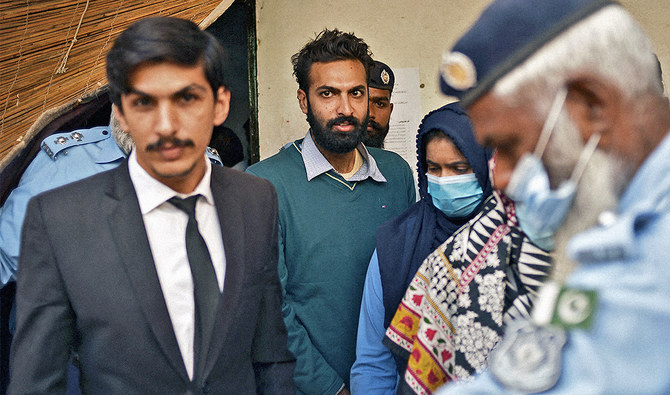
Policemen escort Zahir Jaffer (C), a Pakistani-American man who went on trial accused of raping and beheading Noor Mukadam, after his court hearing in Islamabad, Pakistan, on October 20, 2021. (AFP/File)
Short Url
Updated 10 February 2022
Follow

In twist in Noor Mukadam murder case, prime suspect Zahir Jaffer pleads not guilty

  • Jaffer says someone killed the victim at a “drug party” held at his house and arranged by the deceased woman
  • Noor Mukadam, the daughter of a former diplomat, was found beheaded at Jaffer’s Islamabad house on July 20

ISLAMABAD: Zahir Jaffer, a prime suspect in last year’s grisly murder of 27-year-old Noor Mukadam, on Wednesday pleaded not guilty to the killing, saying he was innocent and wrongly implicated in the case.

Mukadam, a former Pakistani diplomat’s daughter, was found beheaded in Islamabad’s upscale F-7/4 neighborhood in July last year. The murder sparked public outrage and grabbed media attention unlike any other recent crime against women. Jaffer was arrested from the crime scene, his residence, on the day of the murder and has since been in custody. 

Others charged in the case include Jaffer’s parents, Zakir Jaffer and Asmat Adamjee, their three household staff, Iftikhar, Jan Muhammad and Jameel, and six employees of Therapy Works, a counseling center from where Jaffer had received certification to become a therapist and where he had been receiving treatment in the weeks leading up to the murder.

The trial for the case is now in the concluding stage at Islamabad’s district court, where additional sessions judge Atta Rabbani has been conducting the hearings. 

At Wednesday’s hearing, the judge handed over a questionnaire to all the accused in the case to give  written responses to the allegations against them. He also gave the accused the opportunity to defend themselves against the charges presented by the prosecution.

“I am innocent,” Jaffer pleaded. “My parents and I are being implicated in this case because the unfortunate incident took place at my home.”

At an indictment hearing in October last year, Jaffer had pleaded guilty to the crime, telling the court: “I accept I have committed this crime, now it’s up to you to punish or forgive me … We quarreled, and we both were angry, and this all happened.”

On Wednesday, however, Jaffer’s counsel Usman Gill informed the court that Mukadam had arranged a “drug party” at Jaffer’s residence on July 20 as his parents were away in Karachi.

Mukadam and Jaffer, along with their other friends, consumed drugs, he added.

“I was not in my senses due to the overuse of drugs,” Jaffer said. “When my senses came back, I found myself tied up in the lounge of my house.”

“I found out later that somebody in the drug party or someone else had killed Noor Mukadam,” he said. Jaffer also said he was “rescued” from the crime scene by some uniformed police officials. 

He said the plaintiff of the case, Shaukat Mukadam, the victim’s father, was an influential person who had managed to falsely implicate him in the murder of his daughter with the help of police.

Jaffer also requested the judge to allow him to present evidence to prove his innocence in the court.

Explaining his association with Mukadam, he said he had a “living relationship” with the victim and their families knew each other for a long time.

“I didn't have any contact with Noor Mukadam for the last six months,” Jaffer said. “She came to my residence on July 18 on her own and asked me to arrange a drug party but I refused.”

He said that she invited her friends to his place for the gathering as well.

Jaffer said the victim carried “a huge quantity” of drugs to his house, adding that his flight to the US was booked on July 19, though Mukadam insisted he should cancel it since she also wanted to go with him.

He said that she contacted her friends to arrange the money to book the flight.

To a question about a DNA report regarding her rape, he said the report came positive since “we were in a relationship with mutual consent.”

Earlier, all other accused including Jaffer’s household staff submitted their statements in the court and pleaded not guilty to the crime.

The court will now resume the hearing on February 14.


Pakistan, global crypto exchange discuss modernizing digital payments, creating job prospects 

Updated 05 December 2025
Follow

Pakistan, global crypto exchange discuss modernizing digital payments, creating job prospects 

  • Pakistani officials, Binance team discuss coordination between Islamabad, local banks and global exchanges
  • Pakistan has attempted to tap into growing crypto market to curb illicit transactions, improve oversight

ISLAMABAD: Pakistan’s finance officials and the team of a global cryptocurrency exchange on Friday held discussions aimed at modernizing the country’s digital payments system and building local talent pipelines to meet rising demand for blockchain and Web3 skills, the finance ministry said.

The development took place during a high-level meeting between Finance Minister Muhammad Aurangzeb, Pakistan Virtual Assets Regulatory Authority (PVARA) Chairman Bilal bin Saqib, domestic bank presidents and a Binance team led by Global CEO Richard Teng. The meeting was held to advance work on Pakistan’s National Digital Asset Framework, a regulatory setup to govern Pakistan’s digital assets.

Pakistan has been moving to regulate its fast-growing crypto and digital assets market by bringing virtual asset service providers (VASPs) under a formal licensing regime. Officials say the push is aimed at curbing illicit transactions, improving oversight, and encouraging innovation in blockchain-based financial services.

“Participants reviewed opportunities to modernize Pakistan’s digital payments landscape, noting that blockchain-based systems could significantly reduce costs from the country’s $38 billion annual remittance flows,” the finance ministry said in a statement. 

“Discussions also emphasized building local talent pipelines to meet rising global demand for blockchain and Web3 skills, creating high-value employment prospects for Pakistani youth.”

Blockchain is a type of digital database that is shared, transparent and tamper-resistant. Instead of being stored on one computer, the data is kept on a distributed network of computers, making it very hard to alter or hack.

Web3 refers to the next generation of the Internet built using blockchain, focusing on giving users more control over their data, identity and digital assets rather than big tech companies controlling it.

Participants of the meeting also discussed sovereign debt tokenization, which is the process of converting a country’s debt such as government bonds, into digital tokens on a blockchain, the ministry said. 

Aurangzeb called for close coordination between the government, domestic banks and global exchanges to modernize Pakistan’s payment landscape.

Participants of the meeting also discussed considering a “time-bound amnesty” to encourage users to move assets onto regulated platforms, stressing the need for stronger verifications and a risk-mitigation system.

Pakistan has attempted in recent months to tap into the country’s growing crypto market, crack down on money laundering and terror financing, and promote responsible innovation — a move analysts say could bring an estimated $25 billion in virtual assets into the tax net.

In September, Islamabad invited international crypto exchanges and other VASPs to apply for licenses to operate in the country, a step aimed at formalizing and regulating its fast-growing digital market.