

Pakistani police investigate case of woman with nail hammered into head to ‘guarantee’ male child

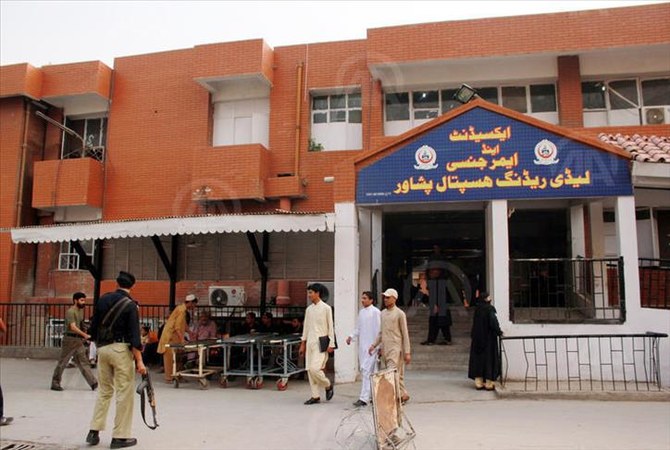
This undated photo shows emergency ward of the Lady Reading Hospital in Peshawar, Pakistan.  (Photo courtesy: Social Media)
Short Url
Updated 10 February 2022
Follow

Pakistani police investigate case of woman with nail hammered into head to ‘guarantee’ male child

  • The woman was treated at a medical facility whose staff did not maintain any record of the surgery along with the victim’s address
  • Police have traced the vehicle in which the woman arrived at the hospital after the nail was allegedly hammered on a faith healer’s instruction

PESHAWAR: Police in the northwestern Pakistani city of Peshawar said on Wednesday they were investigating the case of a woman that hospital officials say came in for surgery four days ago with a nail hammered into her head, allegedly on the instructions of a faith healer who said it would guarantee she gave birth to a boy.

Officials of the law enforcement agency decided to probe the incident after pictures of a woman’s bleeding forehead went viral on social media along with an x-ray image showing a nail in her head.

The woman was treated at the Lady Reading Hospital, the city’s largest medical facility, though its staff did not maintain a record of the surgery or note down the victim’s address.

Arab News could not independently verify if the nail had been hammered on the instructions of a faith healer or if this was some other matter, including of domestic violence.

However, police said on Wednesday it had constituted an investigation team that had traced the autorickshaw in which the woman arrived at the hospital to receive medical treatment.

“After examining the footage of 350 CCTV cameras, our team managed to identify the rickshaw in which the woman along with a man arrived at the Lady Reading Hospital for treatment. I am sure we will get to the bottom of this very soon,” Senior Superintendent Police (SSP) Haroon Rashid Khan told Arab News.

He said the hospital had no record of the woman, adding its management should have immediately reported the case to the police.

He did not say, however, if any legal action would be taken against the medical crew that was on duty when the woman arrived at the hospital.

Muhammad Asim, the spokesperson of the medical facility, confirmed the hospital had not kept any record of the case, though he maintained the woman was rushed to the operation theater soon after her arrival since she required urgent treatment.

“Unfortunately, we do not have her record and the staff on duty did not make an entry,” he continued. “She underwent a surgery and was allowed to go immediately.”

Huma Khan, member of the provincial commission on the status of women and a rights activist, said the tragic case reflected how Pakistani women were frequently subjected to physical and psychological violence.

“Strict action must be taken against this patriarchal mindset,” she said. “The KP Commission on the Status of Women and the Women Parliamentary Caucus should consider this incident as a test case and deal with it.”

A senior surgeon at the medical facility said on condition of anonymity it was “sheer negligence” on part of the hospital that it had not kept the record of this particular case.

Dr. Haider Suleman, the neurosurgeon who is said to have operated on the woman, declined to comment on the case, saying the media should reach out the hospital spokesman instead.


Pakistan top military commander urges ‘multi-domain preparedness’ amid evolving security threats

Updated 23 December 2025
Follow

Pakistan top military commander urges ‘multi-domain preparedness’ amid evolving security threats

  • Asim Munir says Pakistan faces layered challenges spanning conventional, cyber, economic and information domains
  • His comments come against the backdrop of tensions with India, ongoing militant violence in western border regions

ISLAMABAD: Pakistan’s top military commander Field Marshal Asim Munir on Tuesday stressed the need for “multi-domain preparedness” to counter a broad spectrum of security challenges facing the country, saying they ranged from conventional military threats to cyber, economic and information warfare.

Pakistan’s security environment has remained volatile following a brief but intense conflict with India earlier this year, when the two nuclear-armed neighbors exchanged missile and artillery fire while deploying drones and fighter jets over four days before a ceasefire was brokered by the United States.

Pakistan has also been battling militant violence in its western provinces of Khyber Pakhtunkhwa and Balochistan, where authorities say armed groups operate from across the border in Afghanistan and receive backing from India. Both Kabul and New Delhi have rejected claims.

The military has also warned that disinformation constitutes a new form of security threat, prompting tighter regulations that critics say risk suppressing dissent. Munir also pointed to a “complex and evolving” global, regional and internal security landscape while addressing participants in the National Security and War Course at the National Defense University (NDU).

“These challenges span conventional, sub-conventional, intelligence, cyber, information, military, economic and other domains, requiring comprehensive multi-domain preparedness, continuous adaptation and synergy among all elements of national power,” he said, according to a military statement.

“Hostile elements increasingly employ indirect and ambiguous approaches, including the use of proxies to exploit internal fault lines, rather than overt confrontation,” he continued, adding that future leaders must be trained and remain alert to recognize, anticipate and counter these multi-layered challenges.

Munir also lauded the NDU for producing strategic thinkers who he said were capable of translating rigorous training and academic insight into effective policy formulation and operational outcomes.