Pakistan, Saudi Arabia begin two-month long joint exercise in Multan 

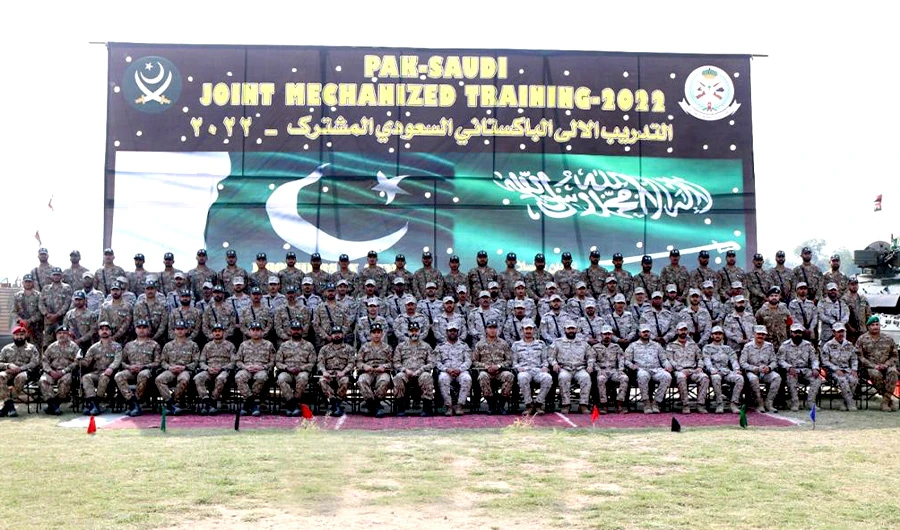
A group photo of Pakistani and Saudi soldiers taking part in Pak-Saudi joint military exercises in Multan on Feb 9, 2022. (ISPR)
Short Url
Updated 09 February 2022
Follow

Pakistan, Saudi Arabia begin two-month long joint exercise in Multan 

  • Joint training is aimed at strengthening and sharing of knowledge through a comprehensive training program
  • Two countries have strong defense ties and Pakistan regularly trains Saudi officers and soldiers

ISLAMABAD: Pakistan and Saudi Arabia launched a two-month-long joint military exercise in the Pakistani city of Multan, the Pakistan army’s media wing said on Tuesday, part of a longstanding defense cooperation deal between the two countries.
Pakistan regularly trains Saudi officers and soldiers. In September last year, Saudi and Pakistani forces conducted the joint Naseem Al-Bahr 13 naval exercise in the Arabian Sea near Karachi, with Saudi F-15 aircraft participating in a missile firing drill for the first time.
“To enhance and strengthen the existing military cooperation between Pakistan Army and Royal Saudi Land Forces (RSLF), a contingent of Royal Saudi Land Forces arrived for Joint Mechanized Training in Multan Garrison,” the Pakistan army said in a statement, saying the program would go on for two months.

“The joint training is aimed at strengthening and sharing of knowledge through a comprehensive training program,” the statement said. “Drills and procedures will be practiced and tactical exercises conducted to refine the same.”
Earlier this week, Saudi Interior Minister Prince Abdulaziz bin Saud bin Naif visited Islamabad and in a meeting with Pakistani counterpart Sheikh Rashid Ahmed agreed to enhance cooperation to counter the security challenges.
“Both sides discussed hosts of issues including regional security situation and enhancing cooperation and coordination between the ministries of two countries to meet the security challenges confronting Pakistan and Saudi Arabia,” a statement from the Interior Ministry read.

Pakistan approves $713 million to ease power sector’s cash flow constraints

Updated 5 sec ago
Follow

Pakistan approves $713 million to ease power sector’s cash flow constraints

  • Finance minister chairs Economic Coordination Committee meeting to approve grants, review economic situation
  • Pakistan is grappling with a ballooning “circular debt,” or unpaid bills and subsidies, that has choked its power sector

KARACHI: Pakistan’s top economic body this week approved a grant of $713 million to ease the power sector’s cash flow constraints, the Finance Division said in a statement, as Islamabad looks to reform its priority sectors. 

The development took place as Finance Minister Muhammad Aurangzeb chaired a meeting of the Economic Coordination Committee (ECC) to approve grants for various projects and review the overall economic situation of the country. 

“[ECC approved] another Technical Supplementary Grant amounting to Rs200 billion ($713 million) under the head of Government of Pakistan investment in DISCOs’ equity to address cash flow constraints in the power sector,” the Finance Division said on Thursday. 

DISCOs, which handle billing, recoveries and grid maintenance, have long suffered from corruption and political interference. 

Pakistan has attempted to privatize its loss-making state-owned enterprises to raise funds and reform them as envisaged under a $7 billion International Monetary Fund (IMF) program secured last year. 

Prime Minister Shehbaz Sharif’s government plans to privatize three DISCOs, the Islamabad Electric Supply Company (IESCO), Faisalabad Electric Supply Company (FESCO) and Gujranwala Electric Power Company (GEPCO) in the months ahead. 

The Pakistani government, which owns or controls much of the power infrastructure, is grappling with a ballooning “circular debt,” or unpaid bills and subsidies, that has choked the power sector and weighed on the economy.

The liquidity crunch has disrupted supply, discouraged investment and added to fiscal pressure, making it a key focus under Pakistan’s IMF program.

The ECC also approved, on the interior ministry’s proposal, a provision of Rs 4.775 billion [$17.19 million] as payment to 945 families of “missing persons” as identified by the Commission of Inquiry on Enforced Disappearances. 

“The disbursement will be made under the supervision of the Commission in accordance with approved procedures,” it added. 

Taking stock of the economic situation, the ECC noted that cumulative inflation for the period July–November averaged 5 percent, which it said was “significantly lower” than the 7.9 percent figure recorded during the corresponding period of the previous year. 

It attributed this improvement to prudent fiscal management, effective price stabilization measures and close market monitoring by the government.