NEW YORK: A former New York Times editorial page editor was put on the defensive on Tuesday in Sarah Palin’s defamation trial against the newspaper over a 2017 editorial.
The editorial incorrectly linked the former Republican vice presidential candidate and Alaska governor to an earlier mass shooting in Arizona.
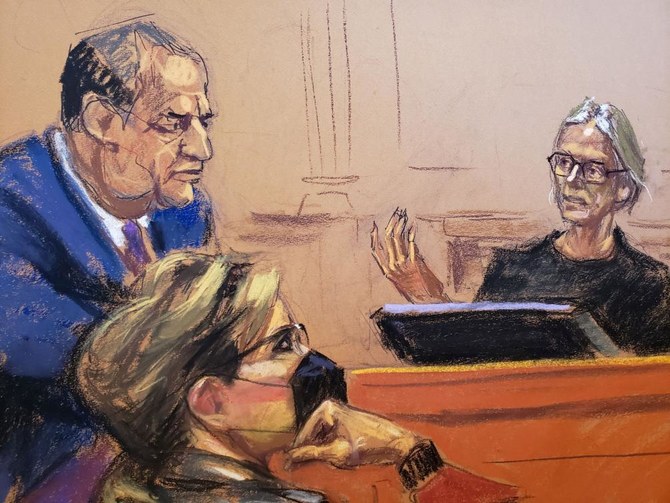
James Bennet, the former editor, testified during the trial’s fourth day that he relied upon research done by colleagues before adding language to a draft editorial that suggested Palin’s political action committee might have incited the 2011 Arizona shooting.
Six people died and former US congresswoman Gabby Giffords was seriously wounded in that shooting.
The June 14, 2017, editorial about gun control and the decline of political discourse followed a shooting at a baseball practice in Virginia in which Steve Scalize, a member of the House of Representatives’ Republican leadership, was wounded.
“I was really concerned ... that something like this didn’t seem like such a big deal anymore,” Bennet told Palin’s lawyer Shane Vogt in Manhattan federal court. “It seemed like a huge deal that several Republican congressmen had been shot, and I did want to get our readers’ attention to that.”
The trial is a test of legal protections that have long safeguarded US media from defamation claims by public figures.
Palin’s lawyers have accused the Times of trying to falsely smear her, and questioned other Times journalists about the newspaper’s writing and editing procedures.
Palin, 57, has signaled that if she lost at trial she would use an appeal to challenge the landmark 1964 US Supreme Court decision in a case called New York Times v Sullivan.
She is trying to prove that Bennet and the Times acted with “actual malice,” https://www.reuters.com/article/uk-new-york-times-palin-idUKKBN25O31B a high standard adopted in the Sullivan decision, meaning they knew the editorial was false or had reckless disregard for the truth.
Bennet is the highest-level Times journalist expected to testify.
In the disputed editorial, Bennet referenced the circulation by Palin’s political action committee before the Giffords shooting of a map putting the congresswoman and 19 other Democrats under cross hairs, and wrote that “the link to political incitement was clear.”
In a subsequent correction, the Times said there was no such link. “We got an important fact wrong,” the Times wrote on Twitter.
Bennet said he added the disputed material to a draft prepared by Elizabeth Williamson, then a member of the newspaper’s editorial board. Williamson testified last week.
Bennet also said he had no independent recollection of whether he had read some background material that colleagues had sent him prior to publication that might have alerted him to the error.
“It’s so hard, Mr. Vogt, for me to tell now what I knew at the time, what I’ve learned since, and I’m sorry, I’ve kind of mixed that stuff up,” Bennet said.
Bennet has said he intended no harm to Palin, and that he thought the editorial was correct when published.
Linda Cohn, a retired Times editor, testified earlier on Tuesday that she never heard Bennet discussing Palin negatively, and that he appeared surprised to learn people were upset with the editorial’s wording.
“There was a general sense of ‘oh no,’” she said.
Palin was the Republican 2008 vice presidential nominee and served as Alaska governor from 2006 to 2009.


![]()

New York Times editor on defensive at Sarah Palin defamation trial
Short Url
https://arab.news/5s38z
New York Times editor on defensive at Sarah Palin defamation trial
- James Bennet, the former editor, testified during the trial's fourth day that he relied upon research done by colleagues
- "I was really concerned ... that something like this didn't seem like such a big deal any more," Bennet told Palin's lawyer Shane Vogt in Manhattan federal court


Latest updates


© 2026 SAUDI RESEARCH & PUBLISHING COMPANY, All Rights Reserved And subject to Terms of Use Agreement.