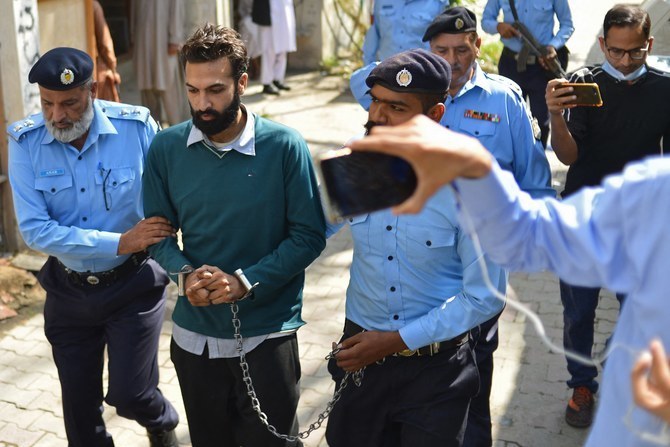
ISLAMABAD: A local court in Islamabad on Monday issued a short order and rejected three separate applications filed by prime suspect Zahir Jaffer in the Noor Mukadam murder case, as the prosecution described his written submissions as delaying tactics.
Filed by Jaffer’s counsel during the last hearing, the first application demanded action against the Islamabad police chief for issuing a press release about one of the previous court hearings. The second application sought action against the investigation officer for allegedly drawing a flawed map of the crime scene, and the third one wanted to determine the ownership of a mobile phone SIM used by the victim’s mother.
Mukadam, a former Pakistani diplomat’s daughter, was found beheaded in Islamabad’s upscale F-7/4 neighborhood on July 20 last year. Her murder sparked public outrage and grabbed media attention unlike any other recent crime against women. Jaffer, the key suspect, was arrested from the crime scene on the day of the murder and has since been in Rawalpindi’s Adiala Jail.
Others charged in the case include Jaffer’s parents, Zakir Jaffer and Asmat Adamjee, their three household staff, Iftikhar, Jan Muhammad and Jameel, and six employees of Therapy Works, a counseling center from where Jaffer had received certification to become a therapist and where he had been receiving treatment in the weeks leading up to the murder.
The case is now in the concluding stage in Islamabad’s district court, where additional sessions judge Atta Rabbani has been conducting its hearings. Eyewitnesses have recorded their statements in the case and defense attorneys have cross-examined them.
During Monday’s hearing, advocate Nisar Asghar, a counsel for the plaintiff, Shaukat Mukadam, urged the court to dismiss all three applications filed by Jaffer.
“Such applications at this stage seem to be a tactic [on part of the accused] to delay the case,” he pleaded to the court.
The counsel informed the court the mobile number the suspect’s lawyer had pointed out was under the use of the victim’s mother, Kausar Mukadam.
Regarding the application against the investigation officer Inspector Abdul Sattar, the counsel defended the site plan prepared by the prosecution after the murder, saying the green area and jungle across Jaffer’s house had been fully incorporated in it.
He said that reports prepared on July 24 and 27 fully contained the green area of the house.
On the third application against the Islamabad police chief, public prosecutor Hassan Abbas said that police had not addressed any press conference as mentioned in the suspect’s application.
“The IG [Inspector General of Police] did not try to interfere in the court proceedings,” he said.
However, he admitted the Islamabad administration had released an explanation on Twitter, adding: “We cannot even think of any interference in the court proceedings.”
Zahir Jaffer’s state counsel Shaharyar Nawaz urged the court to seek the ownership record of mobile SIM that Shaukat Mukadam claimed was in the name of her wife Kausar.
“The court should check the record to determine the number’s ownership because as per our information this number is registered in someone else’s name,” he said.
He also raised questions over the police clarification issued on January 25 on Twitter regarding a court hearing.
The state counsel argued the basement of the house and jungle side were not mentioned in the site plan of the crime scen and the court should look into it.
After hearing arguments from both sides, the court rejected all three applications and deferred the hearing till Wednesday.


Islamabad court rejects Zahir Jaffer’s applications in Noor Mukadam case
https://arab.news/chvum
Islamabad court rejects Zahir Jaffer’s applications in Noor Mukadam case

- The prosecution urged the court to dismiss applications, calling them tactics to delay the case
- Noor Mukadam, daughter of a former diplomat, was found beheaded in Islamabad on July 20 last year

Pakistan, Afghanistan trade heavy casualty claims, battlefield losses as cross-border fighting escalates
- Pakistan says 133 Afghan Taliban killed in counter-strikes, Kabul says 55 Pakistani soldiers dead
- Both sides report destruction, capture of military posts as escalation deepens, signaling widening conflict
Islamabad/Karachi: Pakistan and Afghanistan traded claims of heavy battlefield losses early Friday as cross-border fighting intensified along their shared frontier, marking the most serious escalation in hostilities between the bitter neighbors in recent months.
The fighting follows Pakistani airstrikes earlier this week targeting what Islamabad said were Tehreek-e-Taliban Pakistan (TTP) and Daesh militant camps inside Afghanistan. Pakistan said those strikes killed more than 100 militants, while Kabul said women and children were killed and condemned the attacks as violations of Afghan sovereignty.
With both governments now announcing retaliatory operations and publishing sharply conflicting casualty figures, the confrontation signals a rapid deterioration in relations between the two countries.
Pakistani officials said the latest strikes were in response to what they described as unprovoked firing by Afghan forces along multiple sectors of the border late Thursday. The Pakistani prime minister’s spokesman Mosharraf Zaidi said at 0345 hours Friday counter-strikes were continuing.
“A total of 133 Afghan Taliban are confirmed killed, more than 200 wounded,” Zaidi said in an X update. “Twenty seven (27) Afghan Taliban posts have been destroyed, and nine (9) have been captured.”
He added that strikes had targeted military positions in Kabul, Paktia and Kandahar, and that corps headquarters, brigade headquarters, ammunition depots, logistics bases and other installations had been destroyed.
Pakistan’s Information Minister Attaullah Tarar described the military action as “Operation Wrath for the Sake of Truth,” saying Pakistan’s “effective counter operations are ongoing.”
Defense Minister Khawaja Asif adopted sharply escalatory language on X, declaring: “Now it is open war between us and you.”
On the Afghan side, Taliban government spokesperson Zabihullah Mujahid accused Pakistan of bombing major cities.
“The cowardly Pakistani army has bombed some places in Kabul, Kandahar, and Paktia. Praise be to God, no one was harmed,” Mujahid said on X.
In a separate statement, Afghanistan’s Ministry of National Defense said its forces had conducted retaliatory operations along the shared border.
The ministry claimed 55 Pakistani soldiers were killed, two garrisons and 19 posts captured and military equipment seized. It said eight Afghan fighters were killed and 11 wounded in the clashes, and alleged that 13 civilians were injured in Nangarhar.
Pakistani officials said no Pakistani posts had been damaged or captured.
None of the casualty figures or battlefield claims from either side could be independently verified.
Cross-border violence has intensified in recent weeks, with Pakistan blaming a surge in suicide bombings and militant attacks on insurgents it says are based in Afghanistan. Kabul denies providing safe havens to anti-Pakistan militant groups.
The latest clashes mark the third major escalation between the neighbors in less than a year. Similar Pakistani strikes last year triggered weeklong fighting before Qatar, Türkiye and other regional actors mediated a ceasefire in October.
The 2,600-kilometer (1,600-mile) frontier, a key trade and transit corridor linking Pakistan to landlocked Afghanistan and onward to Central Asia, has faced repeated closures amid tensions, disrupting commerce and humanitarian movement. Trade and movement of people between the two nations has remained closed since October 2025.
The confrontation also unfolds against a backdrop of growing friction over Afghanistan’s regional alignments. Pakistan has repeatedly accused the Taliban authorities of allowing Indian influence to expand in Afghanistan, an allegation Kabul has rejected.
Pakistan’s defense minister Asif renewed that accusation on Friday, saying the Taliban government had turned Afghanistan into “a colony of India.”
Islamabad has long accused India of using Afghan territory to support anti-Pakistan militant groups, a charge New Delhi denies.


