

Pakistan says won’t close ‘doors for dialogue’ after four days of clashes with separatists

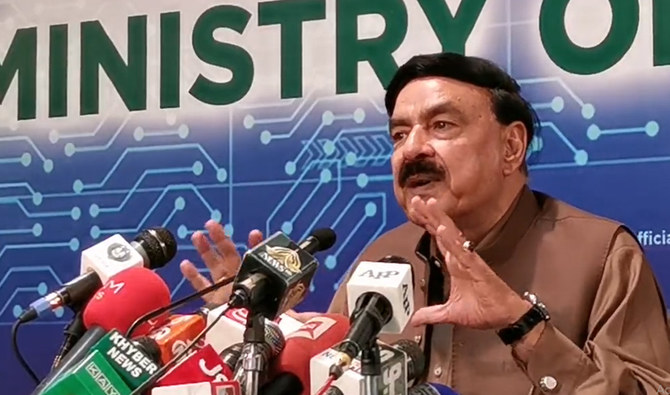
Pakistani Interior Minister Sheikh Rashid Ahmed pictured during a press conference in Islamabad on Feb 6, 2022. (Screengrab)
Short Url
Updated 06 February 2022
Follow

Pakistan says won’t close ‘doors for dialogue’ after four days of clashes with separatists

  • Baloch insurgents launched attacks on paramilitary camps in Balochistan’s Naushki and Panjgur districts on Wednesday
  • On Saturday, army said 20 militants and nine soldiers were killed in 70-hour-long operation to clear the bases

ISLAMABAD: Pakistani Interior Minister Sheikh Rashid Ahmed said on Sunday Islamabad would not close the “doors for dialogue” with militants, a day after troops concluded a four-day long operation against separatist insurgents in the southwestern Balochistan province.

On Wednesday night, Baloch insurgents launched attacks on paramilitary camps in Balochistan’s Naushki and Panjgur districts near the border with Iran. On Saturday, the Pakistan army said 20 militants and nine soldiers had been killed in the operation to clear the bases, which lasted over 70 hours. 

The Baloch Liberation Army (BLA), which had earlier claimed the attack, also issued a statement on Saturday night saying “all targets successfully achieved.” It said 16 fighters “sacrificed” themselves in the attacks.

Baloch separatists have been fighting the Pakistani state for decades, saying the central government unfairly exploits Balochistan’s rich gas and mineral resources.

“Doors for dialogue (with militants) can’t be closed,” the Pakistani interior minister told reporters on Sunday. “But terrorists who took up arms against Pak army, Pakistan and attack our installations, they shouldn’t be forgiven.”

Ahmed also spoke about peace talks with the Pakistani Taliban, or Tehreek-e-Taliban Pakistan (TTP), a group that has fought for years to overthrow the government in Islamabad.

The government reached a cease-fire deal with the group last November, which the TTP called off a month later, accusing the government of breaching terms including a prisoner release agreement and the formation of negotiating committees. The TTP has since stepped up its attacks around the country.

When asked whether negotiations had been restarted with the TTP, the interior minister said: “I am not aware of talks with the TTP. I don’t want to comment on it.”

On Friday, six people, including two paramilitary soldiers, were injured after a bomb attack targeted a paramilitary Levies check post in Balochistan’s Chaman district bordering Afghanistan.

Last week, the army said insurgents killed 10 soldiers in an attack on a post near the port of Gwadar on the Arabian Sea, the heaviest death toll for the army in the Balochistan insurgency in years.


‘Fully stand with Bangladesh’: Pakistan PM backs decision to boycott India match

Updated 04 February 2026
Follow

‘Fully stand with Bangladesh’: Pakistan PM backs decision to boycott India match

  • Pakistan’s government have not allowed the national cricket team to play its World Cup match against India on Feb. 15
  • Pakistan has accused India of influencing ICC decisions, criticized global cricket body for replacing Bangladesh in World Cup

ISLAMABAD: Prime Minister Shehbaz Sharif on Wednesday backed his government’s decision to bar the national men’s cricket team from playing against India in the upcoming T20 World Cup tournament, reaffirming support for Bangladesh. 

Pakistan’s government announced on social media platform X last week that it has allowed its national team to travel to Sri Lanka for the World Cup. However, it said the Green Shirts will not take the field against India on their scheduled match on Feb. 15. 

Pakistan’s participation in the tournament was thrown into doubt after Pakistan Cricket Board (PCB) Chairman Mohsin Naqvi criticized the International Cricket Council (ICC) for replacing Bangladesh with Scotland. The decision was taken after Bangladesh said it would not let its team travel to India out of security concerns. 

During a meeting of the federal cabinet, Sharif highlighted that Pakistan has said that politics should be kept away from sports. 

“We have taken this stand after careful consideration and in this regard, we should stand fully with Bangladesh,” Sharif said in televised remarks. 

“And I believe this is a very reasonable decision.”

Pakistan has blamed India for influencing the ICC’s decisions. The global cricket governing body is currently led by Jay Shah, the head of the Board of Control for Cricket in India. Shah is the son of Indian Home Minister Amit Shah. 

Pakistan’s boycott announcement has triggered media frenzy worldwide, with several Indian cricket experts and analysts criticizing Islamabad for the decision. An India-Pakistan cricket contest is by far the most lucrative and eagerly watched match of any ICC tournament. 

The ICC has ensured that the two rivals and Asian cricket giants are always in the same group of any ICC event since 2012 to capitalize on the high-stakes game. 

The two teams have played each other at neutral venues over the past several years, as bilateral cricket remains suspended between them since 2013 due to political tensions. 

Those tensions have persisted since the two nuclear-armed nations engaged in the worst fighting between them since 1999 in May 2025, after India blamed Pakistan for an attack in Indian-administered Kashmir that killed tourists. 

Pakistan denied India’s allegations that it was involved in the attack, calling for a credible probe into the incident.