

France to provide UAE with military support to protect airspace

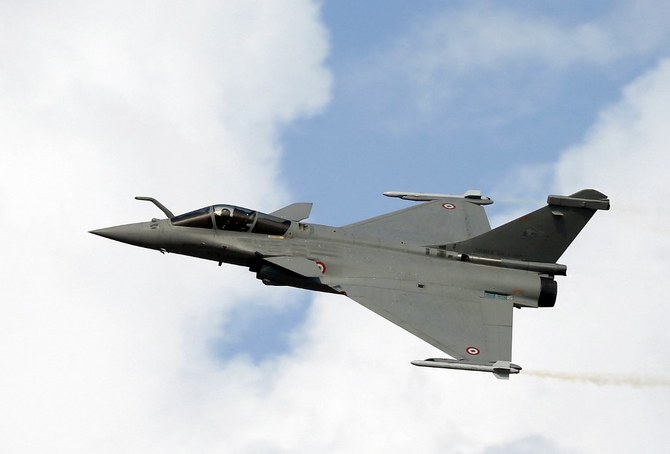
A Dassault Aviation French made Rafale performs during the Dubai Airshow on November 18, 2013. (File/AFP)
Short Url
Updated 05 February 2022
Follow

France to provide UAE with military support to protect airspace

PARIS, DUBAI: France will reinforce the UAE’s air defense system after a series of ballistic missile and drone attacks launched from Yemen by Iran-aligned Houthi rebels on the country, the French armed forces minister said on Friday.

Paris has close economic and political ties with Abu Dhabi and has a permanent military base in the Emirati capital.

It sealed a deal in December to sell some 80 Rafale fighter jets to the Emirates, the largest ever overseas sale of the French warplane.

“The United Arab Emirates was victim of serious attacks on its territory in January,” Florence Parly wrote on Twitter.

“In order to show our solidarity with this friendly country, France has decided to provide military support, in particular to protect the airspace against any intrusion.”

The UAE has in the past fortnight been attacked twice with drones and missiles, claimed by the Houthis, including one targeting a base hosting the US military. It was thwarted by US-built Patriot interceptors.

France’s Armed Forces Ministry said the agreement with Abu Dhabi would see operations conducted from Al-Dhafra airbase offering refueling and surface-to-air capacities.

“Aircraft operations are planned ... in coordination with the Emirati air forces, to detect and intercept drone strikes or cruise missiles targeting the UAE,” the ministry said.

Refueling and regular Rafale fighter jet observation missions would take place solely over Emirati territory, French officials said.

Earlier this week, the US had also said it would send fighter jets to assist the UAE following missile attacks on the Gulf state launched by Yemen’s Houthi movement.

The UAE-trained Giants Brigades in Yemen has this year inflicted heavy losses on the Houthi rebels, disrupting their efforts to seize a key city that could determine the outcome of the war.

According to Yemeni military sources, more than 30,000 fighters — most of them former army personnel — joined its ranks to repel a Houthi advance in the country.

The brigades possess tanks, heavy artillery and other weapons.

Made up of 15 brigades, the Giants’ military efforts focused on a 300-km coastal strip in the country’s west from Bab Al-Mandab to Hodeidah on the Red Sea.

Ahmed Nagi of the Malcolm H. Kerr Carnegie Middle East Center said the Giants Brigades is considered one of the most “disciplined” forces of the coalition.

“It’s good relationship with the coalition leadership ... has given it the ability to succeed in many military operations,” he said. Their entry into the Marib battle is “a new pressure tool used by the coalition.”

“Whether these forces continue their military operations ... in Marib or not, their capacity and equipment will remain a deterrent factor against the Houthis and will impose new rules of engagement on them,” said Nagi.


Iran war chokes aid corridors, obstructing global relief efforts

Updated 3 sec ago
Follow

Iran war chokes aid corridors, obstructing global relief efforts

  • “People in dire need of assistance ⁠will have to ⁠wait longer for food,” said Bauer
  • Tents, tarpaulins and lamps destined for Gaza and the West Bank have become stuck in the supply chain, the IOM said

GENEVA: Key humanitarian air, sea and land routes are being constricted by disruption from the war in the Middle East, delaying life-saving shipments to some of the world’s worst crises, 10 aid officials have told Reuters.
The US–Israeli war on Iran entered its seventh day on Friday, convulsing global markets and disrupting supply chains with airspace closures and the halt of shipping through the critical Strait of Hormuz.
Aid to Gaza and Sudan is grinding to a halt and costs are soaring for help to the hundreds of millions suffering hunger crises around the world.
“People in dire need of assistance ⁠will have to ⁠wait longer for food,” said Jean-Martin Bauer, Director of Food Security at the World Food Programme.
Already, tents, tarpaulins and lamps destined for the Israeli-occupied Palestinian territories of Gaza and the West Bank have become stuck in the supply chain, the International Organization for Migration said.

DUBAI AID HUB HOBBLED BY AIR AND SEA RESTRICTIONS
Aid groups say higher operational costs are straining budgets already facing massive donor cuts. The IOM said shipping firms were demanding emergency surcharges of approximately $3,000 per ⁠container.
Humanitarian groups stocking goods for rapid regional deployment at warehouses in Dubai’s Humanitarian Hub face challenges moving supplies onto transit routes.
The International Federation of Red Cross and Red Crescent Societies cannot move trauma kits to help the Iranian Red Crescent with search and rescue from its Dubai hub, where they sit in a estimated 1 million Swiss franc ($1.28 million) pre-positioned emergency stockpile, said Cecile Terraz, a director at the IFRC.
The group cannot move stock through Jebel Ali port — the region’s largest container terminal, which was set on fire by the debris of an intercepted missile — from where cargo normally moves onto planes or into the Strait of Hormuz.
The World Health Organization’s Dubai hub operations are also frozen, regional director Hanan Balkhy said, obstructing ⁠50 emergency requests from 25 ⁠countries and hampering operations such as polio vaccination.
Ripple effects farther afield are also likely.
Famine-struck Sudan is particularly exposed due to additional restrictions since February 28 on the Suez Canal and the Bab el-Mandeb Strait at the southern entrance to the Red Sea, the UNHCR said.
“We are particularly concerned about Africa,” said a spokeswoman, adding that some cargoes were being sent around the Cape of Good Hope. The route takes up to three weeks longer.
Costs for fuel, transportation and insurance are also rising, and Terraz said the IFRC may have to cut deliveries to the Iranian Red Crescent.
Emma Maspero, senior manager in Copenhagen of the supply division of the UN children’s body UNICEF, said she hoped flights carrying perishable humanitarian goods such as vaccines could be prioritized amid the airspace restrictions.