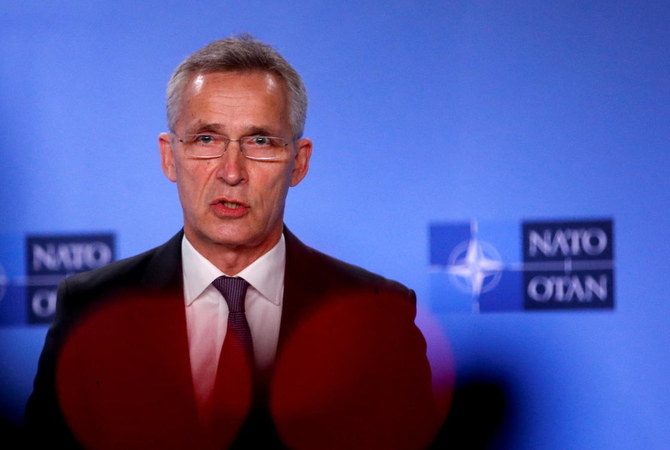
BRUSSELS: NATO Secretary-General Jens Stoltenberg expressed concern Thursday that Russia is continuing its military buildup around Ukraine, and that it has now deployed more troops and military equipment to Belarus than at any time in 30 years.
Meanwhile, more high-level diplomacy unfolded in Moscow and Kyiv amid deep uncertainty about Russia’s intentions. Ukrainian President Volodymyr Zelenskyy hosted Turkish President Recep Tayyip Erdogan for talks in the Ukrainian capital. Russian President Vladimir Putin was to meet with his Argentine counterpart, Alberto Fernandez, in Moscow.
Russia now has more than 100,000 troops stationed near Ukraine’s northern and eastern borders, raising concern that Moscow might invade again, as it did in 2014, and destabilize the Ukrainian economy. Russian officials deny that an invasion is planned.
“Over the last days, we have seen a significant movement of Russian military forces into Belarus. This is the biggest Russian deployment there since the Cold War,” Stoltenberg told reporters at NATO headquarters in Brussels.
He said Russian troop numbers in Belarus are likely to climb to 30,000, with the backing of special forces, advanced fighter jets, Iskander short-range ballistic missiles and S-400 ground-to-air missile defense systems.
“So we speak about a wide range of modern military capabilities. All this will be combined with Russia’s annual nuclear forces exercise, expected to take place this month,” Stoltenberg said.
Russian Defense Minister Sergei Shoigu was in Minsk to check on preparations for major Russia-Belarus war games scheduled for Feb. 10 to Feb. 20. Shoigu met with Belarusian President Alexander Lukashenko. Speaking about the drills, Lukashenko said the goal was “to reinforce the border with Ukraine.”
At the same time, Belarus’ defense ministry accused Ukraine of violating the country’s airspace with a drone last month. The ministry summoned Ukraine’s defense attaché and handed him a note of protest over “frequent violations of the state border” with Belarus.
Kyiv rejected the allegation and accused Belarus of working with Russia to try to further unsettle Ukraine. “We call on Minsk to refrain from playing along with Russia’s destabilizing activities,” foreign ministry spokesman Oleg Nikolenko said on Twitter.
Ukraine’s defense minister sought again to project calm, saying the probability of an invasion was “low,” and he welcomed a change by US officials, who have stopped using the term “imminent” when describing the risk of a Russian attack.
Oleksii Reznikov said “the threat exists, the risks exist, but they have existed since 2014, ever since Russia has become an aggressor.” He said “there are no grounds for panic, fear, flight or the packing of bags.” The minister put the number of Russian troops near Ukraine at 115,000.
Still, Stoltenberg renewed his call for Russia to “de-escalate,” and repeated warnings from the West that “any further Russian aggression would have severe consequences and carry a heavy price.”
NATO has no intention of deploying troops to Ukraine should Russia invade, but it has begun to reinforce the defenses of nearby member countries — notably Estonia, Latvia, Lithuania and Poland. The 30-nation military alliance also plans to beef up its defenses in the Black Sea region near Bulgaria and Romania.
Stoltenberg also embraced President Joe Biden’s decision on Wednesday to send 2,000 US-based troops to Poland and Germany and to shift 1,000 more from Germany to Romania, demonstrating to both allies and foes Washington’s commitment to NATO’s eastern flank.
“We are committed to finding a political solution to the crisis, but we have to be prepared for the worst,” Stoltenberg said, and he appreciated other recent offers of troops and equipment from several allies. Russia objects to the troop move and has described it as “destructive.”
Erdogan, a prominent NATO ally in the Black Sea region, is positioning himself as a possible mediator. Speaking before departing for Kyiv, he reiterated Turkey’s support for Ukraine’s territorial integrity and said Ankara was ready to do what it can to reduce tensions.
“We are closely following the challenges that Ukraine is faced with as well as the tension in the region,” he said. “We express on every platform that we support the territorial integrity and sovereignty of our strategic partner and neighbor Ukraine.”
“As a Black Sea nation, we invite all sides to exercise restraint and dialogue in order to bring peace to the region,” Erdogan said.


![]()

NATO says Russian buildup in Belarus is biggest in 30 years
Short Url
https://arab.news/jx7he
NATO says Russian buildup in Belarus is biggest in 30 years
- More high-level diplomacy unfolded in Moscow and Kyiv amid deep uncertainty about Russia’s intentions
- “This is the biggest Russian deployment there since the Cold War,” NATO Secretary-General Jens Stoltenberg told reporters


Latest updates


Recommended


© 2026 SAUDI RESEARCH & PUBLISHING COMPANY, All Rights Reserved And subject to Terms of Use Agreement.