

Saudi skier shrugs off pressure of historic Beijing Winter Olympics

1 / 3
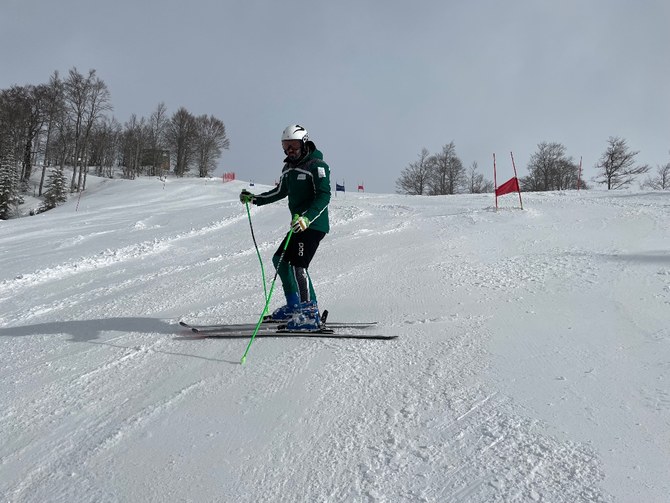
Alpine Skier Fayik Abdi is Saudi Arabia's first ever Winter Olympian. (Supplied)
2 / 3
Alpine Skier Fayik Abdi is Saudi Arabia's first ever Winter Olympian. (Supplied)
3 / 3
Alpine Skier Fayik Abdi is Saudi Arabia's first ever Winter Olympian. (Supplied)
Short Url
Updated 03 February 2022
Follow

Saudi skier shrugs off pressure of historic Beijing Winter Olympics

  • Fayik Abdi is the first and only Saudi Winter Olympian and hopes he can inspire others to emulate his mission impossible

LONDON: Fayik Abdi could be forgiven for basking in the glory of becoming a Saudi Arabian national hero.

The giant slalom skier has achieved the unthinkable by qualifying for the Beijing Winter Olympics after only seven months’ training and during a global pandemic.

He is the first and only Saudi to have achieved this gargantuan feat, but the self-deprecating Abdi is eager to avoid the limelight.

“I don’t want this to be about me,” Abdi told Arab News ahead of the Games, which take place on Feb 4-20. “I don’t want the attention, I don’t want the spotlight.

“I want this to be about Saudi. I want this to be about other Saudis and I want to inspire them to find a passion, to do new things and tell them that anything is possible and nothing is impossible.”

Abdi’s tale of the unexpected began when the newly formed Saudi Winter Sports Federation offered him the chance of a lifetime last March.

The SWSF harbored a seemingly fanciful ambition of sending Saudi sports talent to the Winter Olympics and duly helped Abdi to fund top coaches, a training program and his travel to competitions.

The 24-year-old is no skiing rookie, though, having dedicated his life to the sport since taking it up at the age of four.

As such, he has great confidence in his ability and an innate cool-headedness.

“I’m going to stay relaxed,” he said ahead of his race on Feb. 13. “The only thing I’m nervous about is catching COVID at the Olympics or right before it, but I’m not as nervous (about anything else) as you might imagine.

“That’s kind of my personality.”

So how did a man from a desert nation become so captivated by skiing?

“My mother was a recreational skier and she taught me how to ski in Lebanon. Ever since then, I fell in love with the sport and have been trying to pursue it,” said Abdi, who was born in San Diego, California, to two Saudi parents, but who grew up in the Kingdom between the ages of three and 14.

“When I turned 14, I went to boarding school in Florida and wanted to be a professional football player. But to be honest, I kept getting injured playing football.

“I kind of had to give it up and said to myself: ‘I wanna go somewhere where I can ski.’ I felt like that was my calling.

“I went to the University of Utah in 2016. I studied criminal justice. If you ask ‘why?’, it’s because I wanted to study something relatively easy so I could ski,” he said, laughing.

“While at university, I also worked as a ski technician tuning skis and took online classes and basically skied for 120-plus days every season. I wasn’t racing, I was just free riding. It was the best time of my life because I was doing what I loved.

“When I ski, I don’t worry about anything. I’m only thinking about skiing and being in the present moment.”

After graduating in December 2020, he returned to Saudi and started a project aimed at bringing sand-skiing to the Kingdom.

While doing this, he responded to an advert looking for Saudi skiers to film a photoshoot at NEOM, the new net-zero megacity on the Kingdom’s northwest Red Sea coast.

The SWSF’s CEO, Sultan Salama, had heard of Abdi’s skiing prowess and asked him to meet him and his colleagues in Riyadh.

“They asked me if I wanted to go to the Olympics,” Abdi said. “I didn’t know if they were for real. I was like: ‘Well, the Olympics is in 11 months and I’ve never trained for anything like that.’

“They asked me to look for a training program and a coach and I found someone, Jeff Books, a Canadian guy (and experienced skiing director).”

After starting training in Austria last August, Abdi and his team trained and competed in countries such as Switzerland, Sweden, Montenegro and Italy.

But his arduous regime was made even harder by COVID-19’s disruptive impact.

“It’s been really challenging because we haven’t been able to go to races we wanted to go to because of cancellations, and we haven’t been able to train at venues.

“It’s just a challenge that adds to the journey, and I think it makes (my qualification) even more sweet.”

Books and his fellow coaches had understandably felt Abdi’s Olympic qualification hopes were “extremely difficult to the point of impossible.”

“They’re even surprised about where we’re at right now,” Abdi said. “They’re completely mind-blown, to be completely honest.”

Abdi competed in “about 11 races” in Europe and explains the Olympic qualification criteria thus: “You need to have five results to average below 160 points. So basically add your best five results, divide that by five and that’s your average. 

“The best skier in the world has zero points and our objective was to average below 160 points, and if you do this you have qualified, basically. I have 131 points.”

Explaining his grand slalom discipline, he said: “In alpine skiing, you have four disciplines — slalom, giant slalom or GS, super-G and downhill. Slalom is the slowest one as in speed, GS is second, super-G is third and downhill is the fastest.

“In GS, you have gates that are set around 25-32ish meters apart and you race through the course to the finish twice. Whoever has the best time in the two runs basically wins the race.”

Two of Abdi’s teammates, Rakan Alireza and Salman Al-Houwaish, also secured the points that they needed to qualify for Beijing 2022, but have agonizingly missed out on selection.

Abdi said Alireza, a cross-country skier, needed to have participated in a World Championship to qualify.

Al-Houwaish, meanwhile, was pipped by Abdi on account of his inferior world ranking of 3,722 as opposed to Abdi’s 3,512.

“It’s been really tough for Salman and I for the past two or three weeks,” Abdi said. “When we first started this project, we were told we would both be able to go if we both qualified. Once we both qualified, we found out that only one of us could go and that changed the whole scenario.

“This is life and this is sports and sometimes it’s like cruel like that.

“I feel for him and consider him (to be) like a brother. I know he’s going to do great things in the ski industry and in life.”

Abdi is flying the flag for Saudi alone in Beijing. Undaunted, he insists he is not there to make up the numbers or to revel in the “glamor” of the occasion.

He cites Wayne Rooney as his greatest inspiration, given the legendary ex-Manchester United and England footballer’s “competitive tenacity,” and hopes to display such a quality in China.

“My goal is just like every race: Just to try and ski the best you can. A race is just skiing and I think that’s what a lot of racers forget sometimes; they try and do something different in a race to what they do in training.

“I want to beat as many nations as I can. I’m going to be competitive.

“This is a long-term journey for me. I’m not just doing this to get to the Olympics. I want the next Olympics and then the next one.”

Whatever happens next in his incredible skiing odyssey, Abdi said that he owes everything to the SWSF.

“They’re legends in my opinion. They really shot for the stars and it’s amazing that they had the trust to send us out there with seven months of training and hope we would qualify for the Olympics. I give them so much credit for trusting us, for supporting us, and really just their ambition is truly remarkable.”

Abdi himself is truly remarkable and it is touching to learn that he wants to leave a lasting legacy when he hangs up his skis.

“Honestly, my biggest dream and accomplishment would be to breed a major male or female skier and have them become World Cup skiers who are constantly on the circuit winning races and putting Saudi Arabia on the map.”


The sum of all fears

Updated 10 sec ago
Follow

The sum of all fears

  • After 3 years and millions spent on 24 foreign and local players and 3 new coaches, the question fans and pundits are asking is: Where is Al-Nassr’s return on investment?
  • Ronaldo’s PR war with the club and the Saudi Pro League is now being played out in public after he missed a second straight game against Al-Ittihad

RIYADH: Cristiano Ronaldo’s famed PR prowess is in full flow as controversy surrounding his refusal to play for Al-Nassr continues. Meanwhile, his club and the Saudi Pro League are standing their ground. And across the Kingdom, and around the world, the question fans and pundits are asking is: Where is Al-Nassr’s return on investment since the Portuguese superstar joined just over three years ago?

A solitary Arab Club Champions Cup in 2023, with no major domestic or continental titles, would be — for a club of Al-Nassr’s stature — unacceptable during any period, never mind one which includes Ronaldo and a host of expensive foreign and local signings.

The club have signed over 50 players in the Ronaldo era and appointed three full-time coaches, including incumbent Jorge Jesus. The return has been scant, to say the least.

The club’s malaise on the pitch has been matched in the boardroom with a host of changes taking place during the continuing trophy drought. In 2024, Al-Nassr’s President Ibrahim Al-Muhaidib resigned due to lack of control at the club and was eventually replaced by Abdullah Al-Majid.

In January of 2025, Majid Al-Jam’an replaced Al-Nassr’s CEO at the time of Ronaldo’s arrival, Guido Fienga, whose role changed to club adviser. Following restructuring demands by Ronaldo, Al-Jam’an himself was replaced last summer with Jose Semedo. At the same time, Simao Coutinho replaced former Real Madrid legend Fernando Hierro as sporting director.

Such turmoil has hardly been conducive to success and trophies, despite all the incoming signings.

The fallout from Ronaldo’s refusal to play for Al-Nassr since the last day of the winter transfer window continues to be felt almost a week on.

It is safe to say the direction of Saudi football itself has shifted dramatically since the turn of the month. With the transfer window initially not producing any fireworks, it seemed like all the focus would return to the title race between Al-Hilal, Al-Nassr, Al-Ahli and Al-Qadsiah as the season entered its final third.

That changed following a contract renewal dispute between Karim Benzema and Al-Ittihad, which led to the Frenchman’s departure. A swift move to Al-Nassr’s city rivals and league leaders Al-Hilal followed, leading to the dramatic fallout that caused shockwaves across the football industry.

The repercussions of Benzema’s transfer have reshaped the league’s landscape. Ronaldo, reportedly frustrated that Al-Nassr had only signed Hayder Abdulkareem from Al-Zawraa and Abdullah Al-Hamdan from Al-Hilal, withdrew from his side’s clash with Al-Riyadh on Feb. 2.

As reports emerged suggesting that Ronaldo was unhappy with the way the Public Investment Fund was managing the league’s four major clubs, global media attention turned to how the situation would unfold.

Despite the noise off the field, Al-Nassr remain just one point behind Al-Hilal in the title race with more than a third of the games still to play.

The side endured a difficult run against Al-Qadsiah, Al-Ahli and Al-Hilal, but the league remains wide open with all four sides still in contention.

While Ronaldo returned to training amid false reports of his departure from the Kingdom, he missed a second consecutive match on Feb. 6 — a 2-0 win against Benzema’s former club Al-Ittihad.

It is fair to say that the drama has been the biggest seen in Saudi football since Ronaldo joined at the end of 2022, and arguably one of the biggest ever.

It is not the first time that the 41-year-old star has leveraged his status in world football to drive his ambitions, and his grievances, to the fore. His move to Saudi had taken place following an infamous interview with international television host Piers Morgan in which he criticized his then-club Manchester United, leading to his signing for Al-Nassr.

Now, with no clarity on whether Ronaldo will feature against Al-Fateh on Feb. 14, questions surrounding his immediate future remain unanswered.

A day prior to the Al-Ittihad encounter, a Saudi Pro League spokesperson revealed in an official statement to the BBC that “no individual — however significant — determines decisions beyond their own club.”

However, an Al Arabiya source outlined there were four factors behind Ronaldo’s reported dissatisfaction.

Firstly, Al-Nassr were said to be close to signing Saud Abdulhamid, but the deal collapsed amid claims that Al-Hilal, one of the player’s former clubs, believed his return to the league should only be with them.

Secondly, the source claimed Al-Nassr did not receive the same backing as Al-Hilal during the transfer window.

Thirdly, the league leaders made four foreign signings, including Benzema, to dwarf Al-Nassr’s efforts.

The source finally alleged that Ronaldo believed Al-Nassr’s CEO and sporting director had been restricted in their ability to operate.

While many fans continue to voice their support for Ronaldo, alternative viewpoints have emerged as his absence has continued.

Sports lawyer Ahmed Al-Shikhi posted on social media that, based on the official FIFA Transfer Matching System data for 2025, Al-Nassr were the highest spending club not just in Saudi Arabia, but across Asia.

Some fans have noted that, despite the club’s heavy spending, Al-Nassr remain the only member of Saudi Arabia’s traditional “big four” not to have won a major trophy since Ronaldo’s arrival.

For his part, renowned sports commentator and former Saudi footballer, Turki Al-Awad, defended Al-Nassr and eluded that given everything Cristiano Ronaldo has offered Saudi football, "the GOAT" should be above criticism.

“Ronaldo was the first to join the Saudi project, and on that basis, he should be treated (with respect), with the issue resolved quickly. We were very happy with his arrival, and he added a lot to us,” he said recently on Fi Al Marmi, a leading sports talkshow on Al-Arabiya News Channel.

On a similar note, Piers Morgan also voiced his support for Ronaldo.

Posting on X, he wrote: “Cristiano has revolutionised Saudi football in a way nobody else could have done. He just wants a level playing field”.

The situation ultimately underscores the growing tension between individual star power and institutional governance within the Saudi Pro League.

As the title race is set to enter its decisive phase in the coming weeks — including a Riyadh derby that could prove pivotal — it remains to be seen whether Ronaldo’s absence proves a momentary protest or a sign of deeper friction that will become clearer in the coming weeks.

For now, the episode has shone a light on the fact that the Saudi Pro League’s evolution is entering a more complex phase — one in which the battle between stars and structure proves difficult to govern.