

Islamabad calls Indian media reports of delay in appointment of US envoy 'baseless'

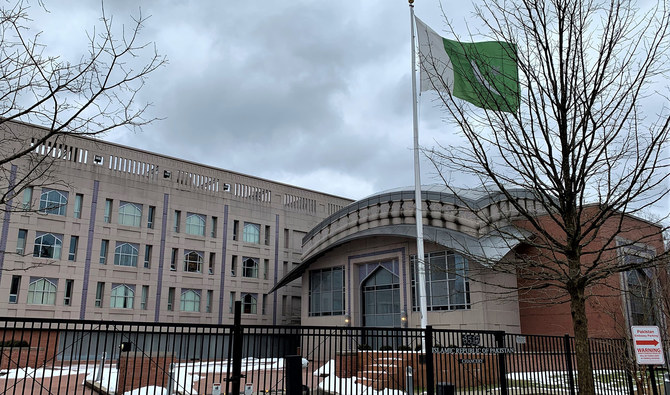
This undated file photo shows Pakistan Embassy in Washington DC, US. (Photo courtesy: social media)
Short Url
Updated 01 February 2022
Follow

Islamabad calls Indian media reports of delay in appointment of US envoy 'baseless'

  • Pakistan nominated Masood Khan its ambassador to US in November 2021
  • The nomination was supposed to be approved in up to eight-week time

ISLAMABAD: Pakistan on Tuesday rejected Indian media reports about a delay in the appointment of its envoy to the United States as "baseless," the Pakistani foreign office said, with Washington-Islamabad ties getting increasingly colder for geo-political reasons. 

The foreign office sent the nomination of Ambassador Masood Khan, who served as the Azad Kashmir president until August 2021, to Washington in November last year. His nomination was supposed to be approved in up to eight-week time, but the US State Department has sought some more time for the clearance. 


Sardar Masood Khan, President of Azad Kashmir, talking to Arab News in Islamabad on Monday, August 12, 2019. (AN photo)

Meanwhile Indian news agency ANI reported that in a letter to Joe Biden, Congressman Scott Perry urged the US president to reject Khan's appointment as it would undermine US interests in the region. 

Islamabad rejected the “scandalous claims” made by Indian media outlets in their reports. 

"This is a part of the wider Indian disinformation campaign to malign Pakistan and those who represent Pakistan, by using fake news to make scandalous claims and baseless allegations," Asim Iftikhar Ahmad, the spokesperson for the Pakistani foreign office, said in a statement. 

"Ambassador Masood Khan is a highly accomplished diplomat with 40 years of experience in both multilateral and bilateral diplomacy. His Agre’ment is being processed in the US system." 

Ambassador Khan has previously served as Pakistan’s permanent representative to the United Nations (UN) and its ambassador to China. He is to replace the outgoing Pakistani envoy in Washington Asad Majeed Khan. 

The development comes amid years of strained relations between Washington and Pakistan since US officials thought they were not getting requisite support from Islamabad to win the war in Afghanistan. 

They have suffered a greater setback after the arrival of President Joe Biden who refused to speak to Pakistan's prime minister, even as his administration continued to seek Islamabad's support in Afghanistan. 

Washington does not have the same amount of interest in Pakistan after the pullout of foreign forces from Afghanistan in August 2021. It is also critical of Islamabad's close ties with China, although Pakistan has said that it does not want to become a part of any bloc. 


Pakistan reviews austerity measures amid Middle East crisis, urges strict nationwide implementation

Updated 11 March 2026
Follow

Pakistan reviews austerity measures amid Middle East crisis, urges strict nationwide implementation

  • Deputy Prime Minister Ishaq Dar chairs review meeting of austerity steps
  • Officials briefed on salary cuts, school closures, four‑day week, petrol conservation

ISLAMABAD: Pakistan’s government on Wednesday assessed progress on a sweeping set of austerity measures introduced to mitigate the country’s economic strain from sharply rising global oil prices and supply disruptions linked to the ongoing war in the Middle East.

Prime Minister Shehbaz Sharif this week announced a series of austerity steps, including a four‑day work week for government offices, requiring 50  percent of staff to work from home, cutting fuel allowances for official vehicles by half, grounding up to 60  percent of the government fleet and closing all schools for two weeks to conserve fuel amid the global oil crisis.

The measures were unveiled in response to global oil market volatility triggered by the conflict involving the United States, Israel and Iran, which has disrupted supply routes such as the Strait of Hormuz and pushed crude prices sharply higher, straining Pakistan’s heavily import‑dependent energy sector.

“The meeting stressed the importance of strict and transparent adherence to the austerity measures, promoting fiscal responsibility and prudent use of public resources,” Deputy Prime Minister and Foreign Minister Senator Mohammad Ishaq Dar said in a statement.

He was chairing a meeting of the Committee for Monitoring and Implementation of Conservation and Additional Austerity Measures, constituted under the directions of the PM, bringing together federal and provincial officials to review execution of the broad cost‑cutting plan. 

Dar emphasized the government’s commitment to enforcing the PM’s austerity steps nationwide. The committee’s review also covered reductions in departmental expenditure, deductions from salaries of senior officials earning over Rs. 300,000 ($1,120), and coordination with provincial administrations to ensure uniform implementation of the plan.

Participants at the meeting reiterated that all ministries and divisions must continue strict monitoring and reporting, with transparent oversight mechanisms, as Pakistan navigates the economic pressures from the prolonged Middle East crisis and its fallout on global energy and trade markets.