

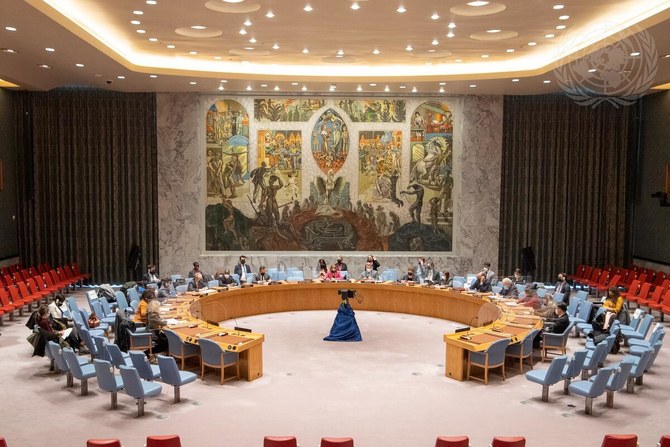

NEW YORK: The Security Council on Monday extended the mandate of the UN Support Mission in Libya until the end of April after days of contention on a range of issues — from the language about future elections to the length of the mandate extension.
The renewal, which should have been a formality, followed a deadlock between Russia and the US with Moscow demanding that a special envoy to Libya be appointed by the secretary-general to replace current special adviser US Stephanie Williams.
The UK, the penholder on Libya, had authored a resolution to extend UNSMIL’s mandate for one more year, urge Libyans to hold national elections and call for the withdrawal of foreign mercenaries from the North African country. Russia had intended to veto the text before proposing its own resolution for a vote.
The Russian text, as reported by Agence France Presse, stipulated a shorter extension, until April 30 when, according to Moscow, the political situation in Libya would become clearer. It also called for the appointment of an envoy “without further delay.”
The final, unanimously adopted resolution 2619, which consists of only three operative paragraphs, is a technical carryover of UNSMIL’s core mandate. It contains one new provision recalling that UNSMIL should be led by a special envoy and “recognizing the Secretary-General’s responsibility to appoint a Special Envoy as set out in resolution 2542 (of 2020.)”
The security council recently split over whether to reconfigure UNSMIL’s leadership, with several member states demanding the special envoy’s post be transferred from Geneva to Tripoli.
Since the sudden resignation of former envoy Jan Kubis in November, American Stephanie Williams has served as UN special adviser on Libya. It appears that the secretary-general wanted to appoint Williams, the former acting special representative and head of UNSMIL, as interim head of UNSMIL, but Russia opposed the move.
Instead, Guterres named her as his special adviser for Libya, a position that does not require council approval.
Williams is currently in Tripoli leading UN mediation efforts.
Nathalie Broadhurst, France’s deputy permanent representative, expressed regret over the council’s failure to reach agreement on “a substantive renewal” of the mission’s mandate.
“After the postponement of the first round of the presidential election scheduled for December 24, 2021, Libya is at a critical moment of its political transition,” Broadhurst said.
“The Security Council must encourage Libyans to resolve their differences to allow for the holding of presidential and parliamentary elections as soon as possible.”
She added: “In order to give UNSMIL all the tools necessary to carry out its mediation, it is essential that the secretary-general appoints a special envoy without delay.”
Ireland’s Geraldine Byrne Nason said that UNSMIL’s role on the ground in Libya is “more important than ever, given the fragility of the political situation and the need for progress on the security and economic tracks.”
Most importantly, the Irish envoy added, an effective UNSMIL “is vital to support the Libyan people and their legitimate expectations of a democratic and peaceful future.
“The sustained support and leadership from the UN and from this council is essential to instill confidence in the Libyan political process and to help Libyan stakeholders forge agreement on the way forward and on the holding of elections as soon as possible.”


