

UK business minister tours Jubail Industrial City during visit to Saudi Arabia

1 / 2
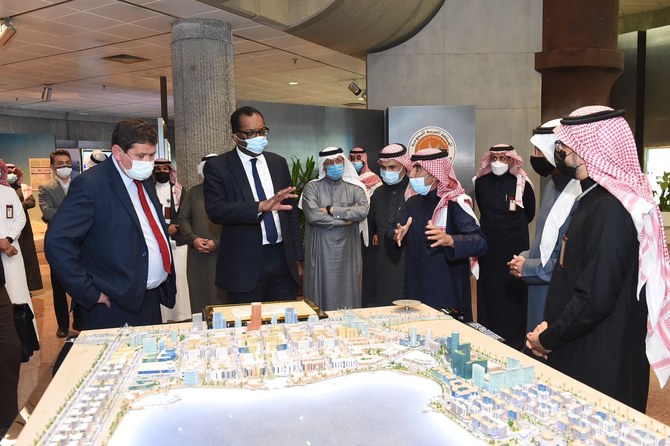
UK Secretary of State for Business, Energy and Industrial Strategy Kwasi Kwarteng tours Jubail Industrial City. (Royal Commission for Jubail and Yanbu)
2 / 2
UK Secretary of State for Business, Energy and Industrial Strategy Kwasi Kwarteng tours Jubail Industrial City. (Royal Commission for Jubail and Yanbu)
Short Url
Updated 01 February 2022
Follow

UK business minister tours Jubail Industrial City during visit to Saudi Arabia

  • Kwasi Kwarteng also held talks with Saudi minister of energy

RIYADH: UK Secretary of State for Business, Energy and Industrial Strategy Kwasi Kwarteng on Monday held talks with Abdullah Al-Saadan, president of the Royal Commission for Jubail and Yanbu, during his visit to Saudi Arabia.
He was briefed on the industrial, economic and investment weight of the commission and the diversity of industries and products in Jubail Industrial City, the Saudi Press Agency reported.
Kwarteng was also “briefed on the development, economic depth and the huge industrial revolution that characterizes the city, which enables it to be a source of attraction for local and foreign investment, and the focus of attention of global investors.”
The minister viewed a presentation on the establishment of Jubail Industrial City, the most prominent challenges it faced and the industrial renaissance it has witnessed from its inception until now.
Kwarteng was then briefed on the model of the new economic center in Jubail Industrial City, which is located in Mardoma Bay in the heart of the city’s residential area, within an area of ​​275 hectares. It is also located near new residential neighborhoods to the east and west, and a new university to the south, which has made it the economic center of the city.
The minister, who was accompanied by UK Ambassador to the Kingdom Neil Crompton, CEO of the Royal Commission in Jubail Dr. Ahmed bin Zaid Al-Hussein and CEO of Ras Al-Khair Industrial City Ahmed bin Mohammed Hassan, toured the industrial zone, including introductory visits to several companies to learn about their most important products.
Kwarteng also held talks with Saudi Minister of Energy Prince Abdulaziz Bin Salman. They toured the King Abdullah Petroleum Studies and Research Center in Riyadh and Shaybah oil field in the Empty Quarter.


Kuwait forecasts 54.7% rise in fiscal deficit as oil revenues weaken 

Updated 11 sec ago
Follow

Kuwait forecasts 54.7% rise in fiscal deficit as oil revenues weaken 

JEDDAH: Kuwait expects its fiscal deficit to widen sharply in the 2026–2027 budget year as lower oil income weighs on public finances, with the shortfall projected to rise 54.7 percent to 9.8 billion dinars ($31.9 billion). 

Announcing the draft budget, Finance Minister Yaqoub Al-Refaei estimated total expected revenues at 16.3 billion dinars, marking a 10.5 percent decline compared with the previous fiscal year. 

Kuwait is pushing Vision 2035 reforms to diversify its economy and boost non-oil growth but remains exposed to oil price volatility despite moderate inflation and strong non-oil expansion. 

“The minister disclosed that oil revenues were budgeted at 12.8 billion dinars, a 16.3 percent contraction compared to the current budget ending March 31, 2026,” the Kuwait News Agency, known as KUNA, reported. 

Highlighting a positive trend for fiscal diversification, non-oil revenues are projected to rise 19.6 percent to 3.5 billion dinars. 

He noted that total expenditure is expected to reach 26.1 billion dinars, with salaries and subsidies accounting for 76 percent, capital spending 11.8 percent, and other expenditures 12.2 percent. The FY 2026–2027 budget is based on a conservative oil price estimate of $57 per barrel. 

The minister, however, stressed that Kuwait’s fiscal break-even price — the price needed to balance the budget — is significantly higher, at $90.5 per barrel. 

The draft budget, covering April 1, 2026, to March 31, 2027, includes capital spending of 3.1 billion dinars, with significant allocations for infrastructure and strategic projects, according to a release by the Ministry of Finance. 

Of this, 318 million dinars will fund the Ministry of Public Works for developments such as Mubarak Al-Kabeer Port, the Umm Al-Hayman plant expansion, the North Kabd station, and the expansion of Kuwait International Airport’s Terminal 2. 

Additional allocations support the health ministry’s cancer control center, as well as the Defense and Interior ministries for military equipment. 

Higher spending is also driven by a 741.2 million-dinar increase in the public treasury’s contribution to social insurance to cover pension fund deficits. 

Conversely, support for fuel used in power generation and refined products declined by 449.2 million dinars due to falling global oil prices. 

The ministry highlighted that the budget would create 14,518 new positions, reflecting efforts to boost employment while continuing to diversify revenue sources.