

Loyalists drive Houthis from swaths of Yemen

1 / 3
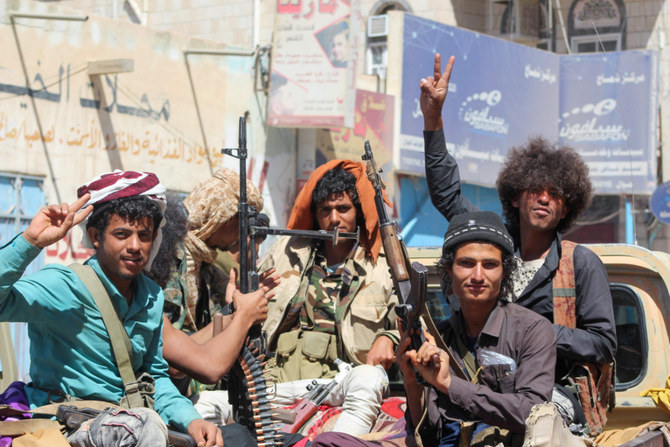
Yemeni pro-government fighters man a position on the outskirts of al-Jawba in Marib on Jan. 27, 2022. (Photo by Saleh Al-Obeidi / AFP)
2 / 3
Yemeni pro-government fighters man a position on the outskirts of al-Jawba in Marib on Jan. 27, 2022. (Photo by Saleh Al-Obeidi / AFP)
3 / 3
Yemeni pro-government fighters man a position on the outskirts of al-Jawba in Marib on Jan. 27, 2022. (Photo by Saleh Al-Obeidi / AFP)
Short Url
Updated 30 January 2022
Follow

Loyalists drive Houthis from swaths of Yemen

  • New victories for Giants Brigades fighters

AL-MUKALLA: Loyalist fighters from the Giants Brigades drove the Houthis out of swaths of central Yemen on Saturday as the Iran-backed militia suffered more military defeats.

“The national army and the Giants Brigades are inflicting heavy blows on the Houthis,” army spokesman Gen. Abdu Abdullah Majili told Arab News.

Government troops recaptured Najed and Al-Hajela in Juba district and made gains in Abedia district, both south of Marib, Majili said.

The Giants Brigades stormed Houthi locations on the Malla’a mountain range as they sought to join up with army troops outside the Houthi-controlled Um Resh military base in Juba. They also resumed their push inside the Houthi-controlled Al-Bayda province, retaking the Gharaba area in Natea district, east of Al-Bayda.

The Houthis have suffered a string of military defeats since the beginning of this year, when the Giants Brigades began an offensive that led to the recapture of the oil-rich province of Shabwa, and seized control of large amounts of lands from the Houthis in the bat- tleground Marib province.

Their successes have alleviated pressure on government troops who have been defending the central city of Marib since February last year.

Hundreds of Houthis have been killed in Marib, Shabwa and Al-Bayda since earlier this year when the Coalition to Restore Legitimacy in Yemen intensified airstrikes against the militia’s military targets.

The Giants Brigades have now redeployed some of their fighters, and thanked the coalition for military support to their forces since the first day of their offensive.

“The forces completed their mission in liberating the district of Shabwa and securing it, and pushed the Houthis out of the district of Harib, south of Marib,” a Giants Brigades official said.

“The force that was repositioned did not leave the front lines, but rather began putting up defensive measures to repel any military attacks by the Houthis.

“What is not yet liberated in Marib province is left up to the government, which has hundreds of thousands of soldiers, and it is their turn to kick the Houthis out of Marib.”

Yemen’s Defense Ministry said on Saturday that a coalition airstrike had killed nine Houthis and destroyed a cannon after targeting their location in Jabal Habashy district, west of Taiz.

Fighting between government troops and the Houthis has intensified in Jabal Habashy since last week, when government troops mounted a new offensive to liberate the district and break the Houthi siege on Taiz.

Earlier, five Giants Brigades fighters were killed and several more injured when a missile fired by the Houthis hit their location in Al-Safha in Shabwa’s Bayhan district.


UN rights chief slams dangerous ‘tit-for-tat dynamic’ in Mideast war

Updated 10 March 2026
Follow

UN rights chief slams dangerous ‘tit-for-tat dynamic’ in Mideast war

  • Turk deplored the extensive attacks in residential areas, on health facilities, schools, cultural property and water and energy infrastructure
  • He stressed that “under the laws of war, civilians and civilian infrastructure must be protected at all costs“

GENEVA: The United Nations rights chief voiced alarm Tuesday at the Middle East conflict’s deepening impact on civilians, warning of the dangers of the seeming “tit-for-tat dynamic” between the warring sides.
The United States and Israel began striking Iran on February 28, prompting waves of Iranian strikes across the Gulf.
With hostilities intensifying, UN High Commissioner for Human Rights Volker Turk deplored the extensive attacks in residential areas, on health facilities, schools, cultural property and water and energy infrastructure.
“This apparent tit-for-tat dynamic, involving essential infrastructure with extremely significant civilian impacts, will only increase risks for civilian populations more broadly, with potentially dire consequences across the entire region,” he warned in a statement.
Turk stressed that “under the laws of war, civilians and civilian infrastructure must be protected at all costs.”
“All parties are bound by these rules, and must be held to account if they do not,” he said, warning: “the world is watching.”
The UN rights chief warned that “strikes against vital civilian infrastructure in the Middle East — as well as the widening geographic spread of strikes — are further increasing risks for populations across the region, and beyond.”
He pointed to strikes on a water desalination plant and fuel facilities in Iran over the weekend, igniting fires and reportedly disrupting water access for dozens of villages.
It also prompted warnings of “acid rain” that could cause chemical burns and serious lung damage.
“The foreseeable impacts on civilians and the environment of these strikes raise serious questions as to compliance of these attacks with the requirements of international humanitarian law of proportionality and precaution,” Turk said.
“This warrants careful legal scrutiny.”
He also highlighted the broader impact of the war.
The plunge in commercial shipping activity through the Strait of Hormuz was taking a severe toll on access to energy, food and fertilizer across the region and beyond — hitting the world’s most vulnerable people the hardest.
Turk raised concern about reports of detentions, charges and other forms of repression and intimidation against people in a number of countries, in connection with their expression of opinions around the Middle East conflict.
He demanded that all those arbitrarily detained be released immediately and unconditionally.
“States are reminded of their obligation under international human rights law to respect and protect people’s right to freedom of expression — particularly in times of crisis,” he said.