

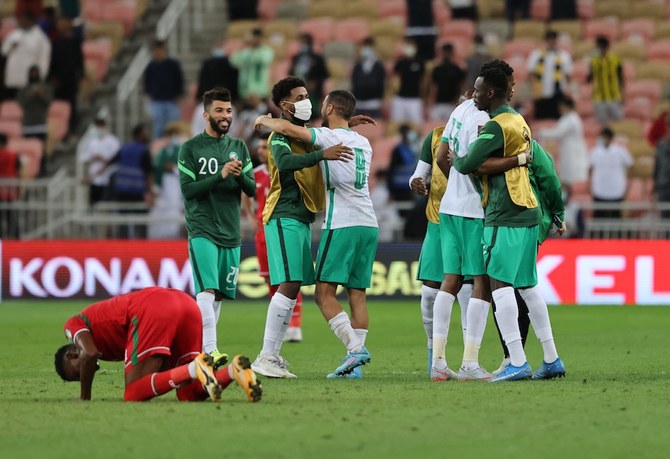
Saudi Arabia take giant step towards 2022 World Cup with tense win over Oman

After their victory over Oman, a win against Japan at Saitama Stadium will now take Saudi Arabia to Qatar 2022. (Reuters)
Short Url
Updated 27 January 2022
Follow

Saudi Arabia take giant step towards 2022 World Cup with tense win over Oman

  • The 1-0 win victory means Green Falcons top Group B on 19 points, with only 3 matches left

JEDDAH: Saudi Arabia stayed on course for the 2022 FIFA World Cup with a hard-fought 1-0 win over a spirited Oman in Jeddah on Thursday, with Firas Al-Buraikan getting the all-important goal for the under-par hosts early in the second half.

With Group B rivals Japan defeating China 2-0 and Australia breezing past Vietnam with a 4-0 win earlier in the day, the pressure was on, but victory keeps the Green Falcons four points clear of the Samurai Blue, next Tuesday’s opponents, and five above Australia with just three games left to play. Qatar is getting closer and closer.

A win against Japan at Saitama Stadium will now take Saudi Arabia to Qatar 2022.

Those earlier results may have put pressure on Saudi Arabia, but the team’s first half performance was the worst 45 minutes in the whole third round of qualification. Oman, missing several players due to COVID-19, were well organized and looking to deny the group leaders any space, so chances were always going to be at a premium early in the game. What was less expected was that the visitors would look likelier to score.

Midway through the first half, the Reds had the best opportunity of the game so far. Rabia Al-Alawi, always a busy and dangerous presence in attack, cut inside Ali Al-Bulaihi on the edge of the area and produced a low diagonal shot from the right that rolled just centimeters wide of the left hand post, with Mohammed Al-Owais in goal unable to do anything but stand, watch and hope.

In the absence of injured Salman Al-Faraj in the middle, the Saudis were not only giving the ball away far too often, but looked short of urgency and intensity. Coach Renard, who cut a frustrated figure on the sidelines and was continually signaling to his players to wake up, had seen enough by the half-hour and withdrew the anonymous and ineffectual Sami Al-Najei from the middle to bring in Hattan Bahebri.

Yet Oman continued to ask the questions. Right-back Amjad Al-Harthi’s low shot was almost turned in by Al-Alawi.

In the final five minutes of the first half, Saudi Arabia finally got home fans on their feet, though there were still no clear chances created. Al-Buraikan challenged the Omani goalkeeper for a Yasser Al-Shahrani cross and the volume rose soon after as the hosts appealed for a penalty for what they felt was a kick on Sultan Al-Ghannam. The half ended with a long-range half-volley from Abdulelah Al-Maiki and a shot from Al-Shahrani.

The one positive going into the break was that the second half could only get better, and so it seemed when Saudi Arabia took the lead three minutes after the restart. Befitting the performance, it was not the prettiest of goals, but nobody cared.

Omani goalkeeper Faiyz Al-Rashidi could only palm a low Al-Ghannam shot into the path of Al-Buraikan, and the 21-year-old was not going to miss from such close range.

That did not mean that the game opened up, as Saudi Arabia still struggled to impose any control and Oman still asked questions. Just past the midway point of the half, Al-Alawi had a header from close range fall straight into the arms of Al-Owais and soon after the same striker was turning in the area and firing just over.

Hearts were in mouths right at the end. Arshad Al-Alawi’s long-range effort was tipped over by Al-Owais and from the resultant corner, the same player somehow headed over from close range with the goal at his mercy.

That was the last action of what was, in truth, an ugly win — a fourth 1-0 victory out of seven games so far, but that will not bother anyone but the few Omanis in Jeddah. Saudi Arabia have taken another huge step towards a successive World Cup appearance and, with that vital cushion of four points still in place, the Green Falcons’ focus turns to Japan and a huge game on Tuesday.


Injuries a blessing in disguise for Australia as new Ashes heroes emerge

Updated 15 January 2026
Follow

Injuries a blessing in disguise for Australia as new Ashes heroes emerge

  • The absence of key bowlers did not hamper the home team’s determination to win the series

LONDON: Before the recently concluded Ashes series between Australia and England began, I mused on the potential impact which injuries to two of Australia’s fast bowlers may have on the outcome.

There was a sense, at least amongst England’s supporters, that they had a chance of winning the series or, at least, running Australia very close. As those supporters are now well aware, any such hopes were dashed in disappointing fashion.

England’s performances have been raked over ad infinitum in the media and on social media. It seems almost unnecessary to add to this welter of views and analyses.

However, it is worth going back to my pre-series thoughts about the potential impact of injuries and whether they did have an impact on the outcome.

One of the triumvirate of Australian quicks, Josh Hazlewood, was ruled out of the series before it began. Doubts over a second member, Pat Cummins, the team captain, were confirmed before the first Test. Ongoing back problems restricted him to one Test, the third.

This placed significant responsibility on the third member, Mitchell Starc, as well as the replacements for Hazlewood and Cummins and the stand-in captain, Steve Smith. Starc rose to the occasion magnificently.

At lunch on the second day, England sat in the box seat, 100 runs ahead and nine second innings wickets standing. By the end of the day, Australia had won the match. This was thanks to a seven-wicket haul by Starc and a swashbuckling 123 by Travis Head that left England “shellshocked,” according to its captain, Ben Stokes.

Head had been promoted to open because of injury to regular opener, Usman Khawaja. In the second Test at Brisbane, Starc reduced England to five for two in its first innings, going on to claim six wickets. It was a replacement quick bowler, Michael Nesser, who took the honors in the second innings with five wickets in Australia’s victory.

At Adelaide in the third Test, Starc was relatively quiet, claiming four wickets, as Cummins returned to claim six, along with spinner Nathan Lyon, who added five to take his total Test wickets to 567. He would not add more because of a hamstring injury. Cummins also sat out the rest of the series.

Although England won the fourth Test at Melbourne, in another two-day contest, Australia claimed the fifth Test at Sydney, where Starc took five wickets to take his series total to 31 and become player of the series. It may be safely concluded that injuries to key Australian bowlers did not hamper Australia’s determination to win the series.

One English broadcaster of considerable experience opined that England had played Australia’s second XI for most of the time. Although, in addition to key bowlers, Australia was without opening batter, Khawaja, for 1.5 Tests, this seems to be pushing the impact of injuries too far.

It also begs the question of why England could not take advantage. Three quick bowlers left the series due to injury, dealing a blow to a strategy based on fast bowlers.

Both Mark Wood and Jofra Archer have had their careers blighted by injury in recent years and it was little surprise that Wood’s tour ended after the first Test and Archer’s after the third.

Gus Atkinson followed them in Melbourne, whilst the super-human efforts to which Ben Stokes insisted on subjecting his body, finally got the better of him in the final Test. None of the batters got physically injured sufficiently to cause them to miss a Test.

The postmortems on where it all went wrong for England have intensified since the fifth Test was concluded. There are myriad views ranging from ex-players, to broadcasters, print and press media and anyone who loves the game.

The England and Wales Cricket Board will conduct an internal review. It will not be the first one and probably not the last. At the heart of any review should be a central question: If the two teams were judged to be close in ability prior to the series, as they were by most pundits, how did that judgement translate into a 4-1 advantage for Australia?

All manner of accusations have been levelled at England’s players and management.

Amongst these are inadequate preparation, poor technique, inferior mental toughness, arrogance, an unwavering belief in the aggressive, fearless, strategy adopted over the last three years, a laissez-faire culture that has led to a lack of discipline, and a drinking culture. This is a long charge sheet.

There is an old saying that cricket is played in the head. The strategy adopted by England over the last three years has put into the players’ heads the need to be positive and aggressive. Some have been confused by this mantra and have moved away from playing their natural game.

Joe Root has been an example. His class and technique do not need him to be any more aggressive than his talent naturally facilitates. The best opponents — India and Australia — have prepared themselves for England’s approach.

In this last series Australia effectively nullified it, except for several sessions. One of these was at Adelaide, where England made a bold attempt to chase down a target of 424 runs. The consensus view is that Australia outplayed England in the basics of the game.

Glenn McGrath, who took 563 Test wickets for Australia between 1993 and 2007, said that he “bored” people out. He aimed to hit the top of off stump with every delivery, saying that “it is pretty simple stuff, but the complicated thing is to keep it simple.”

This requires a combination of mental discipline and technical skill. Australia’s bowlers followed this approach more successfully than England’s. Australia’s batters scored faster than England when they needed to do so. When conditions changed, they adapted, as in the first innings in Brisbane where they ground out a total of 511 to gain a lead of 177 runs.

In the aftermath of the series defeat, Stokes reflected that “we’re at an interesting place as a team. What we managed to achieve in the first two-and-a-half years was very good.

“We wanted to grow as a team and we wanted to be even more consistent. If anything, we’ve done the opposite. We've started losing more. When that is happening on a consistent basis … you need to look at the drawing board and make some adjustments to get you back on the path of success.”

This suggests an acceptance that there is a problem and that a revised strategy may be implemented in which a return to the basics of the game and an acceptance that the match situation needs to be better assessed might be expected.

It also suggests that Stokes is thinking along different lines to the coach, who has said that he is “open to progress, open to evolution and some nipping and tucking,” but wants “ultimately to be able to steer the ship.”

In the first innings on day two of the third Test at Adelaide, with England reeling on 71 for four, Stokes played an innings which was the antithesis of the team’s attacking strategy.

In 41 degrees Celsius, he was targeted relentlessly by Australia’s attack, taking blows to his body and head, scoring 45 from 151 by the close of play. The following day he was finally dismissed for 83 from 198 deliveries. It was as if he was saying to his fellow batters, there are times when it is acceptable to adopt a different approach, according to the circumstance of the match.

It remains to be seen if there will be a change of approach or personnel when England’s next Test series is played against New Zealand in June. The next action is the T20 World Cup in India and Sri Lanka, a format which demands attacking approaches.

A failed campaign will place even greater pressure on England’s management. They are low on credit, having left behind a feeling of disappointment and anti-climax in Australia, for whom injuries proved to be a blessing in disguise.