Dubai regulator issues $135.5 million fine on Pakistani founder of Abraaj Group

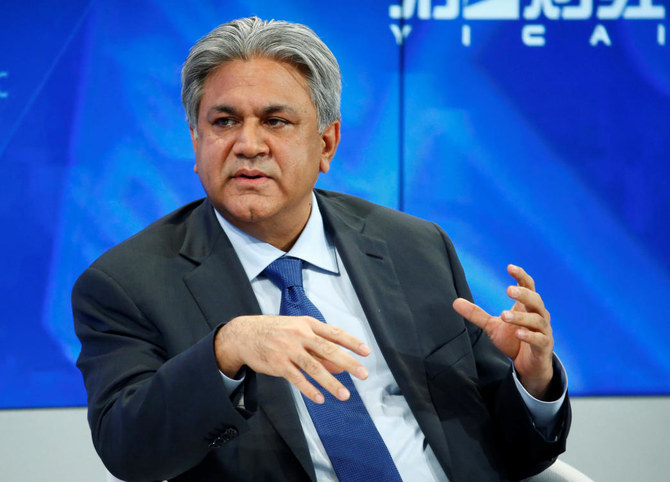
Arif Naqvi, founder and Group CEO, Abraaj Capital, and Co-Chair of the Governors Meeting for Investors 2010 attends a session at the World Economic Forum (WEF) in Davos January 27, 2010. (REUTERS/FILE)
Short Url
Updated 27 January 2022
Follow

Dubai regulator issues $135.5 million fine on Pakistani founder of Abraaj Group

  • Dubai Financial Services Authority DFSA said Arif Naqvi was slapped with the financial penalty ‘for serious failings’
  • It also said it was fining former Abraaj senior manager and one-time Chief Operating Officer Waqar Siddique $1.15 million

DUBAI, United Arab Emirates: A regulatory body in Dubai said Thursday it is fining the Pakistani-born founder of Abraaj Group, the now defunct Mideast private-equity firm accused of fraud, a staggering penalty of $135.5 million.
The Dubai Financial Services Authority DFSA said CEO Arif Naqvi was slapped with the financial penalty “for serious failings.” The regulator also said it was fining former Abraaj senior manager and one-time Chief Operating Officer Waqar Siddique $1.15 million.
The DFSA said the fine reflects the seriousness of Naqvi’s alleged misdoings and is based on his earnings from the Abraaj Group.
Although the fine is only provisional, it is the latest twist in a saga that has spanned multiple continents and touched some of the world’s wealthiest people. Abraaj managed $14 billion for investors at its peak before its collapse in 2018.
Naqvi and Siddique dispute the regulator’s decision and have referred the notices to the Financial Markets Tribunal, where the parties will present their cases. The DFSA’s decisions are therefore provisional.
Two men attempted unsuccessfully through the tribunal to prevent the notices of fines from being published and to hold the tribunal hearings in private.
Naqvi has asserted his innocence as he fights extradition from the UK to the US, where prosecutors allege that Abraaj Group enticed American investors with the promise of socially responsible investments when instead it engaged in massive fraud. He’s also accused of taking hundreds of millions of dollars from Abraaj for personal gain.
Some of the US investors allegedly defrauded include the Bill & Melinda Gates Foundation and a US government agency that facilitates American business investments in hospitals in developing countries.
A former top executive at the Dubai-based firm told a US court in 2019 that he was wrong to be silent as Abraaj Group tried to recover from massive cash shortfalls by exaggerating its finances to win over new investors. After signing a cooperation deal with US prosecutors, Egyptian-born Mustafa Abdel-Wadood, who oversaw Abraaj investments as a managing partner, pleaded guilty to charges including racketeering conspiracy and securities and wire fraud.
Naqvi founded Abraaj Group in 2002, from which it grew to become the largest private-equity firm in any emerging market. He was the firm’s largest shareholder and its ultimate decision maker, according to the regulator.
The regulator alleges that Navqi used a Cayman Islands-registered firm to mislead investors, withheld sale proceeds from investors less likely to complain or challenge the firm, drafted misleading statements to investors to cover up misuse of their funds, and was involved in the cover-up of a $400 million shortfall by borrowing money to produce bank balances and statements.
Abraaj Group operated out of Dubai’s financial free zone known as Dubai International Finance Center. Known as the DIFC, it is the financial heart of Dubai characterized by sleek mirrored business towers, Michelin-star restaurants and luxury hotels for traveling executives.


Qatar, Pakistan resolve to boost strategic, economic cooperation at Doha talks

Updated 24 February 2026
Follow

Qatar, Pakistan resolve to boost strategic, economic cooperation at Doha talks

  • Both countries urge dialogue on Afghanistan amid renewed border tensions between Islamabad and Kabul
  • Discussions focus on bilateral trade and investment, energy, defense, manpower and labor and culture

ISLAMABAD: Pakistan and Qatar on Tuesday agreed to deepen their strategic and economic cooperation during high-level talks between Prime Minister Shehbaz Sharif and his Qatari counterpart Sheikh Mohammed bin Abdulrahman bin Jassim Al Thani, Sharif’s office said.

Sharif visited Qatar along with a high-level delegation on the invitation of Qatari emir Sheikh Tamim bin Hamad Al Thani. The Pakistani premier also held meetings with Qatar’s trade and defense ministers to discuss cooperation in various domains.

The visit came at a time when Pakistan is seeking closer economic engagement with Gulf partners amid its broader push to stabilize the economy and attract investment, while maintaining security and defense cooperation with key regional states.

During their meeting in Doha, PM Sharif and Qatar’s Sheikh Mohammed discussed bilateral relations and exchanged views on regional and international developments, according to the Pakistan prime minister’s office.

“They reaffirmed the strong brotherly relations between Pakistan and Qatar and expressed satisfaction at the growing momentum in political, economic and institutional ties,” Sharif’s office said.

“Discussions focused on enhancing cooperation in the fields of trade and investment, energy, defense, manpower and labor and culture, with both sides stressing the importance of their task force to accelerate cooperation in all these areas.”

Pakistan and Qatar maintain strong trade and investment ties. In 2022, the office of Qatar’s emir said the Qatar Investment Authority planned to invest $3 billion in Pakistan, targeting sectors including transport, aviation, education, health, media, technology and labor.

Nearly 300,000 Pakistanis live and work in Qatar, according to Pakistan’s foreign office, with many employed in health, education, engineering and public services, as well as construction and transport. The two countries engage through forums such as the Bilateral Political Consultations and the Joint Ministerial Commission.

Sharif said he had productive discussions with Qatar’s emir, Sheikh Tamim bin Hamad Al Thani, on how the two sides could transform their brotherly ties into mutually beneficial economic relationships. 

“We also took stock of the regional situation,” he said on X. “Pakistan and Qatar will continue to work together for peace and stability in the region and beyond.”

Prime Minister Shehbaz Sharif (second right) meets the Qatari Emir Qatar’s emir Sheikh Tamim bin Hamad Al Thani (left) in Doha, Qatar, on February 24, 2026. (PID)

DIALOGUE WITH AFGHANISTAN

Earlier, Sharif and Qatar’s Deputy PM Sheikh Saoud Al-Thani discussed the situation in Afghanistan and called for dialogue to support regional stability.

The meeting took place amid renewed tensions after Islamabad carried out airstrikes last week on what it described as Tehreek-e-Taliban Pakistan (TTP) targets inside Afghanistan. Kabul said the strikes killed civilians and vowed to respond to what it called a violation of its sovereignty.

“Regional developments were also discussed, in particular the situation in Iran and Afghanistan,” Sharif’s office said in a statement. “Both sides emphasized the importance of dialogue, de-escalation and collective efforts to promote peace and stability in the region.”

This was the second time in less than six months that Pakistan conducted airstrikes in Afghanistan. The last strikes triggered heavy, weeklong clashes between the neighbors along their border before Qatar and Turkiye mediated a ceasefire between them in Oct. last year.

Separately, Sharif held meetings with Qatar’s State Minister for Trade Dr. Ahmed bin Mohammed Al-Sayed and a delegation of the Qatar Businessmen Association (QBA), highlighting Pakistan’s investment-friendly reforms.

He invited QBA members to explore opportunities in infrastructure, logistics, energy, agriculture, technology and export-oriented manufacturing, his office said.