

French construction design firm Clestra Hauserman opens regional HQ in Riyadh

1 / 2
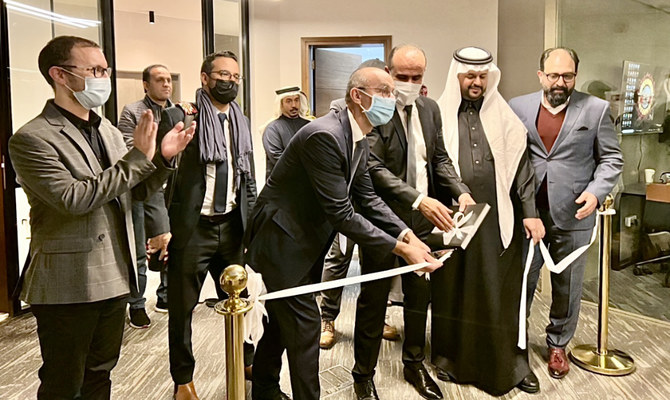
Laurent Estrade, head of the economic department at the French embassy of KSA, alongside Farid Habbas, ME director of Clestra Hauserman, cut the ceremonial ribbon on the opening of the firm's regional headquarters in Riyadh. (AN photo/Zaid Khashogji)
2 / 2
Clestra Hauserman opens their regional headquarters in Riyadh on Tuesday, Jan. 25, 2022. (AN photo/Zaid Khashogji)
Short Url
Updated 27 January 2022
Follow

French construction design firm Clestra Hauserman opens regional HQ in Riyadh

  • Today, the Clestra Hauserman Group has offices in Saudi Arabia, the UAE, Qatar, Kuwait and Oman

RIYADH: A French construction and design firm opened its regional headquarters in Riyadh on Tuesday, in a 50-50 partnership deal with Saudi holding company, Zuhair Al-Habib Group.

Known internationally for their eco-friendly partitions, Clestra Hauserman’s decision to open a regional office in the capital city comes one year after Crown Prince Mohammed bin Salman announced the Riyadh Strategy 2030 plan. 

“Saudi Arabia is our biggest market and as of this year I can say that 80 percent of our business comes from here,” said Farid Habbas, Middle East Director of Clestra Hauserman.

“It was a natural move for the firm that we were happy and ready for. Our firm will now have direct access to the local economy, which will help us gain financial and geographic opportunities,” he told Arab News.

Clestra Hauserman, which had been based in Dubai, joins more than 40 multinational companies that are moving to Riyadh.

The plan includes a policy stating that government and state-backed institutions will no longer sign any contracts with foreign entities from 2024 unless their regional headquarters are based in the Kingdom.

The policy, which paved way for a regional headquarters attraction program, aims to help make “Riyadh one of the ten largest city economies” in the world.

Founded in 1913, the French firm has had a regional presence for more than 40 years, specializing in the manufacture and installation of prefabricated demountable partitions. Its first project in Saudi Arabia was with Aramco in the 1970s and the firm extended its regional presence via the undertaking of airport projects and numerous educational buildings and corporate offices all over the Gulf area.

Today, the Clestra Hauserman Group has offices in Saudi Arabia, the UAE, Qatar, Kuwait and Oman.

“At Clestra, we develop and design our products from scratch, then completely fit out empty buildings from zero to completion,” Habbas told Arab News. “Our work extends to maintenance and after-sales services for all our clients, where we can be on-site for any adjustments needed within 24 hours.”

Habbas said what makes their products special is their move-and-removability, and likened it to the moveable block system made by Lego — the size of partitions can easily be adjusted by adding or removing panels.

“We’re not just selling a product, we’re selling a solution. We believe that Saudi Arabia is in need of the type of flexibility we can bring with our products and expertise, and not to mention the sustainable aspect of reusing our partitions again and again.”

One of their notable projects is at King Saud University, which has more than 200 kilometers of partitions made by the French firm that have been in use for more than 40 years — which speaks to the durability of the product, the secret of which lies in steel and aluminum.

Habbas added that the firm has plans to open a small factory in the first stage, followed a by a larger one in the second, in addition to carrying out workshops that aims to provide knowledge, expertise and training to employees, a move that should provide many jobs.

Fahad Al-Rasheed, CEO of the Royal Commission for Riyadh City said that by 2030 the regional headquarters program will contribute $18 billion to the local economy and create around 30,000 new jobs.

Since the announcement of the Saudi Vision 2030, as well as plans such as the Riyadh Strategy 2030 and the National Investment Strategy, the metropolis has flourished into a regional hub for businesses, trade and plentiful investment opportunities.


Oman targets clean energy, EVs in China talks

Updated 5 sec ago
Follow

Oman targets clean energy, EVs in China talks

JEDDAH: Oman is intensifying efforts to attract investment into its industrial sector and advance toward high-value, technology-led activities through an official visit to China.
The delegation was headed by Saleh Said Masan, undersecretary for commerce and industry at the Ministry of Commerce, Industry and Investment Promotion, who visited a number of major Chinese manufacturing facilities, according to the Oman News Agency.
Industrial development is a central pillar of Oman Vision 2040 and the Industrial Strategy 2040, which target a tripling of manufacturing output, the attraction of approximately 40 billion Omani rials ($104 billion) in investment, and the expansion of advanced and green industries.
“These visits fall within ongoing efforts to strengthen investment in the industrial sector, in line with Oman’s strategy to develop integrated industrial clusters and shift toward high value-added industries driven by innovation and advanced technologies,” ONA reported.
As part of the visit, the delegation toured global solar energy firm JA Solar, where discussions with senior management focused on the latest smart solar cell and panel manufacturing technologies.
Both sides reviewed progress on the establishment of JA Solar’s facility in the Sohar Freezone, following a previously signed memorandum of understanding with the ministry to develop an integrated solar cell and module plant with an estimated investment of $564 million.
Officials confirmed that construction is proceeding according to plan, underscoring Oman’s goal of positioning itself as a regional hub for clean energy technologies and supporting its net-zero emissions target by 2050.
The delegation also visited the headquarters of BAIC Motor Corp., where recent advancements in electric and smart vehicles, along with next-generation transportation systems, were presented.
During the visit, Masan highlighted the incentives and support mechanisms offered by Oman to attract investment in the electromechanical and transport industries, reaffirming the ministry’s commitment to facilitating high-quality industrial projects.
“This direction aims to establish joint ventures in automotive assembly and manufacturing, helping diversify the industrial base and create specialized employment opportunities for Omani professionals in engineering and digital technologies, in line with Industrial Strategy 2040 objectives,” ONA stated.
Concluding the visit, the undersecretary said the engagements reflect the ministry’s focus on a qualitative shift toward capital-intensive and technology-driven industries.
He added that integrating renewable energy projects with JA Solar and localizing vehicle technologies with BAIC would enhance manufacturing’s contribution to gross domestic product and strengthen the competitiveness of national products under the Made in Oman brand.
Masan emphasized the ministry’s commitment to fostering an attractive investment climate that encourages foreign direct investment and supports the integration of small and medium-sized enterprises into the global supply chains of leading international companies.