Peshawar Zalmi, Arab News renew partnership for Pakistan Super League

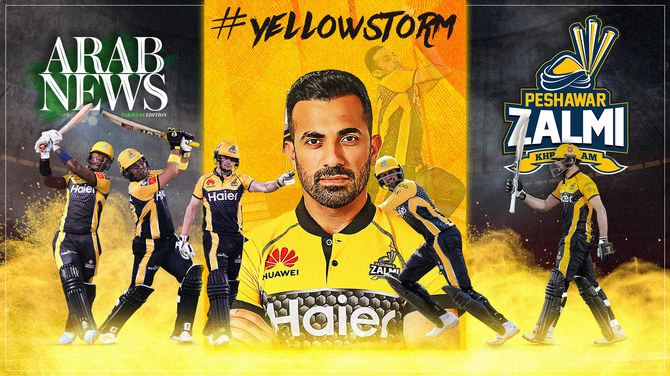
A poster showing players of Pakistan Super League franchise Peshawar Zalmi. (Photo courtesy: @PeshawarZalmi/Twitter)
Short Url
Updated 27 January 2022
Follow

Peshawar Zalmi, Arab News renew partnership for Pakistan Super League

  • Arab News has been Peshawar Zalmi’s media partner for the PSL since the tournament’s fifth edition in 2020
  • Seventh edition of the competition will start in Karachi on Thursday and run through Feb. 27

KARACHI: Peshawar Zalmi, one of the six teams of the Pakistan Super League (PSL), on Wednesday named Arab News Pakistan as its international media partner for the tournament.

Peshawar Zalmi represents Peshawar, the capital of the country’s northwestern Khyber Pakhtunkhwa province. The other teams come from Lahore, Karachi, Islamabad, Quetta and Multan.

The seventh edition of the competition will start in Karachi on Thursday and run through Feb. 27.

Arab News has been Peshawar Zalmi’s media partner for the PSL since the tournament’s fifth edition in 2020.

“We have chosen Arab News as our international media partner for last two seasons and I am glad to renew this for the 2022 edition,” Javed Afridi, the owner of Peshawar Zalmi, announced on Wednesday. 

“Arab News is not only one of the readers’ first choice in the Middle East but it’s Pakistan digital edition is among the most popular in South Asia due to its excellent coverage and positive reporting.”

Launched in 2018, Arab News Pakistan is an edition of Arab News, the biggest English-language daily in Saudi Arabia and a leading newspaper in the Middle East. 

“We are happy to have partnered with Peshawar Zalmi and hope that the franchise will win the final of the seventh edition,” Asia bureau chief of Arab News, Baker Atyani said. “The team has been showing tremendous performance.” .

He added that the PSL had played a major role in promoting cricket in Pakistan and abroad: “PSL deserves to be credited for the return of cricket to Pakistan, and Peshawar Zalmi is at top of the list because it was its owner Javed Afridi who led the campaign to persuade foreigner players to play in Pakistan.”

“We wish Peshawar Zalmi best of luck for the upcoming tournament, and PSL supporters a very exciting and a successful season.”

Pakistan had largely been starved of international cricket since a 2009 attack on a bus carrying Sri Lankan cricketers in Lahore, which killed eight Pakistanis and wounded six players and a British coach. The incident forced Pakistan to play home matches in the United Arab Emirates, with foreign players refusing to play on Pakistani soil.

But the unprecedented popularity of PSL, which brought 40 foreign players to the country in 2019, is seen as pivotal in changing the global cricket community’s opinion of Pakistan’s ability to host international matches. 

Over 80 million people, roughly 70 percent of Pakistan’s TV-viewing public, tuned in to watch the final game of the series last year.

The PSL has been a huge success, even though many of the matches in the first five editions had to be played in the United Arab Emirates due to security risks. In 2020, all matches of the series were played in Pakistan for the first time, but the final in March was delayed due to the COVID-19 outbreak and finally played in November before an empty stadium.

Last year, the tournament was postponed after the first 14 matches due to a surge in coronavirus cases in March, and rest of the games, were played in June in Abu Dhabi.

In the final, Multan Sultans defeated Peshawar Zalmi by 47 runs to lift the trophy. 


Survivor recalls ‘chaos’ after suicide bomber struck Islamabad mosque

Updated 5 sec ago
Follow

Survivor recalls ‘chaos’ after suicide bomber struck Islamabad mosque

  • Witnesses say worshippers were bowing in prayer when blast tore through imambargah
  • Authorities blame Daesh network, say attack planned and bomber trained in Afghanistan

ISLAMABAD: Hamza Ali Naqvi was bowing with his hands on his knees during Friday prayers when the first shot rang out. The 21-year-old university student initially mistook the sharp crack for distant fireworks. Seconds later, a second shot, much louder and much closer, resounded through the Qasr-e-Khadijatul Kubra mosque.

“We were prostrating,” Naqvi recalled, his eyes still showing signs of fear as he described the moment the floor beneath him shook from the force of the blast. “I immediately got up, looked around and [saw that] chaos had broken out.”

Friday’s suicide bombing in the Tarlai Kallan area on the outskirts of Islamabad has left 32 people dead and over 150 injured, marking the deadliest assault on the Pakistani capital in nearly two decades. On Saturday, a police officer was killed and four suspects, including an “Afghan Daesh mastermind” behind the attack, were arrested in overnight raids in Peshawar and Nowshera, according to a statement released by Pakistan’s Interior Ministry on social media.

For the survivors, everything else is secondary to the carnage they witnessed in the moments that followed the blast. Naqvi, who had been standing near the door in the fifth or sixth row, said that he stepped over the bodies to reach the epicenter of the explosion.

“When I reached there, I saw a severed head,” he said. “I found out later that it was the head of the attacker.”

“Because people were prostrating, most injuries were to the legs and backs,” he added. “When we lifted the injured, their legs were broken. Those whom I personally helped had broken legs. As we were lifting them, they were screaming and crying.”

Among the screams was the voice of a child, no older than 10, standing over the body of his father, Naqvi recalled as he prayed for the departed souls at the graves of those laid to rest on Saturday.

“I have become an orphan,” he said, quoting the boy who was screaming.

“We were helpless,” he added. “There was nothing we could do.”

While Naqvi was trying to help the injured, 24-year-old Malik Aon Abbas did not survive the attack. Abbas, who had just been engaged and was set to be married later this year, is being hailed as a hero by his family who say he prevented an even higher death toll.

His younger brother, Muntazir Mehdi, said Abbas was in the back rows when two attackers stormed into the mosque. One of them reportedly fled, but the other, already wounded by gunfire from security guards, rushed toward the main congregation.

“The attacker continued firing inside, but my brother abandoned his prayer and caught him,” Mehdi said. “He restrained him and grabbed him. As soon as my brother took hold of him, the attacker detonated himself.”

Mehdi, who shared a deep bond with his brother through their mutual love of religious gatherings and Abbas’s hobby of going live on TikTok, said the family stood between grief and pride.

“Because of my brother, had he, God forbid, not stopped this man, a very major tragedy would have occurred,” Mehdi continued. “He has raised all our heads with pride.”

Pakistan’s interior ministry said on Saturday the attack was carried out by Daesh, with its planning and the bomber’s training being done in Afghanistan.

“The nexus of terrorism under Afghan Taliban patronage remains a serious threat to regional peace,” it said in a social media post, adding that a law enforcement official was killed during the raids carried out to capture the facilitators of the attacker.

Taliban’s Afghan government has denied any role in the attack advising Pakistani authorities to “fulfil their obligations, responsibly review their policies, and adopt a constructive approach based on positive engagement and cooperation.”

For survivors like Naqvi, the horror of that Friday is far from over.

“I went to university, but even there, the same images kept coming back,” he said. “It keeps replaying in my mind. It is difficult to come out of it.”