

Sales tax to increase solar panel rates in Pakistan by 30% — stakeholders

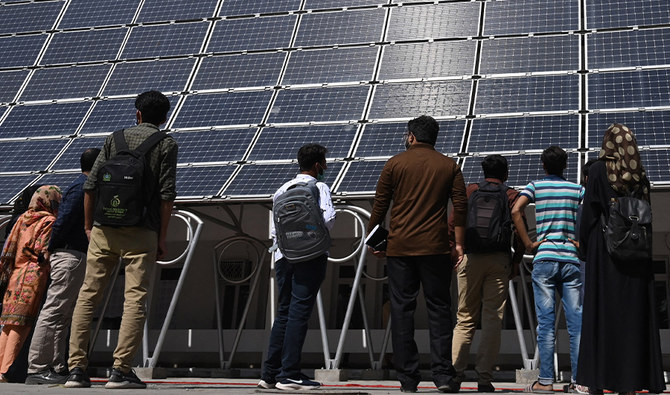
Students look at the facade of a building made with solar panels producing some 148 Kilowatts during its inauguration at the University of Engineering and Technology in Lahore on October 12, 2020. (AFP/FILE)
Short Url
Updated 26 January 2022
Follow

Sales tax to increase solar panel rates in Pakistan by 30% — stakeholders

  • PM Khan wants to reduce carbon emissions by adding 30 percent clean energy to the country’s power mix by 2030
  • Dealers and importers warn the imposition of sales tax can undermine the government’s own renewable energy policy

KARACHI: The imposition of sales tax on the import of solar panels in Pakistan would increase their price by about 30 percent, said dealers and importers on Tuesday, adding it would also make it difficult to add clean power to the country’s energy mix in the coming years.
Pakistan levied sales tax on nearly 150 items, including solar panels, through a supplementary finance bill that was approved by the National Assembly earlier this month to meet one of the conditions of the International Monetary Fund (IMF) for the revival of a stalled $6 billion loan program.
“After the implementation of this tax, the price of solar panels will increase from Rs55 per watt to Rs70 per watt. This is almost a 30 percent surge,” Naveed Karar, vice chairman of the Pakistan Solar Association (PSA), said while addressing a joint news conference with the Karachi Electronic Dealers Association (KEDA).
“If the government will not take this decision back, its impact will be devastating for solarization and industry,” he added.
Pakistan is pursuing Prime Minister Imran Khan’s policy to reduce carbon emissions and decrease its reliance on imported fossil fuel, as it hopes to add 30 percent clean energy to its power mix by the end of this decade.



Saleem Memon, senior vice president of the Karachi Electronic Dealers Association, can be seen with the officials and representatives of the Pakistan Solar Association at a news conference in Karachi, Pakistan, on January 25, 2022. (AN Photo)

Dealers said the recent move to tax solar panels would undermine that vision.
“The imposition of sales tax on the import of solar panels will definitely discourage the government’s efforts to increase the share of renewable energy to the total power mix,” Karar said, adding the decision had been taken despite assurances from the finance minister that the product would not be taxed.
Saleem Memon, senior vice president of KEDA, said sales tax would increase the rate by about Rs12,000 per panel of 540 watts.
“This will be beyond the purchasing power of people who live in the country’s remote areas and frequently rely on this technology,” he added.
Memon said the sales tax would be over and above the freight costs and other charges which were already too high.
“Freight charges have been increased from $800 per container to $6,000,” he said, adding: “The allied products of solar panels, including inverters and batteries, have also been taxed.”
Muhammad Zakir Ali, member of the PSA executive committee, informed that 80 percent solar panels were used by people who did not have direct access to electricity in Pakistan.
He informed that people had imported about 2,380 megawatts of solar panels in 2021 and were planning to increase the quantum further.
“The decision will discourage the use of solar power system in the country since there is no local production of these panels,” Ali said, adding: “The government should have taken the stakeholders into confidence before taking this decision.”
The installation of a solar system is a one-time investment which provides continuous power supply for more than 25 years without additional costs when compared to other power plants that need costly fuels, he added.


Pakistan’s Mahnoor Omer named among TIME’s ‘Women of the Year’ for 2026

Updated 56 min 18 sec ago
Follow

Pakistan’s Mahnoor Omer named among TIME’s ‘Women of the Year’ for 2026

  • Omer moved a Pakistani court against the so-called ‘period tax’ in Sept. 2025 which has since sparked a national debate
  • Taxes on sanitary pads in Pakistan can add up to 40 percent to retail price, UNICEF says only around 12 percent women use such products

ISLAMABAD: Pakistani women’s rights activist Mahnoor Omer, who fought against taxes on menstrual products, has been named among the TIME magazine’s ‘Women of the Year’ for 2026.

Omer’s efforts have been recognized alongside 16 activists, artists, athletes and businesswomen in the TIME’s Women of the Year 2026 list, including Olympic gold medalist Sydney McLaughlin-Levrone and Oscar-nominated filmmaker Chloe Zhao.

Dissatisfied with the efforts to educate Pakistani girls about sexual violence, Omer founded the Noor Foundation at the age of 14 and held her own workshops with village girls about everything from climate change to menstruation, according to the TIME magazine.

Two years later, a conversation with a domestic worker about the price of pads made her realize that not everyone could afford these essentials. She moved a court against the so-called “period tax” in Sept. 2025 and the case has sparked a national debate on the subject, considered a taboo by many in Pakistan, since its first hearing late last year.

“A decade and one law degree after her interest in activism was sparked, Omer, now 25, is putting her passion and expertise to work in the name of gender equity,” TIME wrote about Omer on its website.

Taxes imposed on sanitary products in Pakistan can add up to 40 percent to the retail price. UNICEF estimates just 12 percent of women in the country use commercially produced pads or tampons. The alternative, using cloth, risks health impacts including rashes and infections, and can make it impossible for girls to attend school while menstruating.

Omer’s suit, which awaits the government response, has sparked a national discussion. She says she spoke about menstruation to her father and male cousins, who thanked her for standing up for their daughters.
The 25-year-old, who is currently enrolled in a master’s degree in gender, peace, and security at the London School of Economics, sees this case as just the first of many.

“I’m not free until every woman is free,” she was quoted as saying by TIME. “I want to leave no stones unturned in terms of what I can do with the next few decades, as a lawyer for the women in my country and gender minorities in general.”