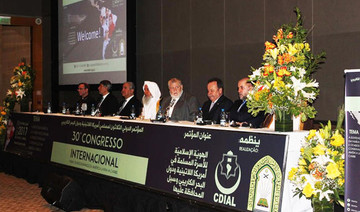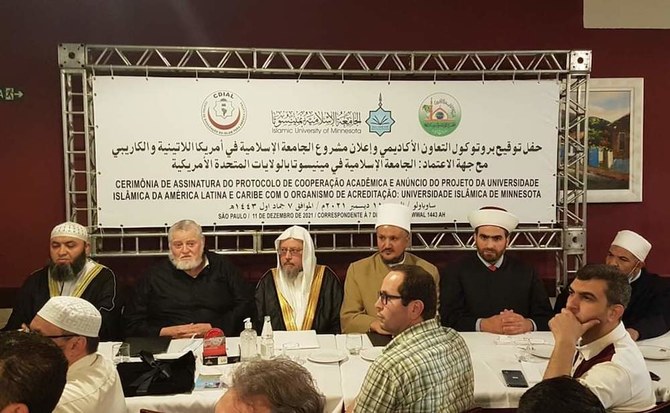


SAO PAULO: Latin American Islamic associations gathered in the Brazilian city of Sao Paulo recently to sign an agreement to create the Latin American and Caribbean Islamic University.
The academic institution will allow future Muslim leaders to study in their own region, without the need to move to Middle Eastern countries and other Muslim nations.
Imams in Latin America had been discussing the idea for years. Now, Brazil’s Islamic Dissemination Center for Latin America, known by the Portuguese acronym CDIAL, and the Supreme Council of Imams and Islamic Affairs in Latin America and the Caribbean have finally made it possible.
CDIAL and the council established a deal with the Islamic University of Minnesota, which will provide academic courses and materials for the new institution.
Initially, it will have headquarters in Sao Paulo, with classes in Portuguese, and Mexico City, with classes in Spanish.
“We’re beginning with the cities with a higher number of potential students. But our idea is that other countries create their own branches in the future,” CDIAL’s Vice President Ziad Saifi told Arab News.
He said the program was inspired by traditional Islamic courses such as those offered by the Islamic University of Madinah in Saudi Arabia and Al-Azhar University in Egypt.
“The university’s goal is not only to educate future sheikhs, but any person who wants to deepen his or her knowledge of Islam,” he added.
Even non-Muslim students will be able to enroll in classes, said Egyptian-born Sheikh Abdelhamid Metwally, who will be the university’s president and academic director.
“We want to educate people in Islamic culture and tradition. We certainly will be able to work on the formation of sheikhs. Students who desire to pursue such a path will be able to continue their studies,” he added.
“But we also want to simply educate people on Islam. Both Muslims and non-Muslims need to have a better understanding of our religion.”
Living in Brazil for 15 years, Metwally believes it is desirable to train in Latin America religious leaders who will work in the region.
That is also the opinion of Sheikh Mohamed Mansour, who will coordinate the Spanish-language courses in Mexico City.
“We need to educate people here so they can think from here. Many times, people go to the Middle East to study and when they come back, they want to impose the Middle Eastern culture in Latin America. That’s not possible,” he told Arab News.
Islam has been growing throughout Latin America and the Caribbean, “but we aren’t growing well if we don’t have true knowledge,” Mansour said. “We need an academic foundation, something that goes beyond the mosques’ teaching.”
In Mexico, he explained, only Spanish can be spoken in class except for Arabic-language courses — if a professor or instructor can only speak Arabic, a translator will be present. “God willing, soon we will have masters and PhD courses too,” he added.
Saifi said many sheikhs and the Muslim community as a whole have been supporting the creation of the university.
“Thankfully, people have been giving their time to this project and working on the translation of educational materials and other tasks,” he added, expressing hope that courses will begin in August.
The coordinating group is working on the university’s official accreditation in each of the region’s countries.
At first the university will operate with distance learning, given the rising number of COVID-19 cases in most Latin American countries. But a physical location is being selected in Sao Paulo, Saifi said.
No distinction will be made between Sunni and Shiite students, and men and women alike will be able to enroll.
Saifi expressed hope that in the future, the Brazilian branch will welcome students coming from other Portuguese-language countries such as Angola and Mozambique.
“We still have a low number of mosques in Brazil, but their number is growing. We’ll certainly need more sheikhs and people educated on Islam,” he said.
Metwally agreed, saying: “In my own community in Sao Paulo, we have members who are already interested in enrolling. We’ll educate good Muslims.”