German woman in dock over joining Daesh in Syria as teenager

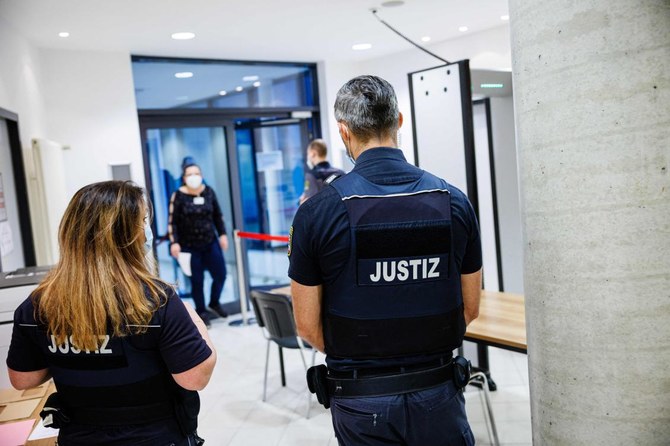
Justice officers secure access to the high security area at the District Court Halle (Justizzentrum) in Halle an der Saale, eastern Germany, on January 25, 2022, before the start of the trial against Leonora Messing. (AFP)
Short Url
Updated 25 January 2022
Follow

German woman in dock over joining Daesh in Syria as teenager

  • Leonora Messing, 21, is on trial on suspicion that she and her husband enslaved a Yazidi woman
  • She joined Daesh in Syria at the age of 15

BERLIN: A German woman who traveled to Syria as a 15-year-old to join Daesh goes on trial on Tuesday accused of aiding and abetting crimes against humanity.
Leonora Messing, now aged 21, is in the dock in the eastern German city of Halle on suspicion that she and her Daesh husband enslaved a Yazidi woman in Syria in 2015.
During the course of the trial scheduled to last until at least mid-May and being held behind closed doors, Messing will also face charges of membership of a terrorist organization and weapons law violations.
The high-profile case has prompted soul searching in Germany about how a teenage girl from a small town became radicalized and joined the Islamist cause.
Messing ran away from her home for the Daesh-controlled part of Syria in March 2015.
After reaching Raqqa, then the de facto “capital” of Daesh in Syria, she became the third wife of a German national originally from that region.
Messing’s father, a baker from the German village of Breitenbach, only learned his daughter had converted to a radical brand of Islam by opening her abandoned computer and reading her journal after her disappearance.
Six days after she vanished, her father received a message informing him his daughter “chose Allah and Islam” and that she had “arrived in the caliphate.”
“She was a good student,” her father, Maik Messing, told regional broadcaster MDR in 2019.
“She used to go to a retirement home to read to the elderly. She took part in carnival as a majorette. That was when a lot of the people we know saw her for the last time.”
Messing had been living a double life and was visiting, apparently without her parents’ knowledge, a mosque in the western city of Frankfurt that was in the crosshairs of Germany’s domestic intelligence service.
She is among the more than 1,150 Islamists who left Germany from 2011 for Syria and Iraq, according to government findings.
Her case has attracted particular scrutiny due to her young age, and because her father agreed to be followed for four years by a team of reporters from public broadcaster NDR.
As part of the report, he made public thousands of messages he continued to exchange with his daughter, offering rare insights into daily life under Daesh, but also eventually her attempts to break free.
Prosecutors say Messing took part in human trafficking, after her husband “bought” and then “sold” a 33-year-old Yazidi woman.
Messing, who had given birth to two small girls, wound up detained in a Kurdish-controlled camp in northern Syria.
In December 2020, she was repatriated in one of four operations bringing 54 people, most of them children, back to Germany.
Although she was arrested upon her arrival at Frankfurt airport, Messing was later released.
Germany has repeatedly been ordered by its courts to repatriate the wives and children of Daesh recruits.
A Berlin tribunal had demanded in October 2019 that a German woman and her three children be brought back, arguing that the minors were traumatized and should not be separated from their mother.
There are an estimated 61 Germans still in camps in northern Syria, as well as around 30 people with a link to Germany, according to official estimates.
A German court in November issued the first ruling worldwide to recognize crimes against the Yazidi community as genocide, in a verdict hailed by activists as a “historic” win for the minority.
The Yazidis, a Kurdish-speaking group hailing from northern Iraq, have for years been persecuted by Daesh militants who have killed hundreds of men, raped women and forcibly recruited children as fighters.


Coast Guard is pursuing another tanker helping Venezuela skirt sanctions, US official says

Updated 22 December 2025
Follow

Coast Guard is pursuing another tanker helping Venezuela skirt sanctions, US official says

  • US oil companies dominated Venezuela’s petroleum industry until the country’s leaders moved to nationalize the sector, first in the 1970s and again in the 21st century under Maduro and his predecessor, Hugo Chávez

WEST PALM BEACH, Florida: The US Coast Guard on Sunday was pursuing another sanctioned oil tanker in the Caribbean Sea as the Trump administration appeared to be intensifying its targeting of such vessels connected to the Venezuelan government.
The pursuit of the tanker, which was confirmed by a US official briefed on the operation, comes after the US administration announced Saturday it had seized a tanker for the second time in less than two weeks.
The official, who was not authorized to comment publicly about the ongoing operation and spoke on the condition of anonymity, said Sunday’s pursuit involved “a sanctioned dark fleet vessel that is part of Venezuela’s illegal sanctions evasion.”
The official said the vessel was flying a false flag and under a judicial seizure order.
The Pentagon and Department of Homeland Security, which oversees the US Coast Guard, deferred questions about the operation to the White House, which did not offer comment on the operation.
Saturday’s predawn seizure of a Panama-flagged vessel called Centuries targeted what the White House described as a “falsely flagged vessel operating as part of the Venezuelan shadow fleet to traffic stolen oil.”
The Coast Guard, with assistance from the Navy, seized a sanctioned tanker called Skipper on Dec. 10, another part of the shadow fleet of tankers that the US says operates on the fringes of the law to move sanctioned cargo. It was not even flying a nation’s flag when it was seized by the Coast Guard.
President Donald Trump, after that first seizure, said that the US would carry out a “blockade” of Venezuela. It all comes as Trump has ratcheted up his rhetoric toward Venezuelan President Nicolás Maduro.
This past week Trump demanded that Venezuela return assets that it seized from US oil companies years ago, justifying anew his announcement of a “blockade” against oil tankers traveling to or from the South American country that face American sanctions.
Trump cited the lost US investments in Venezuela when asked about his newest tactic in a pressure campaign against Maduro, suggesting the Republican administration’s moves are at least somewhat motivated by disputes over oil investments, along with accusations of drug trafficking. Some sanctioned tankers already are diverting away from Venezuela.
US oil companies dominated Venezuela’s petroleum industry until the country’s leaders moved to nationalize the sector, first in the 1970s and again in the 21st century under Maduro and his predecessor, Hugo Chávez. Compensation offered by Venezuela was deemed insufficient, and in 2014, an international arbitration panel ordered the country’s socialist government to pay $1.6 billion to ExxonMobil.
Maduro said in a message Sunday on Telegram that Venezuela has spent months “denouncing, challenging and defeating a campaign of aggression that goes from psychological terrorism to corsairs attacking oil tankers.”
He added: “We are ready to accelerate the pace of our deep revolution!”
Sen. Rand Paul, R-Kentucky, who has been critical of Trump’s Venezuela policy, called the tanker seizures a “provocation and a prelude to war.”
“Look, at any point in time, there are 20, 30 governments around the world that we don’t like that are either socialist or communist or have human rights violations,” Paul said on ABC’s’ “This Week.” ”But it isn’t the job of the American soldier to be the policeman of the world.”
The targeting of tankers comes as Trump has ordered the Defense Department to carry out a series of attacks on vessels in the Caribbean and eastern Pacific Ocean that his administration alleges are smuggling fentanyl and other illegal drugs into the United States and beyond.
At least 104 people have been killed in 28 known strikes since early September. The strikes have faced scrutiny from US lawmakers and human rights activists, who say the administration has offered scant evidence that its targets are indeed drug smugglers and that the fatal strikes amount to extrajudicial killings.
Trump has repeatedly said Maduro’s days in power are numbered. White House chief of staff Susie Wiles said in an interview with Vanity Fair published last week that Trump “wants to keep on blowing boats up until Maduro cries uncle.”
Sen. Tim Kaine, D-Virginia, told NBC’s “Meet the Press” on Sunday that Trump’s use of military to mount pressure on Maduro runs contrary to Trump’s pledge to keep the United States out of unnecessary wars.
Democrats have been pressing Trump to seek congressional authorization for the military action in the Caribbean.
“We should be using sanctions and other tools at our disposal to punish this dictator who is violating the human rights of his civilians and has run the Venezuelan economy into the ground,” Kaine said. “But I’ll tell you, we should not be waging war against Venezuela. We definitely should not be waging war without a vote of Congress.