

Pakistan's COVID-19 positivity ratio above 10% for sixth consecutive day

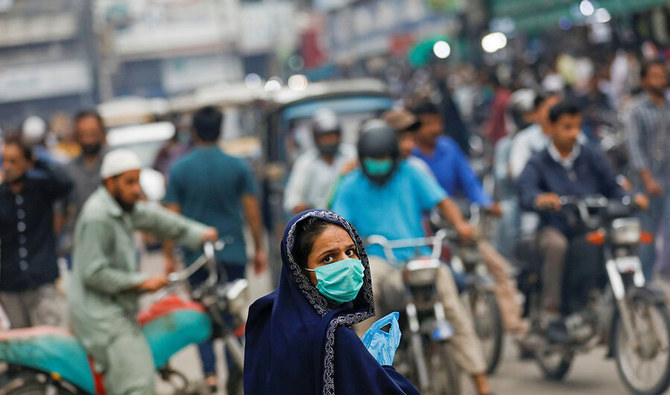
A woman wears a protective face mask as she walks along a road, as the outbreak of the coronavirus disease (COVID-19) continues in Karachi, Pakistan, July 7, 2020. (REUTERS/File)
Short Url
Updated 25 January 2022
Follow

Pakistan's COVID-19 positivity ratio above 10% for sixth consecutive day

  • Omicron-driven fifth wave of infections continues to sweep the South Asian nation
  • The country reported 17 fatalities and 6,357 new infections in the last 24 hours

ISLAMABAD: The coronavirus positivity ratio in Pakistan remained above 10 percent for the sixth consecutive day on Tuesday, with the omicron-driven fifth wave of infections sweeping the South Asian nation. 

The National Command and Operation Centre (NCOC), which oversees the country's pandemic response, recorded the virus positivity rate at 12.81 percent on Tuesday. 

The South Asian nation reported 17 fatalities and 6,357 new cases of coronavirus in the last 24 hours, according to official figures. 

Pakistan is currently battling the fifth wave of the pandemic, as officials maintain the fresh surge in the number of cases has been driven by the highly transmissible omicron strain. 

Pakistan’s planning minister Asad Umar, who also heads the NCOC, last week urged people not to take the omicron strain lightly. 

“More than two thousand people dying of covid daily in the US. So, when you hear omicron is mild, it can still kill you,” he said in a Twitter post. 

The minister said latest research showed booster dose provided significant protection against the disease. “So if it’s been 6 months since 2nd dose, get a booster,” he urged people. 

Pakistan has so far administered at least one dose of a coronavirus vaccine to 103,805,835 people, according to official figures.  

Over 80 million individuals have been fully vaccinated in the country.


Pakistan finance chief calls for stronger emerging market voice during Saudi conference

Updated 6 sec ago
Follow

Pakistan finance chief calls for stronger emerging market voice during Saudi conference

  • Aurangzeb tells Saudi state media developing economies must assume larger global role
  • Minister says AlUla conference can strengthen coordination among emerging economies

KARACHI: Pakistan’s Finance Minister Muhammad Aurangzeb on Thursday called for developing economies to play a greater role in shaping global economic governance in an interview on the sidelines of the AlUla Conference for Emerging Market Economies in Saudi Arabia.

The conference, hosted by the Kingdom’s Finance Ministry, brings together top government functionaries, central bank governors and policymakers from emerging markets to discuss debt sustainability, macroeconomic coordination and structural reforms amid global economic uncertainty.

In a conversation with the Saudi Press Agency, Aurangzeb described the conference as a timely platform for dialogue at a moment of heightened geopolitical tensions, trade fragmentation and rapid technological change, including advances in artificial intelligence.

“It is not merely about discussions but about translating deliberations into concrete policy actions and execution over the course of the year,” he said, according to a statement circulated by the Finance Division in Islamabad.

The minister said emerging markets’ growing share of global output and growth should be matched by greater influence in international decision-making.

He noted these economies must strengthen collective dialogue and coordinated policy responses to address shared challenges, adding that the global landscape had evolved significantly since the inaugural edition of the conference.

Aurangzeb expressed confidence that the outcomes of the AlUla Conference would contribute to strengthening coordination among emerging economies and reinforcing their collective voice in shaping a more inclusive and resilient global economic order, the statement added.