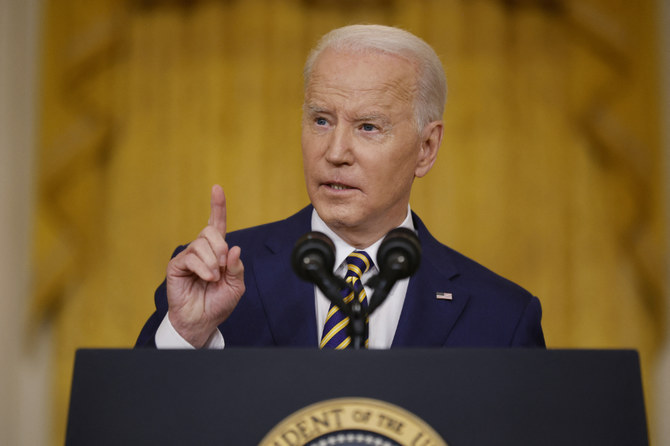
Biden caught insulting Fox News journalist

Fox News reporter said of the president: “nobody has fact-checked him yet.” (AFP)
Short Url
Updated 25 January 2022
Follow

Biden caught insulting Fox News journalist

WASHINGTON: US President Joe Biden was caught on a live microphone Monday calling a Fox News journalist a “stupid son of a bitch” on the sidelines of a White House photo op.
As journalists were leaving the room after the event, a reporter from Fox News, the favorite channel of conservatives, asked whether inflation is a political liability.
The Democratic leader, possibly unaware that his microphone was still on, began by deadpanning: “It’s a great asset. More inflation.”
And then muttered, “What a stupid son of a bitch,” before glancing briefly down.
A pool reporter who was in the room at the time admitted to not being able to hear what Biden actually said over the noise.
But he added that he would “direct your attention to video of the event if you are curious how the president really feels about being asked about inflation from Fox’s Peter Doocy.”
Doocy shrugged the insult off in a later interview on Fox.
“Yeah nobody has fact-checked him yet and said it’s not true,” he said, nonchalantly.


Paris exhibition marks 200 years of Le Figaro and the enduring power of the press

Updated 17 January 2026
Follow

Paris exhibition marks 200 years of Le Figaro and the enduring power of the press

  • The exhibition celebrated the bicentennial of Le Figaro, offering visitors a rare opportunity to step inside the newspaper’s vast historical archive

PARIS: One of France’s most influential newspapers marked a major milestone this month with a landmark exhibition beneath the soaring glass nave of the Grand Palais, tracing two centuries of journalism, literature and political debate.
Titled 1826–2026: 200 years of freedom, the exhibition celebrated the bicentennial of Le Figaro, offering visitors a rare opportunity to step inside the newspaper’s vast historical archive. Held over three days in mid-January, the free exhibition drew large crowds eager to explore how the title has both chronicled and shaped modern French history.
More than 300 original items were displayed, including historic front pages, photographs, illustrations and handwritten manuscripts. Together, they charted Le Figaro’s evolution from a 19th-century satirical publication into a leading national daily, reflecting eras of revolution, war, cultural change and technological disruption.
The exhibition unfolded across a series of thematic spaces, guiding visitors through defining moments in the paper’s past — from its literary golden age to its role in political debate and its transition into the digital era. Particular attention was paid to the newspaper’s long association with prominent writers and intellectuals, underscoring the close relationship between journalism and cultural life in France.
Beyond the displays, the program extended into live journalism. Public editorial meetings, panel discussions and film screenings invited audiences to engage directly with editors, writers and media figures, turning the exhibition into a forum for debate about the future of the press and freedom of expression.
Hosted at the Grand Palais, the setting itself reinforced the exhibition’s ambition: to place journalism firmly within the country’s cultural heritage. While the exhibition has now concluded, the bicentennial celebrations continue through special publications and broadcasts, reaffirming Le Figaro’s place in France’s public life — and the enduring relevance of a free and questioning press in an age of rapid change.