ISLAMABAD: Fingerprints of Zahir Jaffer, the prime accused in the grisly murder of 27-year-old Noor Mukadam in July last year, were not found on a knife recovered from the crime scene, while his pants contained no blood stains at the time of his arrest, the investigating officer in the case said on Monday.
Mukadam, the daughter of a former Pakistani diplomat, was found beheaded at a residence in Islamabad’s upscale F-7/4 neighborhood, in a case that has sparked public outrage and grabbed media attention unlike any other recent crime against women. The prime accused was arrested from the crime scene on the day of the murder and has since been in Rawalpindi’s Adiala Jail.
The case is now in the concluding stage in an Islamabad district court, where additional sessions judge Atta Rabbani has been conducting the hearings. Eyewitnesses have recorded their statements in the case and defense attorneys are now cross-examining them.
During Monday’s proceedings, Jaffer’s counsel, Sikandar Zulqarnain, cross-examined the investigating officer, Inspector Abdul Sattar, to point out weaknesses and loopholes in his testimony.
“Zahir’s marks on the knife are not found in the fingerprint report,” the investigating officer said in response to a question from the defense counsel. “When we arrested Zahir, his pants did not contain any blood stain.”
DNA tests conducted on clothes, the weapon of offense and other material collected from the crime scene had suggested earlier in August 2021 that Jaffer had murdered Mukadam.
An official of the Punjab Forensic Science Agency said at the time that the victim’s blood and the accused’s fingerprints were found on the murder weapon, while tests had confirmed Jaffer’s blood and semen was found on the victim’s clothes but could not confirm rape or consensual sex.
Inspector Sattar said he didn’t see Mukadam’s handbag and clothes that she was wearing on July 18 at the time of entering Jaffer’s home. He said Mukadam’s torn clothes seen in the CCTV footage were not found during investigation.
“There is no evidence that Zahir murdered Noor, except for the forensics,” the investigating officer said, adding that Mukadam’s photogrammetry test was not carried out.
Photogrammetry is a powerful tool in forensic analysis that involves an accurate 3D reconstruction of an accident or crime scene, especially in cases where position, distance and perspective are important.
Inspector Sattar recounted the process of evidence gathering, mapping of the crime scene, recovery of Jaffer and Noor’s mobile phones and other details relating to the case in response to questions asked by the accused’s lawyer.
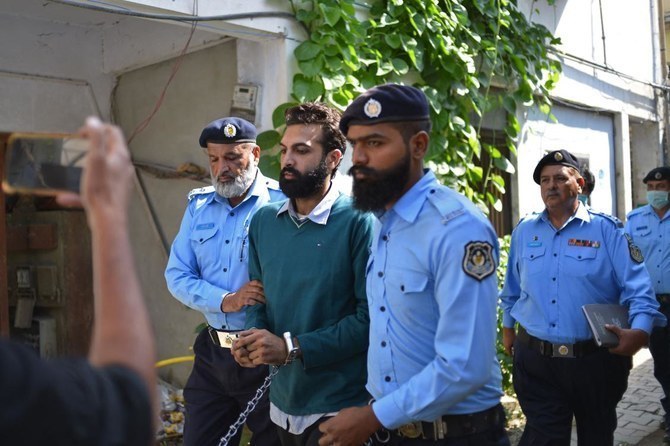
Jaffer on Monday walked into the courtroom along with police officials unlike his previous appearances in a chair or on a stretcher. He remained seated on the floor of the courtroom during the hearing.
Others charged in the case include Jaffer’s parents, Zakir Jaffer and Asmat Adamjee, their three-household staff, Iftikhar, Jan Muhammad and Jameel, and six workers from Therapy Works, a counselling center from where Jaffer had received certification to become a therapist and where he had been receiving treatment in the weeks leading up to the murder.
The court will resume hearing the case on Wednesday.


![]()

Zahir Jaffer’s fingerprints not found on murder weapon – Noor Mukadam case investigator
Short Url
https://arab.news/pe3y3
Zahir Jaffer’s fingerprints not found on murder weapon – Noor Mukadam case investigator
- Mukadam was found beheaded at an upscale residence in Islamabad in July 2021
- Investigating officer says no evidence that Jaffer killed her except for the forensics
Latest updates


© 2026 SAUDI RESEARCH & PUBLISHING COMPANY, All Rights Reserved And subject to Terms of Use Agreement.