
KARACHI: A senior police official responsible for tracking transnational militant groups in Pakistan said on Monday two people blew themselves up during a shootout with police in Sindh, adding they were most likely part of the Daesh network.
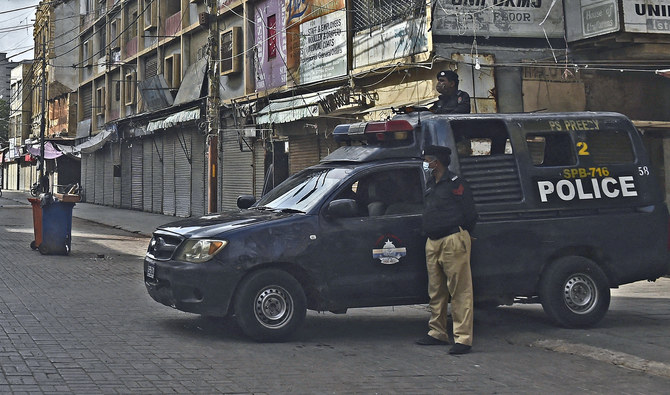
The firefight broke out in Ubauro, a small town near the border between Sindh and Balochistan provinces, after the police stopped the two suspects on a motorbike.
The men blew themselves up with a locally made hand grenade toward the end of the shootout and were later identified as Abdul Hameed, a resident of Rahimyar Khan in southern Punjab, and Imadullah Pitafi, who belonged to Khairpur in Sindh.
“Our record shows that Abdul Hameed, who previously remained associated with Lashkar-e-Jhangvi [LeJ], moved to Afghanistan with his family,” said Raja Umar Khattab who supervises the Daesh and Al Qaeda cell at the Counter Terrorism Department of the Sindh police.
He informed that LeJ had been helping Daesh in Balochistan, adding that Hameed’s background and travel to Afghanistan suggested that he was part of the transnational Daesh network in the region.
“The border region between Sindh and Balochistan has remained a hub of LeJ, a sectarian outfit ideologically close to Daesh,” Khattab continued. “In fact, the LeJ had been providing operational services to Daesh before the latter took a foothold in Pakistan.”
“We have witnessed several terrorist acts in southern Punjab in which Daesh was involved,” he added. “This clearly indicates that a larger network of the terrorist organization has been operating in this region.”
Speaking to Arab News, deputy inspector general of Sukkar police Tariq Abbas Qureshi described the suspects as “clever terrorists” who did not allow the police to get any useful information from them.
“It is a major development that the two eliminated themselves after running out of bullets and did not surrender,” he said. “We suspect that Hameed was on a target and wanted to conceal that information.”
Qureshi said Hameed had been on the watchlist of intelligence agencies, adding that his name was also placed on the fourth schedule by the Punjab police.
“He had been involved in target killings of many people,” he continued. “We are now trying to uncover the network with the help of his phone that we have recovered.”
Last year in January, Daesh claimed responsibility for the kidnapping and execution of 11 coalminers who were members of the ethnic Hazara community in Balochistan.
Earlier this month, the Pakistani police said it had killed six Daesh militants in an overnight raid in the southwestern Balochistan province, though it added that some of their accomplices fled the shootout.
According to an official statement, the police stormed a hideout in Quetta and killed six militants, but “around four to five of these people managed to escape.”