Western diplomats meet Afghan activists amid Taliban talks

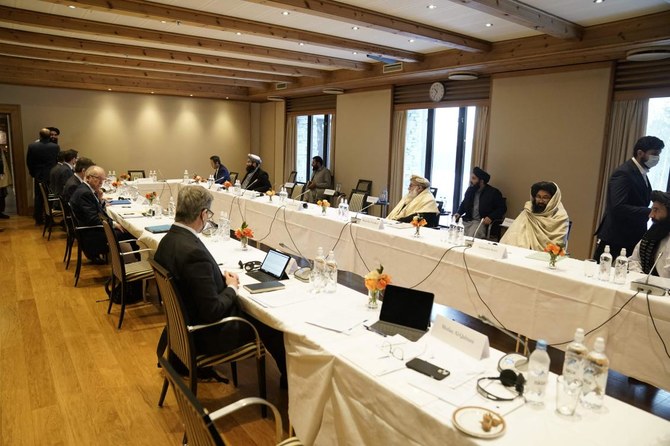
International special representatives and representatives from the Taliban attend a meeting on January 24, 2022 in Oslo, Norway. (AFP)
Short Url
Updated 24 January 2022
Follow

Western diplomats meet Afghan activists amid Taliban talks

  • The EU, the US, Britain, France, Italy and hosts Norway in attendance
  • Taliban expected to lobby for release of $10 billion in assets frozen by US

OSLO: Western diplomats are meeting with Afghan women’s rights activists and human rights defenders in Oslo ahead of the first official talks with the Taliban in Europe since they took over control of Afghanistan in August.
The closed-door meeting was a chance to hear from civil society in Afghanistan and the Afghan diaspora about their demands and assessment of the current situation on the ground. The meeting was taking place at a hotel in the snow-capped mountains above the Norwegian capital and was attended by representatives of the EU, the US, Britain, France, Italy and hosts Norway.
The three-day talks opened on Sunday with direct meetings between the Taliban and civil society representatives.
A joint statement tweeted overnight by Zabihullah Mujahid, the Afghan deputy culture and information minister, following the talks reads that “participants of the meeting recognized that understanding and joint cooperation are the only solutions to all the problems of Afghanistan,” and emphasized that “all Afghans need to work together for better political, economic and security outcomes in the country.”
Later on Monday, Western diplomats are set to meet with Taliban representatives who will be certain to press their demand that nearly $10 billion frozen by the United States and other Western countries be released as Afghanistan faces a precarious humanitarian situation.
“We are requesting them to unfreeze Afghan assets and not punish ordinary Afghans because of the political discourse,” said Taliban delegate Shafiullah Azam. “Because of the starvation, because of the deadly winter, I think it’s time for the international community to support Afghans, not punish them because of their political disputes.”
The United Nations has managed to provide some liquidity and allowed the Taliban administration to pay for imports, including electricity. But the UN has warned that as many as 1 million Afghan children are in danger of starving and most of the country’s 38 million people are living below the poverty line.
Faced with the Taliban’s request for funds, Western powers are likely to put the rights of women and girls in Afghanistan high on their agenda, along with the West’s recurring demand for the Taliban administration to share power with Afghanistan’s minority ethnic and religious groups.
Since sweeping to power in mid-August, the Taliban have imposed widespread restrictions, many of them directed at women. Women have been banned from many jobs outside the health and education fields, their access to education has been restricted beyond sixth grade and they have been ordered to wear the hijab. The Taliban have, however, stopped short of imposing the burqa, which was compulsory when they previously ruled Afghanistan in the 1990s.
The Taliban have increasingly targeted Afghanistan’s beleaguered rights groups, as well as journalists, detaining and sometimes beating television crews covering demonstrations.
A US delegation, led by Special Representative for Afghanistan Tom West, plans to discuss “the formation of a representative political system; responses to the urgent humanitarian and economic crises; security and counterterrorism concerns; and human rights, especially education for girls and women,” according to a statement released by the US State Department.
The Scandinavian country, home to the Nobel Peace Prize, is no stranger to diplomacy. It has been involved in peace efforts in a number of countries, including Mozambique, Afghanistan, Venezuela, Colombia, the Philippines, Israel and the Palestinian Territories, Syria, Myanmar, Somalia, Sri Lanka and South Sudan.


Palestinian family living in Gaza tent denied evacuation to UK despite appeal by academic father

Updated 4 sec ago
Follow

Palestinian family living in Gaza tent denied evacuation to UK despite appeal by academic father

  • Bassem Abudagga, studying for a PhD in York, was told his wife and children’s case not ‘compelling’ enough
  • Family must give biometric data for their visas despite no facilities providing the service in Gaza

LONDON: The UK Home Office has told a Palestinian academic studying in Britain that his wife and children would not be brought to the UK from Gaza as their case is not “sufficiently compelling” for evacuation.

In a letter, the department told Bassem Abudagga his family would need to attend a visa application center in Gaza to provide biometric data before traveling, despite there being no such facility in the enclave.

Abudagga, studying on a scholarship for a doctorate at York St John University, has not seen his family since September 2023, three weeks before the Hamas-led attack on Israel that sparked a regional war. His wife Marim, son Karim, aged 6, and daughter Talya, 10, are living in a tent after their house was destroyed.

On receiving the Home Office letter, Abudagga told The Guardian: “I felt my final hope of being reunited with my wife and children after more than three years had been lost. It was very, very hard.”

He added that his wife “kept saying to me when I called, ‘It seems we will never meet again. Don’t make any more efforts to bring us to the UK because it seems the UK will never get us there. Just keep concentrating on your studies.’”

The letter added that Abudagga’s family’s situation had also been measured against “the interests of national and border security.”

Abudagga said: “When I read that they link bringing my family to the UK with UK security, and suggest the children are better off in Gaza, I simply could not believe in British values and norms anymore. I expected the British government cared about family life, about human rights.”

He had asked the Home Office to give a decision in principle on whether his family’s visa applications would be accepted before requiring his wife to give biometric data. This would have allowed the family to appeal to be evacuated to a third country with a VAC in order to speed up their application. The request was denied.

The Home Office said it was “not satisfied that (the family’s) circumstances are sufficiently compelling for (us) to be able to deviate from our normal policy that requires your clients to attend a VAC prior to consideration of their applications.”

It added that, as Abudagga claimed he eventually wished to return to Gaza, his UK stay was only temporary.

“Consequently it is appropriate for your minor clients to remain with their primary carer, their mother, until circumstances change,” the Home Office said.

The letter said that “circumstances in Gaza are difficult and that due to displacement it may be more difficult to access certain necessities,” but continued that the department was “not satisfied” there was enough evidence to prove the family needed to be evacuated before “it is safe to visit a VAC.”

While trapped in Gaza, Marim has also had to contend with the death of her father two weeks ago.

“My wife is trying to do the daily duties of bringing food, securing the tent from the weather — it is very cold, very windy, very rainy — when her father passed away two weeks ago,” Abudagga said. “The details are very, very hard.”

Another student in the UK was recently permitted to bring her family from Gaza after they were approved to perform biometric checks in Jordan.

“This lady was allowed to get her fingerprints done in Jordan and the Home Office later allowed her family to join. The case is the same as mine,” Abudagga told The Guardian.

Rebecca Long-Bailey, Abudagga’s local MP, wrote to Shabana Mahmood, the home secretary, to ask the Home Office to reconsider the case, but the decision was upheld. Abudagga has since begun the process of legally challenging it.

Sarah Crowe, a lawyer at law firm Leigh Day representing the family, told The Guardian: “We will be writing to the Home Office to set out why their decision-making in this case is plainly unlawful. In line with the Home Office’s own policy, Bassem’s family should have their applications predetermined, which is an important step in reuniting the family.”