

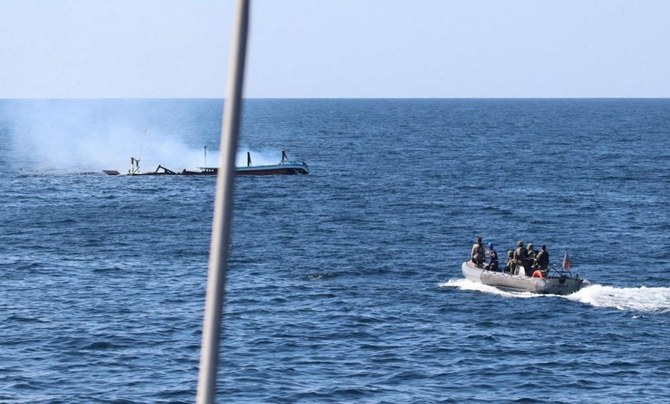
US detains Iranian smuggling ship, UK seizes drugs in Mideast waters

The navy said it boarded and searched the ship, which last year was caught carrying thousands of weapons and handed to Yemen's coast guard. (FIle/AFP)
Short Url
Updated 23 January 2022
Follow

US detains Iranian smuggling ship, UK seizes drugs in Mideast waters

  • The interdictions were just the latest in the volatile waters of the Arabian Gulf as American and British authorities step up seizures of contraband during the grinding conflict in Yemen

DUBAI: The US Navy announced Sunday it seized a boat in the Gulf of Oman carrying fertilizer used to make explosives that was caught last year smuggling weapons to Yemen. The British royal navy said it confiscated 1,041 kilograms (2,295 pounds) of illegal drugs in the same waters.

The interdictions were just the latest in the volatile waters of the Arabian Gulf as American and British authorities step up seizures of contraband during the grinding conflict in Yemen and ongoing drug trafficking in the region.

The US Navy’s Mideast-based 5th Fleet said its guided-missile destroyer USS Cole and patrol ships halted and searched the sailboat, a stateless fishing dhow, that was sailing from Iran on a well-worn maritime arms smuggling route to war-ravaged Yemen last Tuesday. US forces found 40 tons of urea fertilizer, known to be a key ingredient in homemade improvised explosive devices, hidden on board.

Authorities said the vessel had been previously seized off the coast of Somalia and found last year to be loaded with thousands of assault rifles and rocket launchers, among other weapons. UN experts say weapons with such technical characteristics likely come from Iran to support the Houthi rebels. The Navy turned over the vessel, cargo and Yemeni crew to Yemen’s coast guard earlier this week.

Yemen is awash with small arms that have been smuggled into the country's poorly controlled ports over years of conflict. Since 2015, Iranian-backed Houthi rebels have been battling a Saudi-led military coalition for control of the nation. Iran says it politically supports the rebels but denies arming them, despite evidence to the contrary.

The smuggled weapons have helped the Houthis gain an edge against the Saudi-led coalition in the seven-year war. Violence has drastically escalated over the past week amid stalled international attempts at brokering peace. Following a deadly drone attack claimed by the rebels on Abu Dhabi, in the United Arab Emirates.

Officials also revealed Sunday that a British royal navy vessel had seized a large quantity of illegal drugs valued at some $26 million from a boat sailing through the Gulf of Oman on Jan. 15.

The HMS Montrose confiscated 663 kilograms (1,461 pounds) of heroin, 87 kilograms (191 pounds) of methamphetamine and 291 kilograms (641 pounds) of hashish and marijuana, the joint maritime task force said in a statement.


Jailed Turkish Kurd leader calls on government to broker deal for Syrian Kurds

Updated 58 min 47 sec ago
Follow

Jailed Turkish Kurd leader calls on government to broker deal for Syrian Kurds

  • Clashes between Syrian forces and the SDF have cast doubt over a deal to integrate the group’s fighters into the army

ANKARA: Jailed Turkish Kurd leader Abdullah Ocalan said Tuesday that it was “crucial” for Turkiye’s government to broker a peace deal between the Kurdish-led Syrian Democratic Forces (SDF) and the Damascus government.
Clashes between Syrian forces and the SDF have cast doubt over a deal to integrate the group’s fighters into the army, which was due to take effect by the end of the year.
Ocalan, founder of the Kurdistan Workers’ Party (PKK) militant group, called on Turkiye to help ensure implementation of the deal announced in March between the SDF and the Syrian government, led by former jihadist Ahmed Al-Sharaa, whose forces ousted longtime ruler Bashar Assad last year.
“It is essential for Turkiye to play a role of facilitator, constructively and aimed at dialogue,” he said in a message released by Turkiye’s pro-Kurdish DEM party.
“This is crucial for both regional peace and to strengthen its own internal peace,” Ocalan, who has been jailed for 26 years, added.
“The fundamental demand made in the agreement signed on March 10 between the SDF and the government in Damascus is for a democratic political model permitting (Syria’s) peoples to govern together,” he added.
“This approach also includes the principle of democratic integration, negotiable with the central authorities. The implementation of the March 10 agreement will facilitate and accelerate that process.”
The backbone of the US-backed SDF is the YPG, a Kurdish militant group seen by Turkiye as an extension of the PKK.
Turkiye and Syria both face long-running unrest in their Kurdish-majority regions, which span their shared border.
In Turkiye, the PKK agreed this year at Ocalan’s urging to end its four-decade armed struggle.
In Syria, Sharaa has agreed to merge the Kurds’ semi-autonomous administration into the central government, but deadly clashes and a series of differences have held up implementation of the deal.
The SDF is calling for a decentralized government, which Sharaa rejects.
Turkish Foreign Minister Hakan Fidan, whose country sees Kurdish fighters across the border as a threat, urged the SDF last week not to be an “obstacle” to stability.
Syrian Kurdish leader Mazloum Abdi said Thursday that “all efforts” were being made to prevent the collapse of talks.