Jailed British-Iranian man begins hunger strike 

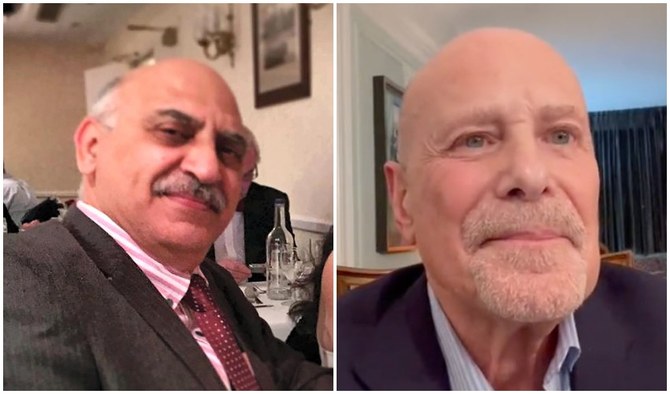
Anoosheh Ashoori (L) is staging a hunger strike in solidarity with Barry Rosen (R), who is staging his own hunger strike outside the nuclear talks in Vienna. (Amnesty/Screenshot)
Short Url
Updated 22 January 2022
Follow

Jailed British-Iranian man begins hunger strike 

  • Anoosheh Ashoori striking in solidarity with American ex-hostage Barry Rosen
  • Rosen on hunger strike to highlight Iran’s hostage-taking strategy

LONDON: A British-Iranian dual national imprisoned in Iran will begin a hunger strike on Sunday in support of an American former hostage of Tehran who is staging his own hunger strike outside the nuclear talks in Vienna.

Anoosheh Ashoori is staging the strike in solidarity with Barry Rosen, 77, who, as then-press attache at the US Embassy in Tehran, was held hostage for 444 days between 1979 and 1981.

Ashoori was arrested in August 2017 and sentenced to 10 years’ imprisonment for espionage. He is now jailed in Evin prison in Tehran.

His wife Sherry said: “We are extremely concerned for his health as he approaches his 68th birthday, but having failed to see any progress in the UK Foreign Office’s efforts to secure his release, and no sign of the welfare of hostages held by Iran currently being a priority of Western governments, he will begin his hunger strike.”

Rosen says hostages should be released as part of a new nuclear deal, and has also been joined on hunger strike by Lebanese US resident Nizar Zakka, who was detained by Iran between 2015 and 2019.

Rosen told The Guardian: “I am receiving heart-rending messages from Iranians, and I am absolutely humbled that Anoosheh is doing this in support of me.

“I support him completely in return and I urge him to be careful and look after himself. I am starting to feel tired and weak, but I am determined to continue.

“I am here to call on the Americans and the Europeans to make the release of the hostages a condition of any agreement to renew the Iran nuclear deal.

“This has been going on for 40 years, and people are being thrown in jail with no evidence. There has to be an agreement that this will end.”

Rosen said he is concerned that Western countries are not taking Iran’s hostage-taking strategy seriously. “It is like herding cats. Each country seems to deal with its dual national hostages on its own,” he added.

“There is no sense of commonality, so they leave Iran to pick each country off. Something is missing here. The Iranians seem to be dividing and ruling.

“I decided to do this (campaign) two weeks ago. I am just an individual, and thought I might be a lone eagle, but it feels like a movement might be starting.”


Iran open to compromises to reach nuclear deal with US, minister tells BBC

Updated 15 sec ago
Follow

Iran open to compromises to reach nuclear deal with US, minister tells BBC

  • A US delegation, including envoys Steve Witkoff and Jared Kushner, will meet with the ⁠Iranians on Tuesday morning
LONDON: Iran is ready to consider compromises to reach a nuclear deal with the United States ​if Washington is willing to discuss lifting sanctions, Iran’s Deputy Foreign Minister Majid Takht-Ravanchi told the BBC in an interview published on Sunday.
Iran has said it is prepared to discuss curbs on its nuclear program in return for the lifting of sanctions, but has repeatedly ruled out linking the issue to other questions including ‌missiles.
Takht-Ravanchi confirmed ‌that a second round of ​nuclear talks ‌would ⁠take place ​on ⁠Tuesday in Geneva, after Tehran and Washington resumed discussions in Oman earlier this month.
“(Initial talks went) more or less in a positive direction, but it is too early to judge,” Takht-Ravanchi told the BBC.
A US delegation, including envoys Steve Witkoff and Jared Kushner, will meet with the ⁠Iranians on Tuesday morning, a source ‌had told Reuters on Friday, ‌with Omani representatives mediating the US-Iran contacts.
Iran’s ​atomic chief said on ‌Monday the country could agree to dilute its most ‌highly enriched uranium in exchange for all financial sanctions being lifted. Takht-Ravanchi used this example in the BBC interview to highlight Iran’s flexibility.
The senior diplomat reiterated Tehran’s stance that ‌it would not accept zero uranium enrichment, which had been a key impediment to reaching ⁠a deal ⁠last year, with the US viewing enrichment inside Iran as a pathway to nuclear weapons.
Iran denies seeking such nuclear weapons.
During his first term in office, Trump pulled the US out of a 2015 Iran nuclear agreement, known as the Joint Comprehensive Plan of Action, the signature foreign policy achievement of former Democratic President Barack Obama.
The deal eased sanctions on Iran in exchange for Tehran limiting its nuclear program to ​prevent it from being ​able to make an atomic bomb.