At least two dead, 22 wounded by bomb in Pakistan's Lahore

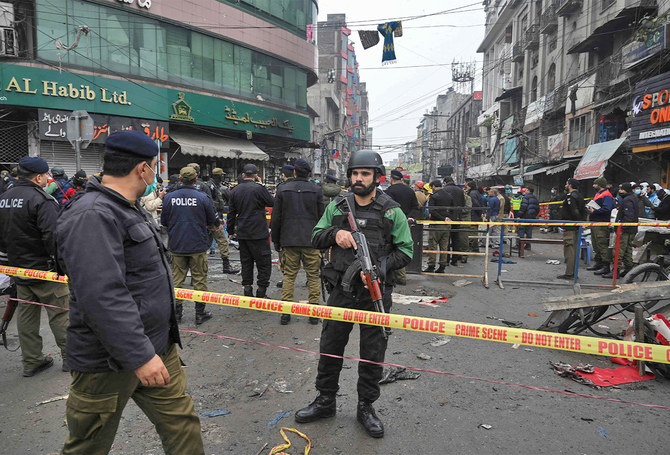
Security officials cordon off the site of a bomb blast that killed two people and wounded 22 others at a busy shopping district in Lahore, Pakistan, on January 20, 2022. (AFP)
Short Url
Updated 21 January 2022
Follow

At least two dead, 22 wounded by bomb in Pakistan's Lahore

  • The attack was claimed by the Baloch Nationalist Army, a separatist group operating in southwest Pakistan
  • Pakistani Prime Minister Imran Khan expressed regret over the 'loss of precious human lives' in a statement

LAHORE: At least two people were killed and 22 wounded Thursday by a bomb blast in a busy shopping district of the Pakistani megacity of Lahore, police and officials said.
The attack was claimed by a spokesman for the Baloch Nationalist Army (BNA), one of several ethnic separatist groups that have been waging an insurgency for years in southwest Pakistan.
The spokesman said police and bank workers were targeted "in response to the killing of women and children by Pakistani forces in Balochistan," the largest province of the south Asian nation.
There will be more attacks "unless the military regime holds meaningful talks ... on the issue of national independence and withdrawal of its troops from Baloch soil," the spokesman said in a statement shared on messaging app Telegram.
Thursday's blast happened in old Lahore's busy Anarkali shopping district, damaging several motorbikes and upturning market stalls.
"Initial investigations show that it was a time-controlled device on a motorbike which was the cause of the blast," Rana Arif, spokesman for Lahore police, told AFP.

Officials said a nine-year-old child was one of those killed.
Pakistani Prime Minister Imran Khan expressed regret over the "loss of precious human lives," a spokesman for his office said.
The seven million inhabitants of mineral-rich Balochistan, bordering Afghanistan and Iran, have long complained they do not receive a fair share of its gas and mineral wealth.
China is investing in the area under a $54-billion project known as the China-Pakistan Economic Corridor (CPEC), upgrading infrastructure, power and transport links between its far-western Xinjiang region and Pakistan's Gwadar port.

Baloch separatists previously claimed several attacks on CPEC projects, and thousands of Pakistani security personnel are deployed in the region to counter the violence.
Pakistan has suffered a string of blasts and attacks against police since December, when a truce between the government and Pakistan's Taliban lapsed.
Tehreek-e-Taliban Pakistan (TTP) -- a home-grown movement that shares common roots with the Afghan Taliban -- has claimed responsibility for most recent attacks.
The TTP said earlier this week it was responsible for a deadly shootout in Islamabad on Monday night -- a rare attack by the militants in the heavily guarded capital.
A police officer was killed and two others injured when two TTP gunmen opened fire from a motorbike on a police checkpoint.
Police said both attackers were killed, and Pakistan's interior minister warned afterwards of the potential for further violence.
Pakistan's government announced late last year it had entered a month-long truce with the TTP, facilitated by Afghanistan's Taliban, but that expired on December 9 after peace talks failed to make progress.
The TTP has been blamed for hundreds of suicide bomb attacks and kidnappings across the country, and for a while held sway over vast tracts of the nation's rugged tribal belt, imposing a radical version of Islamic law.
But after the 2014 massacre of nearly 150 children at a Peshawar school, the Pakistan military sent huge numbers of troops into TTP strongholds and crushed the movement, forcing its fighters to retreat to Afghanistan.


Curfew extended in Gilgit-Baltistan, probe ordered after deadly Khamenei protests

Updated 03 March 2026
Follow

Curfew extended in Gilgit-Baltistan, probe ordered after deadly Khamenei protests

  • At least 15 people were killed in clashes with law enforcement agencies over the weekend in Gilgit-Baltistan
  • Government also announces a de-weaponization campaign, crackdown on hate speech and cybercrime in region

ISLAMABAD: The government in Pakistan’s Gilgit-Baltistan (GB) region on Tuesday extended a curfew in Gilgit district and ordered a judicial probe into violent protests over the killing of Iranian Supreme Leader Ali Khamenei in US-Israeli strikes last week, an official said.

At least 15 people were killed in clashes with law enforcement agencies over the weekend in GB, where protesters torched and vandalized several buildings, including United Nations regional offices, an army-run school, software technology park and a local charity building.

The violence prompted regional authorities to impose curfew in Gilgit and Skardu districts on March 2-4 as officials urged people to stay indoors and cooperate with law enforcers, amid widespread anger in Pakistan, particularly among members of the Shiite minority, over Khamenei’s killing.

On Tuesday, the GB government convened to review the situation and announced the extension of curfew in Gilgit among a number of security measures as well as ordered the establishment of a judicial commission to investigate the weekend violence in the region.

“The government has made it clear that the law will strictly take its course against elements involved in vandalism at government institutions, private properties and incidents of vandalism in Gilgit and Skardu and no kind of mischief will be tolerated,” Shabbir Mir, a GB government spokesperson, said in a statement.

“In view of the security situation, curfew will remain in force in Gilgit, while the decision to extend the curfew in Skardu will be taken keeping the ground realities and the changing situation in view.”

The statement did not specify how long the curfew will remain in place in Gilgit.

Besides the formation of the judicial commission to investigate the violent clashes, the government also decided to launch a large-scale de-weaponization campaign in the entire Gilgit district, for which relevant institutions have been directed to immediately complete all necessary arrangements, according to Mir.

In addition, a crackdown has been ordered on hate speech, spread of fake news and cybercrime.

“The aim of these decisions is to ensure the rule of law, protect the lives and property of citizens and crack down on miscreants,” he said. “Approval has also been given to immediately survey the affected infrastructure and start their restoration work on priority basis.”

Demonstrators in Pakistan’s southern port city of Karachi also stormed the US Consulate on Sunday, smashing windows and attempting to burn the building. Police responded with batons, tear gas, and gunfire, leaving 10 people dead and more than 50 injured.

Pakistani authorities have since beefed up security at US diplomatic missions across the country, including around the US consulate building in Peshawar, to avoid any further violence.