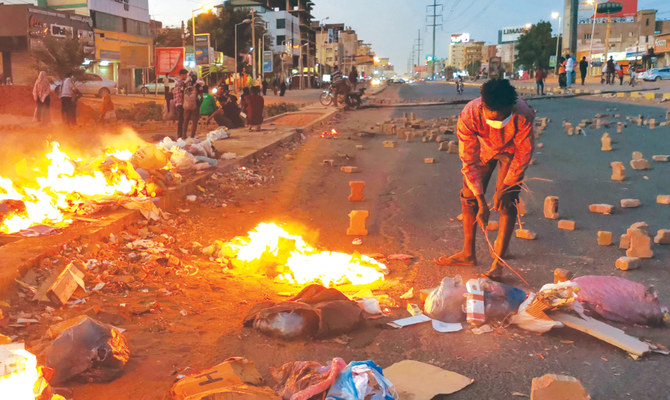

KHARTOUM: Sudanese shuttered shops and barricaded streets with burning tires and rocks on Tuesday, staging angry rallies to protest against one of the bloodiest days since a coup derailed the country’s democratic transition.
Security forces on Monday opened fire killing at least seven people as thousands marched against the army’s Oct. 25 takeover, taking the total number killed in a crackdown since the coup to 71, according to medics.
“No, no to military rule,” protesters chanted in southern Blue Nile state, where some carried banners daubed with the slogan “No to killing peaceful protesters,” said witness Omar Eissa.
The protests come as Washington ramps up pressure in a bid to broker an end to the months-long crisis in the northeast African nation, with top US diplomats expected to arrive in the capital Khartoum for talks.
Sudan’s main civilian bloc, the Forces for Freedom and Change, called for two days of civil disobedience to begin on Tuesday.
“Shop closed for mourning,” said a series of small signs posted on the closed outlets at the sprawling Sajane construction supplies market in Khartoum. One of the merchants, Othman El-Sherif, was among those shot dead on Monday.
Protesters — sometimes numbering in the tens of thousands — have regularly taken to the streets since the coup led by Gen. Abdel Fattah Al-Burhan nearly three months ago.
The military power grab derailed a fragile transition to civilian rule following the April 2019 ouster of autocrat Omar Bashir, with Prime Minister Abdalla Hamdok resigning earlier this month warning Sudan was at a “dangerous crossroads threatening its very survival.”
After Monday’s deaths, the UN special representative Volker Perthes condemned the use of live ammunition, while the US Embassy criticized “violent tactics of Sudanese security forces,” the latest such appeals by world powers, which have not curbed a rising death toll. On Tuesday, police fired tear gas at dozens of protesters setting up roadblocks in east Khartoum.
In several other parts of Khartoum, many pharmacies and other shops were shuttered.
Sudan’s University for Science and Technology suspended all activities as part of civil disobedience, according to an official statement.
Outside the capital, hundreds of protesters also staged demonstrations in other cities, witnesses said.
“We took to the streets to protest the massacre that the security forces committed in Khartoum yesterday,” said protester Hassan Idris, in the eastern state of Kassala.
Al-Burhan on Tuesday formed a fact-finding committee to probe Monday’s violence, with its findings to be submitted within 72 hours, Sudan’s ruling Sovereign Council said in a statement.
It comes as US Assistant Secretary of State Molly Phee and special envoy for the Horn of Africa, David Satterfield, were expected in Khartoum, where they would “reiterate our call for security forces to end violence and respect freedom of expression and peaceful assembly,” spokesman Ned Price said.
On Monday, Sudan’s police said they used “the least force” to counter the protests, in which about 50 police personnel were also wounded.
Sudan’s authorities have repeatedly denied using live ammunition against demonstrators, and insist scores of security personnel have been wounded during protests. A police general was stabbed to death last week.
On Tuesday the “Friends of Sudan” — a group of Western and Arab nations calling for the restoration of the country’s transitional government, and which includes the US, EU, Saudi Arabia, the UAE and the UN — held talks in Saudi Arabia.
“Deep concern about yesterday’s violence,” the UN envoy Perthes said on Twitter, after attending the meeting via video link.
“International support and leverage is needed. Support for political process needs to go along with active support to stop violence.”
The EU foreign policy chief said Sudan’s military rulers have shown an unwillingness to negotiate a peaceful settlement to the country’s ongoing crisis.
EU foreign affairs chief Josep Borrell said that repeated calls for Sudanese authorities to refrain from violence against protesters “have fallen on deaf ears.”
Borrell said the ongoing crackdown, including violence against civilians and the detention of activists and journalists, has put Sudan on “a dangerous path away from peace and stability.” He urged the military authorities to de-escalate tensions, saying: “avoiding further loss of life is of the essence.”
The crackdown, Borrell said, also risks derailing UN efforts to find a peaceful solution to the crisis.
The protest groups, which have continued to mobilize protesters against the coup, have rejected negotiations with the generals. They insist on handing over power to a fully civilian government to lead the transition.