

Pakistani PM's aide visits UAE embassy in display of solidarity after Houthi attack 

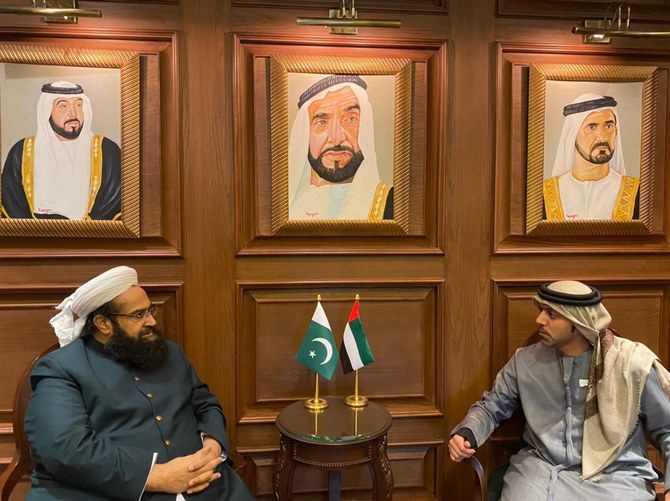
Pakistani Prime Minister Imran Khan’s aide on the Middle East Tahir Mahmood Ashrafi speaks to UAE's envoy to Islamabad Hamad Obaid Al-Zaabi in Islamabad on January 18, 2022. (UAE Embassy Pakistan)
Short Url
Updated 18 January 2022
Follow

Pakistani PM's aide visits UAE embassy in display of solidarity after Houthi attack 

  • Tahir Ashrafi says they consider security and stability of UAE as Pakistan's security and stability 
  • UAE ambassador offers condolences over the death of a Pakistani in Houthi attack on Abu Dhabi 

ISLAMABAD: Pakistani Prime Minister Imran Khan’s aide on the Middle East Tahir Mahmood Ashrafi on Tuesday visited the United Arab Emirates (UAE) embassy in Islamabad to express solidarity with the brotherly country a day after a drone attack on its capital, Abu Dhabi, by Yemen's Iran-aligned Houthi militia.

Houthi rebels on Monday attacked the Emirati capital with missiles and drones, setting off explosions in fuel trucks that killed three people, including a Pakistani national, and injured six others, and causing a fire close to the Abu Dhabi airport.

“The UAE is Pakistan's strongest friend and brother. [We] consider the security and stability of the UAE as Pakistan's security and stability,” Ashrafi told UAE Ambassador Hamad Obaid Al-Zaabi.

“No force can weaken Pakistan-UAE relations,” the Pakistani PM's aide said.

Ambassador Al-Zaabi conveyed condolences from the UAE leadership over the killing of the Pakistani national, who was working for the Emirati oil giant, ADNOC.

“The injured are being fully treated and the UAE foreign ministry is in touch with the Pakistani embassy,” the UAE ambassador was quoted as saying in a statement issued from the office of the Pakistani PM's aide.

Ambassador Al-Zaabi thanked Pakistan for its solidarity and cooperation with the UAE.

Besides being a brotherly country, the UAE is also Pakistan’s largest trading partner in the Middle East and a major source of investment in the South Asian country.

Around 1.6 million Pakistani expatriates in the UAE contributed remittances of more than $6 billion in the last financial year.


Pakistan Navy launches fourth Hangor-class submarine ‘Ghazi’ in China 

Updated 6 sec ago
Follow

Pakistan Navy launches fourth Hangor-class submarine ‘Ghazi’ in China 

  • As per Islamabad’s agreement with Beijing, four of eight submarines will be built in China and the rest in Pakistan
  • Navy says all four submarines under construction in China undergoing sea trials, in final stages of being handed over

ISLAMABAD: The Pakistan Navy announced on Wednesday it has launched the fourth Hangor-class submarine named “Ghazi” at a Chinese shipyard in Wuhan, saying the development will help maintain peace in the region.

Pakistan’s government signed an agreement with China for the acquisition of eight Hangor-class submarines, the navy said in its press release. Under the contract, four submarines are being built in China while the remaining four will be constructed in Pakistan by the Karachi Shipyard and Engineering Works Ltd. company.

“With the launching of GHAZI, Pakistan Navy has achieved another significant milestone where all four submarines under construction in China are now undergoing rigorous sea trials and are in the final stages of being handed over to Pakistan,” the navy said. 

It further said that these submarines will be fitted with advanced weapons and sensors capable of engaging targets at standoff ranges. 

“Hangor-class submarines will be pivotal in maintaining peace and stability in the region,” the navy added. 

Pakistan’s agreement with China is set to strengthen its naval defenses, especially as ties with arch-rival India remain tense. 

India and Pakistan were involved in a four-day military confrontation in May this year before Washington intervened and brokered a ceasefire. Four days of confrontation saw the two countries pound each other with fighter jets, exchange artillery fire, missiles and drone strikes before peace prevailed. 

Pakistan’s air force used Chinese-made J-10 fighter jets in May to shoot down an Indian Air Force Rafale aircraft, made by France.

The altercation between the nuclear-armed neighbors surprised many in the military community and raised questions over the superiority of Western hardware over Chinese alternatives.

Islamabad has long been Beijing’s top arms customer, and over the 2020-2024 period bought over 60 percent of China’s weapons exports, according to data from the Stockholm International Peace Research Institute.